NEWS
Eric Barlow would like Wyoming voters to believe that criticism of his legislative record is either deceptive or false. Unfortunately for Barlow, roll-call votes are stubborn things.
In an Aug. 28 KHOL report, Constitution Party gubernatorial candidate Rebecca Bextel accused Barlow of supporting Medicaid expansion and opposing efforts to ban sanctuary cities. Barlow responded with a blanket denial. “There was quite a bit of negative campaigning in this primary cycle regarding my record, and most of it was either misleading or just flat-out false,” he told KHOL.

That statement may be politically convenient, but it is completely contradicted by Barlow’s own legislative record.
Barlow Voted for Medicaid Expansion
Barlow has cast at least five recorded “yes” votes in favor of Medicaid expansion. Those votes are not interpretations, campaign rhetoric or allegations from a political opponent. They are his legislative history.
In February 2014, Barlow voted to introduce House Bill 84, titled “Medicaid expansion—limited benefits.” The bill failed to receive the two-thirds majority required for introduction during a budget session, but Barlow voted for it.
The following day, Barlow voted to introduce House Bill 161, titled “Medicaid expansion—2.” This wasn’t someone else’s bill that Barlow reluctantly allowed to be debated. Barlow sponsored it.
HB161 directed the governor and Wyoming Department of Health to negotiate a federal demonstration waiver providing Medicaid coverage to the population made eligible under the Affordable Care Act. The bill specified that coverage would begin Jan. 1, 2015. Barlow voted for its introduction, although it also fell short of the two-thirds threshold.
Barlow then authored a Medicaid expansion amendment to the 2014 budget. HB1 Amendment H3034 was explicitly labeled “Medicaid Expansion.” It directed state officials to negotiate a waiver covering the Obamacare expansion population. The amendment required the Legislature to approve the final plan in 2015, but there is no reasonable way to characterize its sponsor as someone who never supported Medicaid expansion. The record continued in 2019.
Barlow voted in the House Labor Committee to advance HB244, titled “Medicaid—work requirements and expansion.” He then voted for the bill again when it reached the House Committee of the Whole. It failed 23-36.
Barlow also voted twice for SF146, which called for a formal study of Medicaid expansion. Those votes did not authorize expansion, but they provide additional evidence of his willingness to move the policy forward. The clearest vote came in 2021.
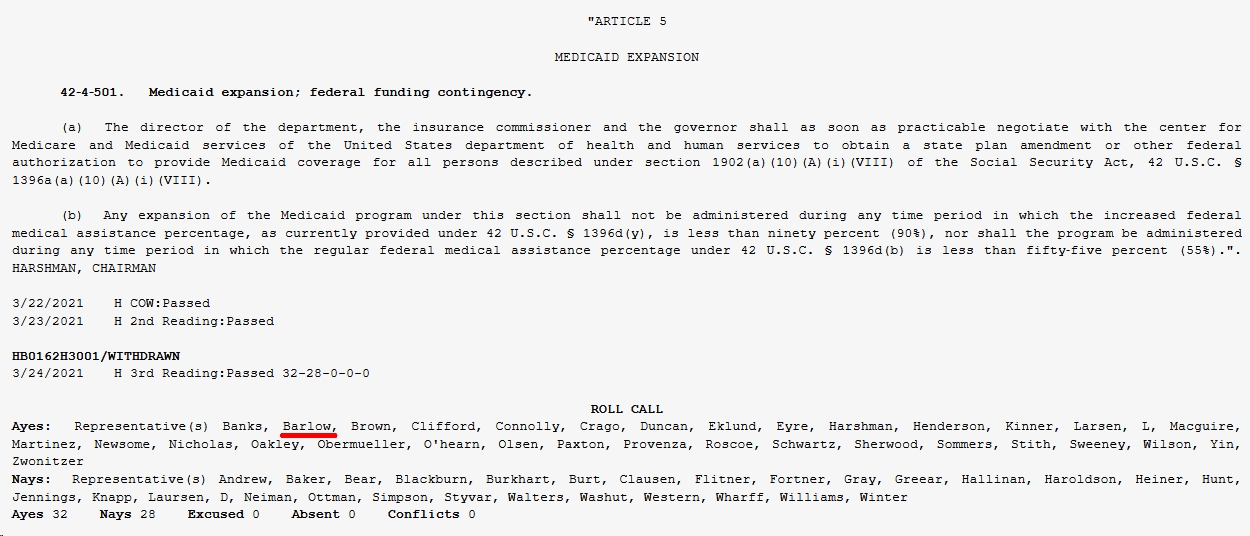
Barlow voted for HB162, the “Medical Treatment Opportunity Act.” That bill would have expanded Medicaid eligibility to adults earning up to 138% of the federal poverty level—the population covered by Obamacare’s Medicaid expansion. HB162 passed the House 32-28, with Barlow voting yes. Following that vote, Barlow acknowledged that he had previously opposed expansion but said he saw “no alternative at this point,” according to Governing.

The defensible count is five individually recorded votes advancing Medicaid expansion bills: two in 2014, two in 2019 and one in 2021. Add Barlow’s 2014 expansion amendment and his two votes for an expansion study, and the broader record is even longer.
While it is true that Barlow has voted against Medicaid expansion measures in the past, most of those votes are against budget amendments and not actual bills. His most recent vote on a Medicaid expansion bill was in favor of 2021’s HB162.
Barlow may oppose Medicaid expansion today. Politicians are allowed to change their positions. What they are not entitled to do is pretend their earlier positions never existed. If Barlow has changed his mind, he should explain when and why. Calling the documented record “flat-out false” is simply not true.
The Same Problem on Illegal Immigration
Barlow’s denial becomes even harder to defend when applied to illegal immigration. Bextel alleged that Barlow had opposed banning sanctuary cities. The legislative record confirms that he did so repeatedly.
In 2018, Barlow voted against introducing HB105, titled “Prohibition on sanctuary cities and counties.” In 2019, he voted against HB151, titled “Ban on sanctuary cities and counties.” In 2020, he voted against introducing HB108, another bill titled “Ban on sanctuary cities and counties.”
Three bills over three consecutive years sought to prohibit sanctuary policies in Wyoming. Barlow voted no all three times. Saying that Barlow opposed efforts to ban sanctuary cities is therefore not misleading. It is a straightforward description of his votes.
Barlow’s broader immigration record follows the same pattern. In 2016, he voted against HB135, which conditioned eligibility for public benefits on lawful presence in the United States and required applicants’ status to be verified. In 2023, Barlow voted against SF166, which would have provided money to Texas and Arizona for border-barrier construction and transportation efforts related to illegal immigration.
In 2025, he voted against SF124, originally titled “Illegal immigration—identify, report, detain and deport.” The original legislation addressed public benefits, cooperation with federal immigration authorities, the employment and transportation of illegal immigrants, inmate-status checks, and proof of lawful status for driver licenses.
As The Open Range Record previously reported, the Senate Judiciary Committee weakened SF124 before it reached the floor, including removing its prohibition against taxpayer-funded benefits for illegal immigrants.
Barlow has defended his vote by arguing that the bill was poorly written and raised concerns among sheriffs. For over a decade, Barlow has not been a powerless spectator. He could have offered amendments addressing those concerns and restoring provisions removed in committee. Instead, he voted to kill the entire bill.
One Recent Vote Does Not Erase the Rest
Barlow’s defenders will correctly point out that he voted for HB133, the sanctuary-city prohibition that finally passed in 2025. That vote should be included in any fair examination of his record. It should not, however, be used to erase his votes against substantially similar legislation in 2018, 2019, and 2020.
The timing is also difficult to ignore. Barlow voted for HB133 on March 4, 2025. Five months later, on Aug. 12, he announced his campaign for governor. Barlow also voted for the 2026 Welfare Fraud Prevention Act amendments, which included immigration-status verification for public benefits. But that legislation required verification only “to the extent practicable.” Those four words make the bill an optional verification and not mandatory.
The Record Is Not “Flat-Out False”
The KHOL article presented Bextel’s claims and Barlow’s denial as competing political assertions. The official record resolves much of that dispute. Barlow voted repeatedly to advance Medicaid expansion, sponsored his own expansion bill, and authored an expansion amendment. He voted against three sanctuary city bans, against conditioning public benefits on lawful presence, against assistance for southern-border states, and against a comprehensive immigration-enforcement bill.
Those facts do not depend on whether Bextel is a strong candidate, whether voters agree with Medicaid expansion, or whether every immigration bill was perfectly drafted. They are simply Barlow’s votes.
A politician can defend his record. He can explain it. He can even admit that experience changed his mind. But he cannot reasonably call a documented legislative history “flat-out false” merely because that history has become inconvenient during a campaign. Eric Barlow’s problem is not negative campaigning. It is that his own record contradicts the candidate he now claims to be.