COLUMN
What young people know about 20th century history is nonexistent … How would they know? They’re never taught anything about it.
--Canadian academician Professor Jordan Peterson
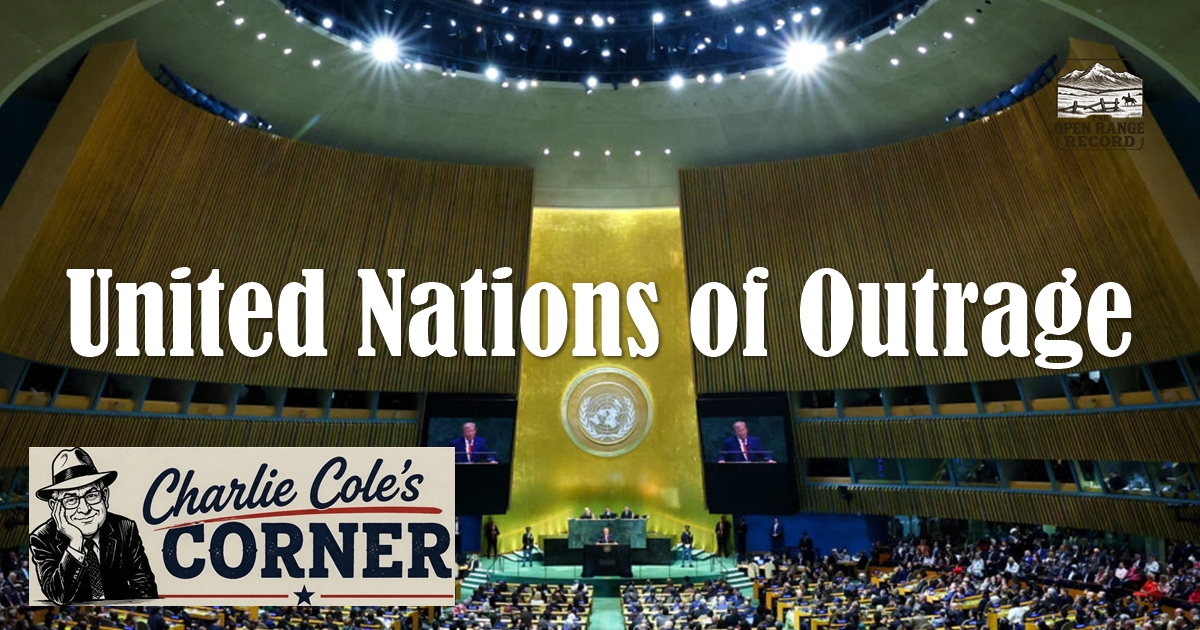
As we saw once again this week, the United Nations displayed an almost incredible hatred for everything (and everyone) American. President Trump’s address told the assembled delegates several truths, none of which they will accept or attend to. No surprise here, given what we know (or should know) about how this international organization came into being and what it’s been engaged in ever since.
President Franklin Roosevelt desperately wanted to resurrect Woodrow Wilson’s great dream of an organization promoting international peace – the flawed, failed, Pollyannaish League of Nations. This was FDR’s motivation in working to establish the United Nations. History has shown beyond refutation that reality has not comported well with Roosevelt’s illusory dreams. The road to perdition is indeed often littered with good intentions. But wishful thinking does not excuse either reckless negligence or willful blindness, not to mention the tragically avoidable results they produce.
It should have been clear to the Roosevelt administration officials attending the Yalta Conference in 1945 that there were abundant reasons to doubt the sincerity and truthfulness of Josef Stalin. And yet, the narcissist-in-chief, Franklin Roosevelt maintained his long-held belief that he could look past all documented evidence of Soviet infamy in pursuit of his pie-in-the-sky dreams of an international organization dedicated to peaceful international resolution of potential conflicts, and the notion that all members of his proposed organization would be honest brokers in the process.
History has proven Roosevelt woefully wrong in this assessment. Among the earliest warning signals about Soviet participation in the United Nations was the presence of Vyacheslav Molotov at the initial organizational meeting in San Francisco in 1945. Molotov was the man who negotiated the infamous 1939 pact which facilitated Hitler’s invasion of Poland, the subsequent Soviet invasion of eastern Poland, the Soviet attacks on Finland, and the forced incorporation of the Baltic States into the USSR. What a fine example of a “statesman” on whom to rely to honestly participate in international efforts at avoiding future wars!
Very soon things got worse when the USSR sent its first official representative to the General Assembly of the United States – Andrei Vyshinsky. This was Stalin’s ruthless prosecutor who had conducted the infamous show trials in Moscow in the 1930s where dozens of completely innocent “defendants” were tortured or otherwise pressured into making bogus “confessions” of guilt and summarily sentenced to long prison sentences or to execution.
And the world was supposed to expect honest “diplomacy” from such creatures?
From the outset the United Nations Declaration (1942) had been a farce as it stated that the signatories “seek no aggrandizement, territorial or other” and “no desire to see changes that do not accord with the freely-expressed wishes of the peoples concerned.”1 By the time of the Yalta Conference in 1945, Stalin had already shown by irrefutable evidence that he had no intention of living up to any of the principles delineated in this document.
At Yalta, the Soviets demanded numerous concessions, and FDR gladly acceded to them. As to the United Nations, Stalin demanded that, in addition to the Soviet Union being a member of the U.N. General Assembly, the Ukrainian and Belorussian “republics” of the USSR also be admitted. Thus, the attitude of giving Stalin whatever he wanted (noblesse oblige in Roosevelt’s own words) clearly continued throughout the Yalta Conference. This included important matters concerning the founding and upcoming operations of the United Nations.
Although no completely accurate estimates from U.S. State Department records and those of independent audits of expenditures can be cited as to total dollars spent on the U.N. since 1945, it is believed that total U.S. spending on the U.N. since the latter’s formation is in excess of $200 billion dollars. Although that figure would certainly be much higher in current dollars when adjusted for inflation. And what has been the return to the American taxpayer for this “investment?”
To answer that question, I consulted the work of numerous sources who have had first-hand experience at the U.N., as well as reviewing reports and interviews with U.S. government officials who have been tasked with monitoring the activities of members of the Soviet U.N. delegation and those of its eastern European “satellite nations” over the years. A truly frightening picture emerges – one which needed never to happen but for the naïve expectations of Franklin Roosevelt and his negligent dealings with Josef Stalin during, and right up to the end, of WWII.
Arguably the largest benefactor of roughly half a century of U.N. operations (1945-1992) was the Soviet intelligence service. The NKVD was renamed the KGB in the early 1950s and continued its comprehensive activities of spying and related intelligence operations until the fall of the USSR in late 1991.
Some of the most notable and accurate descriptions of how the USSR used the U.N. for these purposes come from the memoirs of former KGB Major General Oleg Kalugin. He documents in his 1994 book the scope and effectiveness of Soviet intelligence operations run out of the United Nations. In 1960 Kalugin was assigned to the Soviet “U.N. Mission” in New York City where his duties included developing sources at the U.S. Mission to the United Nations and other high-ranking American government, business, scientific, and media organizations.
In Kalugin’s own words, the Soviet U.N. Mission in New York was “little more than a nest of KGB spies and intelligence officers.”2 His 364-page book is replete with descriptions of Soviet KGB operations, including numerous references to the scope and effectiveness of KGB activities conducted by hundreds of intelligence agents assigned to work within the U.N. system.
There is also the testimony of Arkady Shevchenko – one of the highest-ranking Soviet diplomats ever to defect to the United States. In 1978, while serving as an Under-Secretary-General of the United Nations, he defected and later began giving interviews to American officials in which he exposed the huge KGB web of over 350 intelligence agents operating under U.N. cover. His claims were confirmed in interviews with former FBI agent Richard Kinsey, who had for many years monitored the U.N. activities of numerous Soviet agents and also intelligence personnel from Soviet-bloc nations.3
The outrageous Soviet U.N. operations were especially notable within the United Nations Secretariat – a worldwide organization charged with, among other duties, administering political missions and “peace operations” around the world. This organization, according to Pedro Sanjuan – a former high-ranking American diplomat assigned to work at the U.N. Secretariat – was essentially controlled by the Soviets and their eastern bloc allies to effect a huge intelligence collection operation. Sanjuan describes this operation as follows:
The Soviets largest intelligence operation in the United States was their collection effort based in the UN Secretariat…. This violated the most basic theorems of the UN Charter.4
Sanjuan goes on to claim in his book that the U.S. government “turned a blind eye” to the use of the Secretariat as a base for Soviet espionage activities. His description of the corruption, inefficiency, and ineffectiveness of the United Nations (other than as a base for KGB operations) has been confirmed by other knowledgeable sources over the years. One of these is American journalist Eric Shawn. In his excellent book The U.N. Exposed: How the United Nations Sabotages America’s Security, Shawn exposes numerous failures on the part of the U.N. including the infamous Oil for Food scandal, the World Food Program boondoggle, its feckless “resolutions,” and the U.N.’s total failure to even define, let alone deal with international terrorism. Shawn notes that today’s United Nations has grossly failed to live up to the noble intentions on which its founding was based.
Shawn also notes that despite the enormous amounts the United States pays annually in peacekeeping and other operations, the U.N. has “become the coliseum for confronting and opposing the United States.”5 In other words, not only has this feckless organization become a genuine threat to American national security – U.S. taxpayers are footing the bill!
Thomas Kilgannon has been, over the years, among the fiercest critics of the U.N. In 2006, he published a scathing review of U.N. policies and operations, noting the following among several dangerous aspects of the organization:
It undermines the national security of several nations, including the United States, the sovereignty of the U.S. with the creation of subordinate organizations such as the World Trade Organization (WTO), is a corrupt organization with an ever-growing bureaucracy and equates responsible democracies with dictatorships, promoting wasteful programs such as the Oil-for-Food scam.6
How can one explain the U.N. selection of Iran to a four-year term on the United Nations Commission on the Status of Women? Or selecting Cuba to serve on the U.N. Human Rights Council? This is simply outrageous!
For these and other reasons, Kilgannon proposes that the United States either demand radical reform to clean up the mess left to us by those who set up this organization, or to withdraw from it altogether. Based on my own 50+ years of personal observation of failed U.N. policies and feckless activities, I would wholeheartedly concur. In fact, it may be time for a two-step solution to this mess: First, get the U.N. out of New York. Second, get the U.S. out of the U.N.
Footnotes:
1. Cited in Modern Times: The World from the Twenties to the Nineties, by Paul Johnson, (1991), page 429.
2. The First Directorate: My 32 Years in Intelligence and Espionage Against the West, by Oleg Kalugin,(1994), page 35.
3. DVD entitled “KGB: The Soviet Sword and Shield of Action,” Part 2 – “Nest of Spies” released by IHF films (1981).
4. The UN Gang, by Pedro Sanjuan, (2005), pp. 82-83.
5. The U.N. Exposed, by Eric Shawn, pg. xvi (2006).
6. Diplomatic Divorce: Why America Should End its Love Affair with the United Nations, by Thomas Kilgannon, (2006), page 199.