NEWS
Eric Barlow wants Wyoming voters to judge him as a conservative candidate for governor. But when Wyoming lawmakers had opportunities to take meaningful action against illegal immigration, Barlow repeatedly voted to stop the legislation.
In 2025, Barlow voted against Senate File 124, one of the most comprehensive state-level immigration enforcement bills introduced anywhere in the country. Two years earlier, he voted against Senate File 166, which would have helped border states construct barriers and transport illegal immigrants away from overwhelmed communities. In both cases, Barlow voted against allowing Wyoming to confront a national crisis that was already affecting this state.
SF124: A Serious Immigration Enforcement Bill
The original version of 2025 Senate File 124, sponsored by Sen. Cheri Steinmetz, was titled “Illegal immigration—identify, report, detain and deport.”
It was an ambitious bill. Among other provisions, it sought to:
- Require verification of lawful status before providing certain public benefits.
- Strengthen cooperation between Wyoming law enforcement and federal immigration authorities.
- Address the transportation, concealment and employment of illegal immigrants.
- Improve immigration-status checks involving inmates.
- Require proof of lawful status for Wyoming driver’s licenses and identification cards.
- Prevent state and local governments from obstructing immigration enforcement.
The legislation was strong enough to attract the attention of conservative national commentator Daniel Horowitz. Writing for The Blaze, Horowitz highlighted SF124 as a “comprehensive immigration enforcement bill.” Horowitz used Wyoming as an example of Republican-controlled states failing to follow through on immigration enforcement despite having the political power to act. His column appeared the day after the Wyoming Senate killed the bill.
The Senate Judiciary Committee weakened SF124 before sending it to the floor. Among the provisions removed was the prohibition against providing taxpayer-funded public benefits to illegal immigrants. The committee also changed several law-enforcement requirements after sheriffs and other officials raised concerns about mandatory agreements with federal agencies. The ban on tax dollars going to illegal aliens was completely removed.
But committee amendments are not carved in stone. Once the bill reached the Senate floor, any senator could have offered an amendment restoring the taxpayer-benefit prohibition. Barlow himself could have fixed unclear definitions, addressed legitimate concerns raised by sheriffs, and restored the strongest parts of the original legislation.
Instead, Barlow joined 19 other senators in voting against the bill. SF 124 failed 10-20, with Barlow among the 18 Republicans who voted to kill it. Because of that vote, at the height of the nationwide immigration discussion, the Wyoming Legislature did nothing on illegal immigration.
Barlow has defended his vote by saying the bill was poorly written, and that sheriffs considered parts of it an overreach. But that argument does not explain why Barlow chose to kill the entire bill instead of trying to repair it.
Every sentence of a bill doesn’t need to be perfect before allowing debate to continue. Legislators can offer amendments, remove objectionable sections, and restore provisions stripped out by committees. Barlow didn’t do any of those things. He just voted no.

SF166: Every State Is a Border State
Barlow’s 2025 vote was not an isolated incident. In 2023, he also voted against Senate File 166, the “Border wall and sanctuary city transport” bill. Sponsored by Sen. Larry Hicks, SF166 was based on a straightforward principle: When the federal government refuses to secure the nation’s border, every state eventually bears the consequences.
The bill would have appropriated $5.25 million to assist states directly confronting the southern-border crisis. It included $3 million for Texas and $2 million for Arizona, primarily to support border-barrier construction, with limited amounts available for transporting illegal immigrants. Another $250,000 would have been directed to Florida for transportation efforts.
The proposal recognized that Texas and Arizona were not merely defending their own territory. They were attempting to enforce a national border whose collapse was sending illegal immigrants, illegal drugs, and associated costs into communities across the country. SF166 failed by a vote of 12-18. Barlow voted against it.

The reasoning behind the bill has since been vindicated: Every state is a border state. Wyoming may be hundreds of miles from Mexico, but it is not insulated from illegal immigration. Interstate 25 and I-80 are major transportation corridors. People entering the country illegally do not necessarily remain in Texas, Arizona, or California. They travel into the interior—including Wyoming.
The continuing work of Laramie County Sheriff Brian Kozak provides unmistakable evidence. In a series of commercial-vehicle enforcement operations, the LCSO arrested 128 illegal drivers and turned them over to ICE, including 10 during the latest operation. Previous crackdowns reportedly produced 118 arrests, including 46 during one April operation.
Those numbers destroy the claim that illegal immigration is only a concern for southern states. It is a Wyoming issue. It affects highway safety, law enforcement resources, public spending, and the integrity of the law itself.
The Attempted Defense of Barlow’s Record
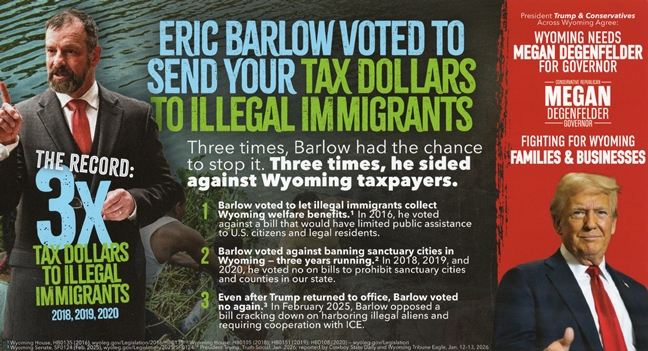
One of the mailers sent by a pro-Megan Degenfelder PAC criticized Barlow’s record on illegal immigration. The first bill listed on the advertisement was 2016’s HB135 sponsored by then-Representative Mark Jennings. Plainly, the bill would ban public funds to anyone not legally present in the state. Barlow voted against it.

In a recent article in the Cowboy State Daily, Barlow once again used the explanation that the bill needed more work. According to CSD, “That bill was numbered two days before its introduction vote, Barlow noted in his Monday interview. ‘This is a significant issue that had implications for local governments,” said Barlow. “We got that bill literally two days before that vote was taken.’”
The CSD goes on to point out that Barlow did vote for “Bo” Biteman’s SF0106 –“Welfare Fraud Protection Act Amendments--saying, “Barlow voted in favor this year of a bill, by Senate President Bo Biteman, restricting public welfare benefits across health and family services programs like food stamps, Medicaid and the Power program.”
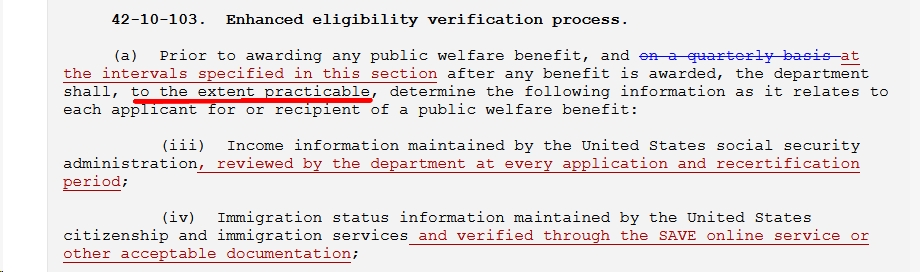
Buried on page 18 of the 22 page SF0106 is the phrase, “Prior to awarding any public welfare benefit, and on a quarterly basis at the intervals specified in this section after any benefit is awarded, the department shall, to the extent practicable, determine the following information as it relates to each applicant for or recipient of a public welfare benefit.” The phrase, “to the extent practicable” means that immigration status verification is not guaranteed.
It’s a loophole that may provide the reason Barlow voted for this bill and not the far more restrictive SF0124 from 2025.
The Record Matters More Than the Rhetoric
Barlow’s supporters will point out that he has voted for other immigration-related legislation, including Wyoming’s eventual prohibition against sanctuary cities. But that doesn’t erase his numerous votes against such a ban in 2018, 2019, and 2020. Barlow’s 2025 vote against sanctuary cities was a clear change from his record on substantially similar sanctuary-city legislation, and it came 5 months before announcing he was running for governor.
SF124 would have established a far broader enforcement framework. SF166 would have helped states attempting to secure a border the federal government had abandoned. Barlow voted against both. One possible reason Barlow voted for 2025 HB0133 is that it was so narrowly tailored that it only prevented cities from ignoring federal immigration enforcement. It didn’t address any of the broader issues surrounding illegal immigration, like tax dollars going to illegal aliens.
Politicians often attempt to explain away their votes by claiming that a bill was imperfect, complicated or in need of more work. Sometimes that criticism is legitimate. But legislating is the work. Lawmakers are elected to amend imperfect bills, negotiate practical solutions and move important policies forward. They are not elected merely to identify flaws and vote no.
On SF124, the prohibition against taxpayer benefits for illegal immigrants could have been restored on the floor. Concerns raised by sheriffs could have been addressed with targeted amendments. Instead, Barlow voted to kill the legislation before that work was completed. With SF166, Wyoming had an opportunity to stand with states bearing the immediate cost of the border crisis. Barlow voted no.
When illegal immigration demanded more than campaign rhetoric—when it required Wyoming to act, Eric Barlow voted no--except when it was politically convenient.