EDITORIAL
Wyoming politicians are no strangers to wounded feelings. In 2019, Gov. Mark Gordon declared himself “deeply offended” by Cheyenne Mayor Marian Orr’s account of their confrontation. In 2025, Sen. Troy McKeown said he “took offense” to a suggestion that lawmakers were using property-tax cuts to get elected.
Fair enough. They are entitled to be offended. So are the rest of us. The trouble begins when a public official mistakes that feeling for authority over someone else’s speech. A free country offers ample opportunity to take offense. There is no protection from everything that causes it. Free speech requires tolerating speech you find offensive—and being offended gives you, or the president, no veto over what someone else says.
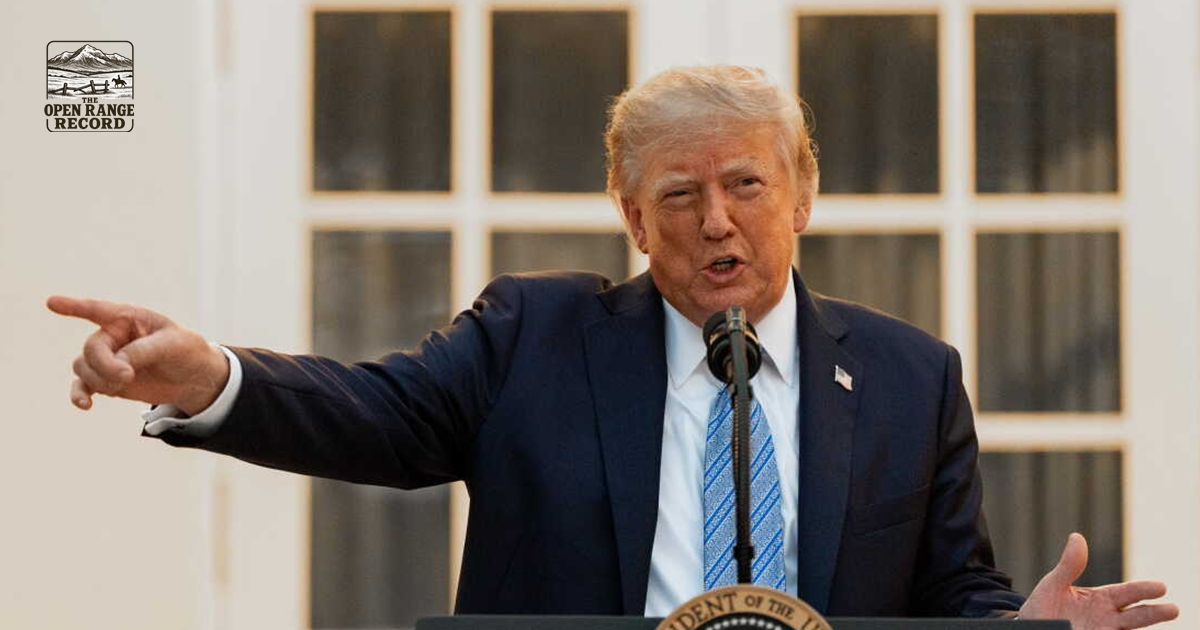
President Donald Trump has now barred CNN, MS NOW, and Politico from the White House, citing “fake news.” Journalists from the three organizations were turned away September 19 after the ban was announced the previous day.
Before anyone mistakes opposition to that decision for an endorsement of these outlets, they hardly have an unblemished record.
In December 2017, CNN misdated an email offering the Trump campaign access to WikiLeaks material. The difference between September 4 and September 14 was the difference between potentially advance access and a message pointing to information already publicly available. CNN corrected its report. Those ten days changed the entire substance of the story.
In March 2020, MSNBC, now MS NOW, aired Brian Williams and guest Mara Gay endorsing the claim that Michael Bloomberg’s $500 million in campaign spending could have given each of 327 million Americans $1 million. The actual figure was roughly $1.53; MSNBC corrected the error. This required a calculator, not an anonymous source.
Politico placed Justice Sonia Sotomayor at dinner with Democratic leaders in 2022. It had mistaken Chuck Schumer’s wife for her. The outlet issued a correction acknowledging that it should have checked its tipster’s identification.
Those are demonstrable factual errors and are very clearly what the President calls “fake news.” They warrant criticism, corrections, skepticism, and in some cases, outright derision. All journalists make mistakes--even the best journalists do. Whether they admit it or not is another matter. But one thing a mistake does not do is force a journalist to turn in their First Amendment card. Certainly, the publishing of fake news does not make the president the licensing authority for American journalism.
The First Amendment would be a remarkably fragile protection if it lasted only until a newspaper got something wrong or until a politician didn’t like their coverage. The delicate feelings of even some Wyoming politicians would eliminate any semblance of journalism if that were the case.
The Supreme Court has taken it a step further beyond potentially damaging factual errors. In New York Times v. Sullivan, the Supreme Court recognized that mistakes are inevitable in free political debate. Unless an outlet showed reckless disregard for the truth, that speech was absolutely covered by the First Amendment.
White House access presents a separate question, but it is hardly uncharted territory. In Sherrill v. Knight, the federal appeals court rejected arbitrary or content-based criteria for White House press passes. Once the government establishes press facilities for eligible journalists, it can’t exclude them arbitrarily.
That doesn’t mean every reporter gets a private interview with the president in the Roosevelt Room. It does mean they get access. Sherrill expressly preserved the president’s discretion to choose interviewers. Security requirements are legitimate, too. But revoking established access because the president doesn’t like the outlet’s reporting crosses the line.
Trump can dispute a story, produce contrary evidence, and demand a correction. If it’s defamation, test it in court. Throwing out three news outlets because he thinks they’re fake news is wrong.
Conservatives should recognize the danger immediately. If “fake news” is sufficient grounds to revoke credentials, the next Democratic president gets to decide which conservative reporter qualifies, if any. Abusive executive power does not become limited government because our preferred president happens to wield it.
A free press includes publications we distrust, dislike, or are offended by. Its constitutional protection cannot depend on our affection—or the president’s approval. Trump has every right to be offended. He does not have a right to be free of the people who cause him that consternation. President Trump does have a veto pen but not over the First Amendment.