NEWS
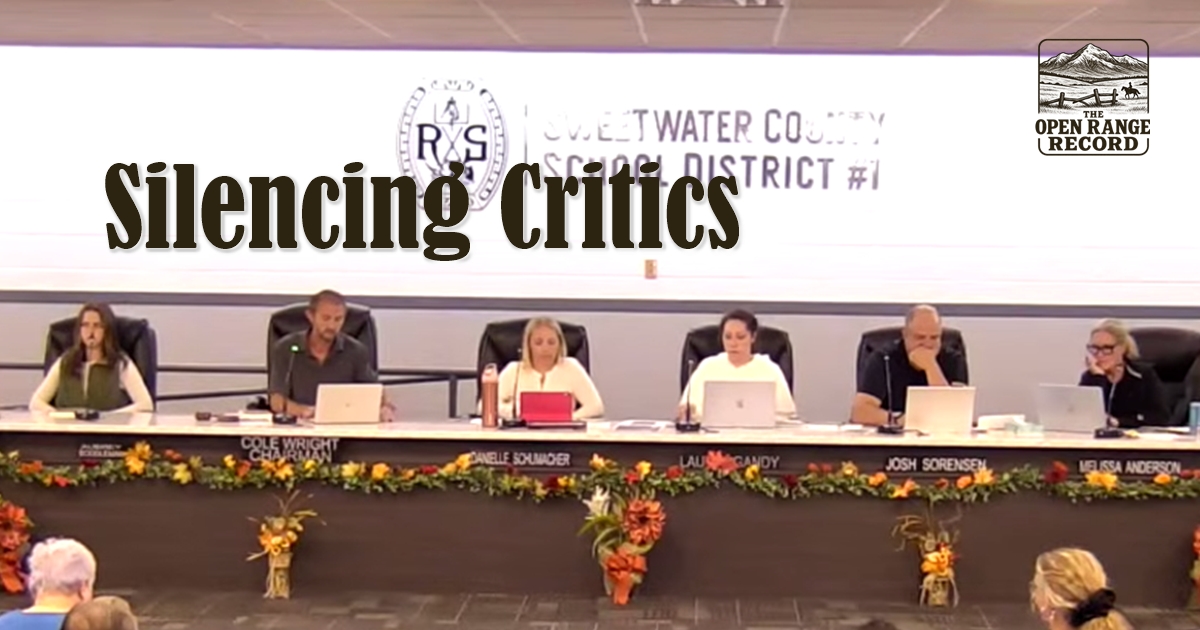
The Sweetwater County School District No. 1 Board of Trustees suspended public comment Monday night while its policy committee reviews the district’s public participation policy. The decision came after the Goldwater Institute challenged the policy on First Amendment grounds and warned that it is prepared to litigate.
SCSD1 board member Danielle Schumacher made the motion to suspend public comment saying, “I will be asking the board to take into consideration suspending the public comment period at board meetings while the policy committee completes its review of our public participation policy.” Schumacher continued, “Last month, just so that everyone is aware, the district received a [sic] correspondence from a national organization written on behalf of a community member questioning whether parts of our public comment policy meets First Amendment standards.”
The district described the matter as correspondence from a “national organization” written on behalf of a community member. Goldwater’s public account is more specific. Two letters were sent to district leaders—one challenging the public comment policy and another demanding unredacted copies of written comments under the Wyoming Public Records Act.
No lawsuit over the policy has been filed. Goldwater said its letters were intended to give the district an opportunity to correct the alleged violations without litigation.
The dispute began after the board amended its policy to prohibit written and spoken comments discussing an individual employee’s “performance or employment.” According to Goldwater, a parent's spoken comments criticizing the assistant superintendent were stopped by the board chairman, and her written comments were redacted from public meeting materials. She had previously been allowed to submit written and spoken comments praising other district employees.
Goldwater argues that allowing praise while blocking criticism is viewpoint discrimination prohibited by the First Amendment and similar protections in the Wyoming Constitution. It also contends that written public comments cannot be withheld simply by labeling them confidential personnel records.
Board members said the policy committee needs additional time to complete its review. They argued that continuing to apply the challenged policy at future meetings could invite more claims, possible attorney-fee awards and months of distraction from the board’s work.
That explanation shifts attention away from who created the problem. Parents did not write this policy. They did not selectively stop speakers, redact criticism, or refuse to release public comments. The board adopted the language, and district officials enforced it. Now the public is being told that the risk of legal consequences makes it necessary to silence everyone.
The board cited Wyoming Statute 16-4-403 and emphasized that meetings will remain open for people to attend. Members explained that Wyoming law requires open meetings but does not require the board to provide a public-comment period. Public comment, they said, is something the board chose to offer and may temporarily pause.
Legally, attending a meeting and speaking at one are different rights. But presenting public comment as a favor granted by the board, after the board’s own restrictions triggered a constitutional challenge, is inconsistent.
The district is not facing scrutiny because parents spoke. It is facing scrutiny because of how it treated their speech. Suspending public comment may temporarily prevent the challenged policy from being enforced again, but it also punishes every parent, teacher, and taxpayer for the board’s failure to adopt and apply a constitutional policy.
The First Amendment guarantees the public the right to go to petition their elected officials for redress of grievances. The Constitution doesn’t call this a privilege or optional.