ANALYSIS
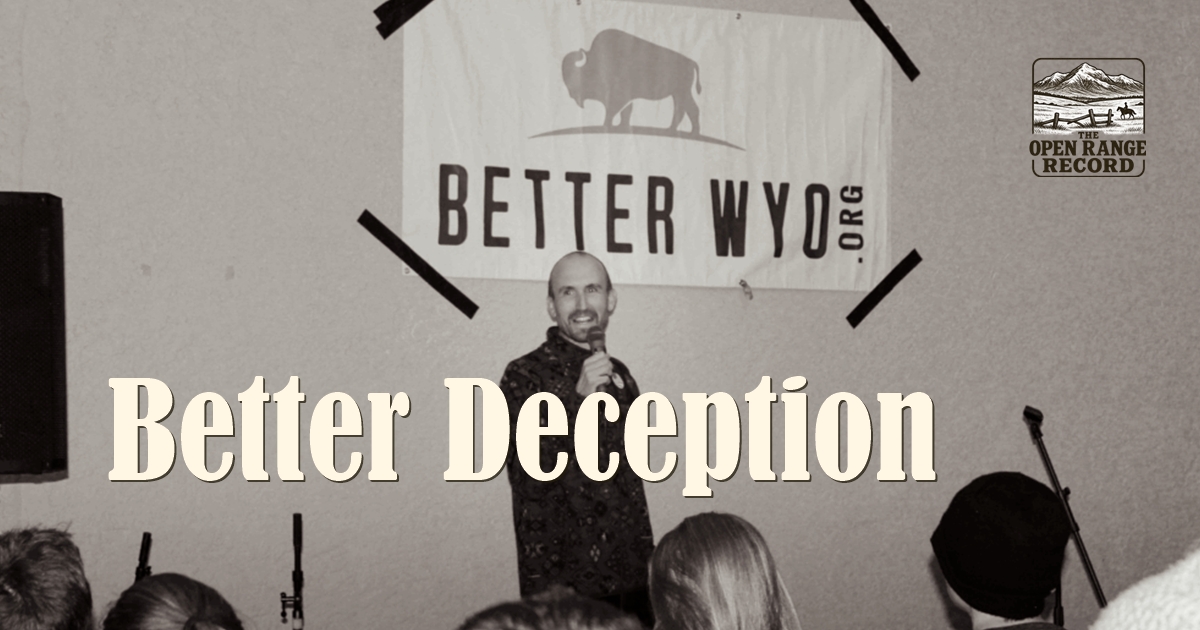
On Tuesday, September 29, the Laramie County chapter of Better Wyoming hosted a public screening of The Librarians at The Williams Center in Cheyenne. The film was recently recognized with an Emmy® Award for “Exceptional Merit in Documentary Filmmaking.” The event was billed as a look at public librarians confronting “book bans.” The screening also offered Wyoming residents an opportunity to examine how the film defines censorship, presents historical evidence, and frames the role of parents and local communities in setting library standards.
Grassroots organizations often present themselves as neutral champions of civic engagement. Better Wyoming, however, describes its own work as civic education, collective action, leadership development, and organizing aimed at influencing public decisions. Those stated purposes make it fair—and necessary—to examine the organization’s political priorities, especially when its campaigns touch school governance, library policy, and parental authority.
The organization’s approach frequently treats parental opt-in proposals, age-based access rules, and legislation such as HB0010 as forms of censorship. As reported by The Open Range Record, HB0010 addressed minors’ access to defined sexually explicit materials in county and school libraries rather than prohibiting adults from obtaining books or removing all disputed works from circulation. Supporters see such measures as community-led oversight and an affirmation of parents’ role in directing their children’s upbringing and education—not as a blanket ban on ideas.
That disagreement is the real issue underlying the screening: who should set boundaries in publicly funded institutions serving children, and how should those boundaries be described? Better Wyoming’s rhetoric tends to cast restrictions as “book banning,” while its critics argue that this framing obscures legitimate disputes over age suitability, local control, and parental consent.
The Missing Context in Eisenhower’s Words
When advocacy groups advance a particular interpretation of public policy, historical context deserves close attention. The film uses a quotation from President Dwight D. Eisenhower’s June 14, 1953, commencement address at Dartmouth College. The quotation is offered in support of the view that restrictions on library materials are inherently dangerous.
“Don’t be afraid to go in your library and read every book...”
But that is not what Eisenhower said.
The full passage is: “Don’t join the book burners. Don’t think you are going to conceal faults by concealing evidence that they ever existed. Don’t be afraid to go in your library and read every book, as long as any document does not offend our own ideas of decency. That should be the only censorship.”
Eisenhower was speaking amid Cold War efforts to remove allegedly subversive books, and his larger message strongly defended open inquiry and access to dissenting ideas. At the same time, the full passage included an explicit reference to “our own ideas of decency.” Whatever modern policy conclusion one draws from that phrase, the omitted language is relevant to today’s debate over content and age standards in publicly funded spaces serving children.
By omitting the rest of the quotation, the film risks turning a historically situated defense of intellectual freedom into a broader claim Eisenhower did not state in those words. The Eisenhower quotation wasn't the only misleading Better Wyoming did or does; it unintentionally gave the audience a prologue of what was to come.
Article 7, Section 20 of the Wyoming Constitution, states: “As the health and morality of the people are essential to their well-being, and to the peace and permanence of the state, it shall be the duty of the legislature to protect and promote these vital interests by such measures for the encouragement of temperance and virtue, and such restrictions upon vice and immorality of every sort, as are deemed necessary to the public welfare.”
Whether that provision legally validates a particular library measure is a separate constitutional question. What it does do is provide a distinctly Wyoming basis for arguing that the Legislature may consider public welfare, morality, and protections for minors when debating library policy.
Leadership, Funding, and Political Connections
Nate Martin has led Better Wyoming since 2017 and serves as its executive director. Martin is married to Rep. Karlee Provenza, a Democratic member of the Wyoming House from Laramie.
The connection is more than familial. Better Wyoming’s own website identifies Provenza as a Wyoming Civic Engagement field strategist and describes her and Martin as grassroots organizers who use narrative to build political power. It also lists them as joint presenters for a Better Wyoming advocacy training designed to help residents appeal to state decision-makers. Photographs published with the organization’s event materials show them participating in that organizing work together.
Liz Storer, president and CEO of the George B. Storer Foundation, has also been closely associated with Better Wyoming’s leadership and financial support. A published account reports that Better Wyoming receives approximately a quarter-million dollars annually from the foundation. Because that figure presently comes from a commentary source rather than grant documents reproduced in this article, it should be attributed rather than stated as an independently verified total.
Together, these facts establish overlapping personal, political, organizational, and financial relationships: Martin directs Better Wyoming; his wife is a sitting state representative and has participated in advocacy work promoted by the organization; and a foundation led by Storer is reported to provide substantial funding. Those relationships do not, by themselves, establish a conflict of interest necessarily. They do, however, create legitimate questions of transparency.
When an organization presents itself as improving communities while organizing residents around legislation, candidates, schools, and public institutions, readers should be told plainly about close relationships between its executive leadership, major funders, and elected officials involved in its advocacy. Without that context, audiences may understand the organization as a more independent civic voice than its leadership, funding, and political connections indicate.
A Growing Statewide Organization
Better Wyoming is building organizing capacity county by county, with a stated emphasis on civic education, collective action, leadership development, elections, school boards, and other public decision-making bodies.
Its publicly identified local chapters include:
- Laramie County — Cheyenne
- Albany County — Laramie
- Natrona County — Casper
- Sheridan County — Sheridan
- Campbell County — Gillette
- Johnson County — Buffalo
Better Wyoming has also discussed establishing additional chapters. An October 1 post on the organization’s Facebook page offers a direct view of the subjects its chapters planned to address that month.
The post said the Laramie County chapter would discuss the property tax ballot initiative, encourage its defeat in November, and identify policy priorities for the coming legislative session.
It said the Campbell and Sheridan County chapters would discuss protecting public schools and community services from proposed property tax reductions and begin planning for the 2027 legislative session.
The Natrona and Converse County group planned to discuss down-ballot voting, Proposition 1, upcoming events, and “building relationships with candidates.”
The Albany County chapter planned discussion of statewide policies, the ballot initiative, school-funding recalibration, maternal healthcare, and upcoming film screenings. Taken together, these topics show that the organization’s work extends well beyond library programming into elections, legislation, education funding, taxation, healthcare, and candidate engagement.
The Cheyenne screening, particularly with its post-film “action steps,” was therefore more than a presentation of a documentary. It also served as an opportunity for political education and organizing around a contested understanding of library policy. Wyoming residents should approach that effort as they would any advocacy campaign: examine the evidence, read quotations in full, scrutinize proposed policies, and decide whether the organization’s priorities reflect their communities.
Age-appropriate access rules, parental consent, and local oversight should be debated on their actual terms—not reduced automatically to “book banning.” The public deserves the complete historical record, precise descriptions of proposed policies, and an honest account of what is at stake. Citizens who care about these questions should attend meetings, read the measures themselves, ask specific questions, and remain engaged in the decisions made by their schools, libraries, and elected officials.