
NEWS
At Dry Creek Station in La Barge, I sell red-dyed diesel. President Donald Trump's new executive order raises an immediate question for customers and retailers: What can we legally do in Wyoming?
As of the morning of October 7, I had not located Wyoming-specific public guidance or a statement from Governor Mark Gordon explaining the state's response. I have emailed the Governor's Office and WYDOT Fuel Tax Administration requesting written guidance and comment.
The Open Range Record contacted Governor Gordon's office for comment on this story. While they did not respond by publication time, this story will be updated in the event they do.
What the federal order does
Trump's October 5 order directs the Treasury to determine the legal basis for deferring specified federal taxes on highway use of dyed diesel through December 31. It directs the IRS to announce specified penalty relief within five days, and requires guidance explaining eligibility, conditions, and payment deadlines.
The distinction is important: deferred taxes are not automatically forgiven. The order calls for exploring forgiveness, including through legislation, and encourages corresponding state action. It does not itself cancel Wyoming's taxes or establish a uniform rule for every state.
How other states are responding
Other states have published different approaches. Nebraska's agricultural relief, which began September 24, lets qualifying users buy tax-paid clear diesel and claim state refunds; eligible interstate carriers can receive credits for qualifying Nebraska miles. Iowa temporarily suspends specified restrictions and tax provisions for hauling listed agricultural products.
Texas permits expanded highway use of dyed diesel but still requires its 20-cent state tax on taxable highway use. South Dakota has shifted enforcement priorities while acknowledging that legislation may be needed to forgive state taxes. Permission to use fuel and cancellation of taxes are separate questions.
This is important on I-80 and I-25. Drivers entering Wyoming with dyed fuel need to know which rules apply here, even if they fueled in a state offering relief.
The taxes in each gallon
The debate also highlights the taxes built into each gallon. Federal rates are uniform nationwide, while state taxes vary. Under ordinary tax treatment, the published rates are:
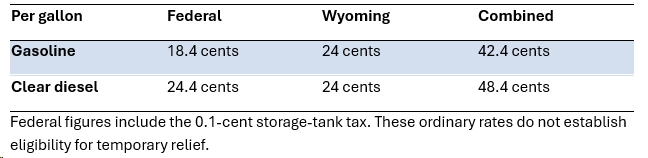
Wyoming's chart lists 1 cent per gallon on dyed diesel, compared with 24 cents on clear diesel. The IRS also generally applies a 0.1-cent storage-tank tax to dyed fuel. Red-dyed diesel is therefore not entirely tax-free, and the chart alone does not authorize highway use.
Is Trump also drawing attention to fuel taxes? His stated purpose is affordability relief. Whatever his broader intent, the discussion gives Americans reason to examine the government portion of each fuel purchase.
Retailers with tax-paid fuel in the ground
For retailers, there is another issue: clear-diesel inventory already purchased with taxes included. If customers switch to cheaper dyed fuel, stores may face slower sales or pressure to absorb the price difference. On 10,000 gallons, Wyoming's 23-cent tax difference alone amounts to $2,300.
The order contains no explicit retailer reimbursement provision for that inventory. A broader tax suspension paired with inventory credits, or customer refunds for documented clear-diesel purchases, deserves consideration. Nebraska's state agricultural refunds demonstrate one alternative to changing fuel types.
Supply delays and refinery capacity
My fuel distributor, known in the industry as a jobber, places the orders nearly a week ahead. I have been told trucks face long waits to load. Suppliers need to clarify whether those delays involve available fuel, loading capacity, scheduling, or delivery-truck availability.
Dye can be injected at the terminal loading rack, so clear and dyed diesel do not necessarily require separate refinery production runs or separate bulk storage before loading. Expanded highway use could make existing dyed inventory available to more customers, but it does not increase refinery production or guarantee shorter loading lines.
U.S. crude-processing capacity remains below its pre-COVID level: EIA reported about 19 million barrels per day at the start of 2020 and 18.2 million on January 1, 2026. Its pandemic-era closure list included Cheyenne's 48,000-barrel-per-day petroleum refinery; its latest report identifies Houston and Los Angeles closures during 2025. Those national figures provide context, not proof of what is causing delays at my supplier's facility.
Why cheaper crude does not guarantee cheaper diesel
Why are pump prices so high when crude is below its 2008 peak? U.S. oil futures reached about $147 a barrel that July. On October 6, 2026, WTI settled near $89 and Brent near $101; the benchmark matters, and comparisons across 18 years also need to account for inflation.
Crude is only part of the pump price. EIA attributes today's diesel pressure to tight global supplies, low inventories, and a larger gap between crude and wholesale diesel prices. Reduced refining abroad and demand for U.S. exports add pressure, alongside refining costs, distribution, and taxes; domestic refinery closures alone do not explain it.
Biden authorized a 180-million-barrel emergency reserve release in 2022. Treasury estimated that coordinated releases lowered gasoline prices at the time; smaller reserves leave less emergency backup but do not establish the cause of today's diesel prices. Trump also authorized a 172-million-barrel release in 2026. The reserve supplies crude, which still needs refining into usable fuel.
Author's Opinion:
Governor Gordon and WYDOT should explain Wyoming's permitted uses, remaining taxes, reporting requirements, and enforcement instructions. Federal officials should clarify deferred liabilities and treatment of tax-paid inventory.
Governor Gordon and WYDOT should explain Wyoming's permitted uses, remaining taxes, reporting requirements, and enforcement instructions. Federal officials should clarify deferred liabilities and treatment of tax-paid inventory.
I support helping customers with fuel costs. Drivers and the businesses supplying their fuel need relief they can understand and use with confidence.