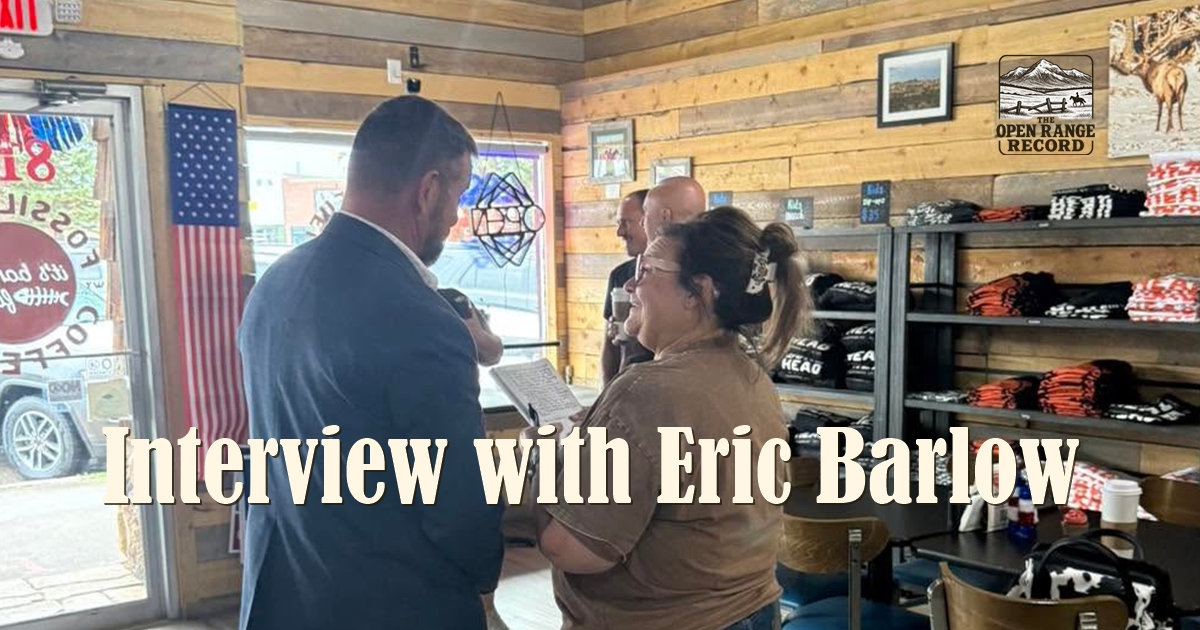
KEMMERER - Republican gubernatorial nominee Eric Barlow stood up for an informal one-on-one conversation September 22, 2026, at Fossil Fuel Coffee in Kemmerer. The Open Range Record visited with him for 5-10 minutes during his campaign stop in southwest Wyoming.
Recreational Marijuana and Property Tax Revenue
Marquardt: You have warned that the proposed 50 percent primary-residence property tax initiative could reduce funding for counties and special districts. You also previously sponsored the Wyoming Medical Cannabis Act. If voters approve the property tax initiative, and the Legislature responds by legalizing recreational marijuana and imposing a substantial tax on it to replace the lost revenue, would you sign the bill or veto it? Would you rule out recreational marijuana taxation as a replacement for property tax revenue?
Barlow: “I don't even know the nexus between the two, dollar-wise. I don't know that there's any nexus.”
Marquardt: What I am getting at is that people keep saying the state will need an increased sales tax or an income tax if the property tax initiative passes. There were also social media statements from Libertarians claiming that, because they helped defeat Freedom Caucus candidates, you owed them legalized cannabis. That is why I am asking.
Barlow: “I didn't make any deals with anybody. I have never supported legalized cannabis in Wyoming. I have supported medical, and I think those are very different things. I guess the dollar amount nexus—the dollar amounts for the residential property tax—I don't know the numbers off the top of my head.”
Marquardt: The estimate is approximately $92 million.
Barlow: “I don't know how much marijuana you'd have to sell to make up for that. That doesn't even equate to me. I do not support—I don't think Wyoming supports recreational cannabis, period.”
Barlow did not state whether he would sign or veto a recreational marijuana bill if one reached the governor's desk.
State and Local Replacement Revenue
Barlow: “And as far as whether the state of Wyoming has an obligation to make up for the loss of revenue if the property tax initiative passes, the state of Wyoming has that obligation for K-12 education, which is approximately 70 percent of the property tax. So the state of Wyoming is going to have to do that.”
“Obviously, the Legislature can have that conversation if it needs to expand the revenue source. But my belief [is] we can probably do that from improving our mineral production on state lands, doing other things, not additional taxes.”
“Local governments—cities, towns, and counties—have other revenue sources, as you pointed out, sales tax and other things. If they can grow their economy, they can maybe make up some of those differences. The ones that don't have that same opportunity, at least that I understand, are special districts—fire districts, hospital districts, cemetery districts, rural health-care districts [and] senior-care districts. Those were districts that were voted on by the citizens in that community. Depending on how dependent the district is on residential [property taxes], it'll have varying impacts.”
Marquardt: That impact would not be the same in every county. In Sublette County, for example, only 4 or 5 percent comes from residential property taxes. The rest is mineral.
Barlow: “Campbell County is the same, but other communities [are] very different.”
Public Lands and Local Input
Marquardt: Western Wyoming communities are surrounded by federal land. Many residents make their living through oil and gas development, livestock grazing, timber harvesting, outfitting, recreation, and the businesses that support those industries. During the Rock Springs Resource Management Plan process, residents, counties, and state officials submitted comments, but it still appeared that much of the area could be closed off. How does Wyoming obtain more influence over federal lands when local economies depend on them?
Barlow: “First of all, [with] most of these RMPs, there's cooperator status. The state of Wyoming and local governments—the counties—have cooperator status. Cooperator status has to be more than just window dressing. You have to have meaningful input, and then they have to actually take that on and say, "We'll do that."
There are examples in the state of Wyoming—the DEQ and other agencies—where we have primacy, where we have an understanding with the federal government that we don't need the Environmental Protection Agency here. DEQ will take that on, and we will enforce the federal law, but we're going to do it right here in Wyoming.”
Marquardt: How do we establish that kind of arrangement with the Bureau of Land Management? People on the East and West coasts can appear to have more say simply because there are more of them. When does a Wyoming resident who lives and works on or around these lands receive greater consideration?
Barlow: “First, they're still public lands. But we're the stewards of those lands. We interact with them in our recreation, in our mining, in our agriculture—logging, you mentioned. I think we just have to insist on being at the table. When we disagree with what they do, we use the courts to defend.”
Congress and Durable Federal Policy
Barlow: “That's what we've been doing. Governor Gordon, Governor Mead prior—we've said, "No, that's not the appropriate way." We also need a Congress that backs us up and gives us that footing or that platform to say states have to be here. We have to have that voice so that it's not all on us. Congress can step in and help.
People think about public policy as a pendulum swinging, like politics. Well, we've turned it into a damn gong show. Everybody's making a lot of noise. What we're doing is not durable. [With] the next lawsuit or the next administration, then you're going the other way.”
Marquardt: Communities such as La Barge have lived through repeated boom-and-bust cycles. It can take years after a change in federal energy policy for projects and jobs to reach a community. If the administration changes again, the policy can reverse before local communities recover. How does Wyoming get more certainty?
Barlow: “It's not just the executive branch. Congress has to make these policies durable.”
Marquardt: Federal policy is also challenged through judge shopping, including disputes involving grizzly bears and wolves.
Barlow: “They couldn't judge shop if the law was different. If the law is supportive, whether you judge shop or not, if we're not doing things that are solid— [if we don't] have a solid foundation—it just gives them that opportunity.
It's durability to me. I don't want to do anything in the Legislature that doesn't provide durability, so people have continuity. You can predict. If I'm going to make an investment in Wyoming, whether I move my family here or have a family here or [operate] a business, I want to know there's some opportunity.”
Support From the Congressional Delegation
Marquardt: Have Sen. Cynthia Lummis, Rep. Harriet Hageman, or Sen. John Barrasso endorsed your campaign?
Barlow: “I think Senator Lummis and [Republican nominee] Hageman have both said, "We're supporting the Republican nominees." I'm one of those. I don't recall about Senator Barrasso. I've spoken with him. He's supportive personally. I don't know if he's done anything publicly. I don't know formally from Senator Barrasso, but he's certainly someone I interact with routinely.”
-End or interview-
As of today there are 29 days until the 2026 General Election. Barlow is facing a challenge from the Constitution Party in Rebecca Bextel and Democrat Kenneth Casner.