NEWS
Wyoming has spent decades building a state-directed economic-development machine. The Wyoming Business Alliance helped create the Wyoming Business Council. Leadership Wyoming helped build the relationships. Governors fill the boards. Public agencies move the money. And now a PAC helps elect the lawmakers who decide whether it all continues.
In this story, “economic development” does not simply mean private businesses investing their own money and creating jobs. It means a government-directed system of taxpayer-backed grants, loans, infrastructure, matching funds and agency introductions used to recruit or assist selected private projects.
If Eric Barlow becomes Wyoming’s next governor, he will not walk into Cheyenne alone. A network already surrounds him, and many of the people behind his campaign already appear throughout that system.
Here is one number that should make voters stop: a cross-check identified 53 people in Barlow’s campaign orbit who were connected to Leadership Wyoming or the Wyoming Academy. Forty-eight were donors. Eleven of those donors also served on his statewide campaign leadership team. Excluding Barlow’s own money, the group gave $59,660.32.
From 2018 through 2025, Wyoming’s inflation-adjusted economy grew approximately 5.3 percent, the slowest growth among all 50 states. Real mining output fell approximately 23 percent.
By 2025, government had overtaken mining as Wyoming’s largest single sector by current-dollar output. By July 2026, federal, state, local and public-school employment totaled 71,000 of Wyoming’s 295,100 non-farm jobs, roughly one out of every four.
However, after roughly $1.5 billion in Wyoming Business Council appropriations and another $155 million for the Energy Matching Fund, taxpayers should ask a simple question: What did Wyoming get for all of this money?
To understand why replacing Mark Gordon with Eric Barlow may change the name on the governor’s door without changing the system behind it, follow the names, the relationships, and the money.
How the Circle Was Built
None of this appeared yesterday. The Wyoming Heritage Society and Wyoming Heritage Foundation were founded in 1979. IRS records for the organization’s current tax identification number date its federal tax exemption to August 1981. In 1998, the Wyoming Heritage Society became the Wyoming Business Alliance; the Wyoming Heritage Foundation kept its name.
The Wyoming Business Alliance is not a state agency or a 501(c)(3) charity. It is a private, tax-exempt 501(c)(6) business league, the federal category used for trade associations and chambers of commerce. Broadly, it is a nongovernmental organization, or NGO, because it operates outside government, but the “501(c)(6) business league” is the more precise description.
The Wyoming Business Alliance says it began pushing for a more aggressive state economic development effort in 1988. A 1996 forum led to a retreat with Governor Jim Geringer and roughly 40 business and political leaders. Lawmakers created the Wyoming Business Council as a state agency in 1998. The Wyoming Business Alliance says it drove that effort and later helped save the agency from elimination.
The Wyoming Heritage Foundation and University of Wyoming established Leadership Wyoming in 1999. Its history credits Bill Schilling, University president Phil Dubois and then-House Speaker Eli Bebout with helping launch it. Bebout chaired both the Wyoming Business Alliance and Wyoming Heritage Foundation and joined the first class. Leadership Wyoming became an independent nonprofit in 2019.
Anyone may apply, but not everyone is selected. Participants spend months traveling, training and meeting business leaders, state officials and policymakers. Alumni later appear on campaigns, trade associations, nonprofit boards, state commissions, as lobbyists and in the agencies moving public money.
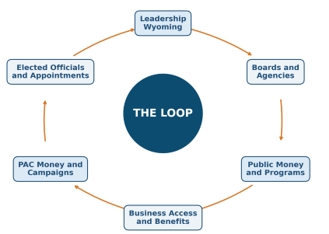
That is the funnel: Leadership Wyoming builds relationships; the Wyoming Academy explains the state-directed system; public officials fill boards; boards direct programs and money; businesses gain assistance and introductions; and political organizations help elect the officials who decide whether the system continues.
When the Wyoming Business Alliance Entered Elections
The loop moved directly into elections in 2026, when conservative lawmakers tried to slash funding for the Wyoming Business Council and reconsider what the agency should do.
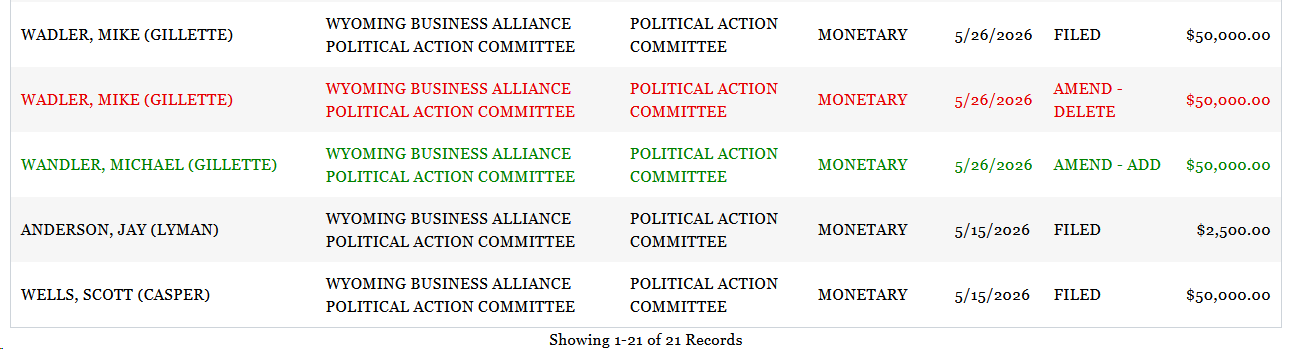
On April 30, the Wyoming Business Alliance formed a political action committee. By Sept. 9, the Wyoming Business Alliance PAC reported $267,350 in net contributions and $261,180.46 in spending. It promoted 32 “pro-business candidates in key races.” The PAC also reported $65,000 in large-dollar contributions from out of state organizations.

Two $50,000 contributions came from L&H Industrial CEO Mike Wandler and True Companies executive Scott Wells. Wells is a Leadership Wyoming graduate who sits on both the Wyoming Business Alliance management committee and steering committee.
The Wyoming Business Alliance PAC paid $243,708.10 to Only Co for digital advertising and printing—93.3 percent of its reported spending. Only Co founder Josh Law is a Leadership Wyoming graduate who also participated in two of its alumni programs.
In the August primary, 13 Freedom Caucus-aligned House incumbents lost reelection. No filing proves the PAC caused those results. However, those lawmakers had threatened the agency the Wyoming Business Alliance helped create.
Why would the Wyoming Business Alliance spend more than a quarter-million dollars helping elect lawmakers? And how many voters understood that the fight over those candidates was also a fight over who would control Wyoming’s economic-development system?
Barlow Is Already Inside the Network
Barlow entered the Wyoming House in 2013 and appears in Leadership Wyoming’s Class of 2013. In 2024, he joined the Wyoming Academy, a program created by Leadership Wyoming and the Wyoming Business Council to help participants understand Wyoming’s state-directed development system, how government agencies, public money and private businesses work together to recruit and support selected projects.
Those 48 donors did not supply most of Barlow’s campaign money. The point is who keeps appearing: leaders of the Wyoming Business Alliance, Wyoming Business Council and Wyoming Energy Authority, along with former lawmakers, consultants, lobbyists, and public-board members.
Rebecca Rood, for example, chairs the Wyoming Business Alliance. She is a Leadership Wyoming graduate, a $2,500 Barlow donor and a member of his campaign leadership. Barlow’s campaign also reported paying her company, Tailored CFO Solutions, $86,385.
Beth Worthen and Bruce Pivic sit on the Wyoming Business Council board and appear in Barlow’s campaign network. Michelle Koch is the Wyoming Energy Authority vice chairwoman and is both a donor and campaign leader. Kara Choquette is the Wyoming Energy Authority secretary, a Wyoming Business Alliance steering member and a Barlow donor.
One connection can be coincidence. Two can be ordinary networking. But when the same names keep appearing in the leadership program, the business lobby, public agencies, appointed boards and one candidate’s campaign, voters should at least ask whether they are looking at separate relationships, or one functioning network.
Where the Public Money Moves
This is important because the Wyoming Business Council administers development programs and recommends many grants and loans supporting selected private projects. The governor co-chairs the council and appoints its board. The State Loan and Investment Board gives final approval to many of those awards.
The governor also appoints the Wyoming Energy Authority board. Since 2022, lawmakers have appropriated $155 million to the governor’s office for the Energy Matching Fund and another $100 million in "large project funding." Gordon delegated management to the Energy Authority, but the governor makes the final decision after the review process.
Those are different money paths, but both run close to the governor. One ends with the five statewide elected officials sitting as the State Loan and Investment Board. The other ends with the governor himself. Who gets appointed helps determine who receives access, which projects receive attention and what kind of development Wyoming pursues.
L and H Industrial Shows How It Works
L&H Industrial CEO Mike Wandler served on the Wyoming Business Council board. He now sits on the Wyoming Business Alliance steering committee and gave the Wyoming Business Alliance PAC $50,000.
In 2022, the Governor’s Office launched CONNEX Wyoming at L&H’s Sheridan facility. The state-supported program connected L&H with Northrop Grumman, and L&H later secured contracts from the company.
The Wyoming Energy Authority later awarded BWXT nearly $10 million for a microreactor assessment. L&H was already working with BWXT, and the companies announced a joint development agreement. Wandler then formed Evercore Energy, which hired former Wyoming Business Council and Wyoming Energy Authority employee Marcio Paes-Barreto. In December 2025, Gordon approved a separate $100 million Energy Matching Fund award to BWXT for a proposed Triso nuclear-fuel plant in Gillette.
The $100 million went to BWXT, not L&H or Evercore, and the records reviewed do not show a pass-through of state money. But L&H calls itself BWXT’s Wyoming partner and says the project could bring it work. That potential benefit makes the relationships worth tracking.
Would L&H have succeeded anyway? Perhaps. However, would a company outside this network receive the same introductions, access and opportunity to help build a publicly funded new industry?
A New Governor or the Same System
This story is not an argument against businesses growing or creating jobs. It is about who controls the door, and whether Wyoming taxpayers are getting enough in return.
In a free market, businesses compete with their own money under rules that apply equally. In Wyoming’s state-directed system, public officials use taxpayer money and government programs to lower costs, open doors and share risk for selected projects. Supporters say Wyoming must “compete with other states”, meaning it must bid against them with taxpayer-backed incentives to persuade companies to locate or expand here. Critics call that government picking winners and losers.
The concern grows when the same network helps create the agency, trains future leaders, staffs the boards, benefits from the programs, finances a PAC and supports the candidate who may appoint the next round of decision-makers. At that point, is this still an open market, or an inside track?
The records do not prove that Barlow promised anyone a board seat or contract. They show that many supporters already hold influential positions in the current system. If he chooses his administration from that circle, Wyoming should expect continuity with Gordon’s state-directed structure. Voters should ask what or if he would audit, which boards he would change and how outsiders would receive an equal chance.
A different governor can bring a different direction. But first, voters must look past the campaign sign and examine the people already standing behind it.