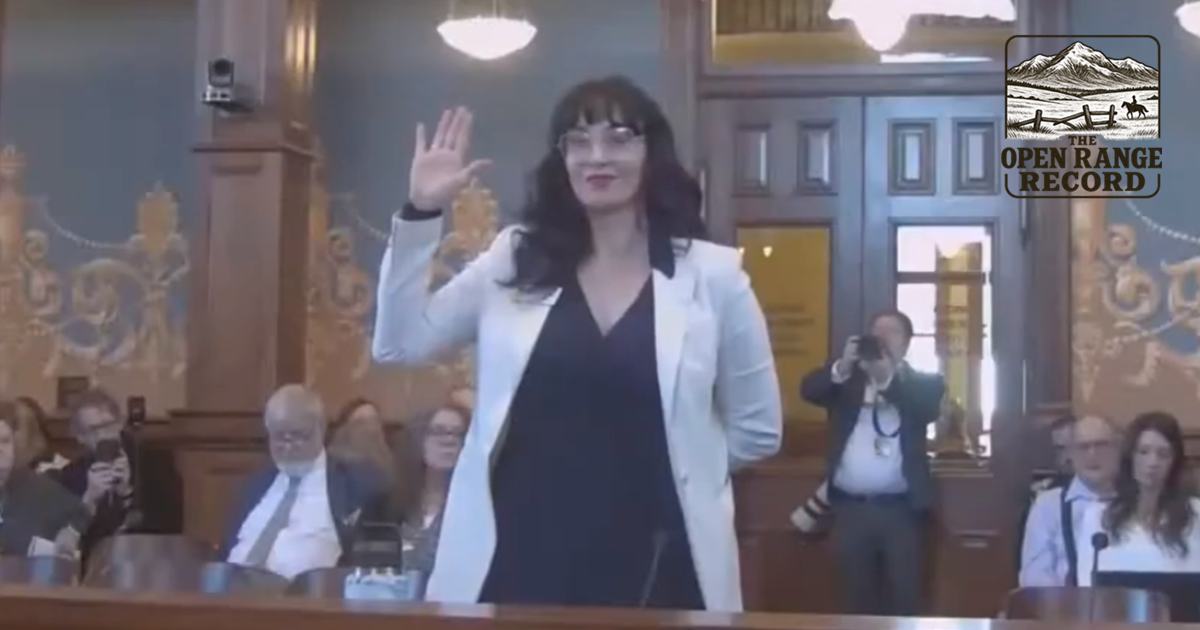
Thursday, February 26th, the Wyoming House of Representatives convened an investigative committee to examine claims that checks had been distributed on the House floor for improper reasons. The controversy began after Representative Karlee Provenza took photographs after floor proceedings on the evening of February 9th. Rather than initiating a formal complaint under House rules, the images were provided to media outlets, quickly generating headlines across the state and framing the incident as potentially nefarious.
Before testimony even began, a moment stood out. Representative Provenza laughed while taking her oath, repeating the phrase “do solemnly swear or affirm under penalty of perjury.” For some observers, that tone struck a sharp contrast with the seriousness of the accusations that had already circulated publicly.
What Was Alleged
Under questioning, Representative Provenza testified that at approximately 5:20 p.m. on February 9th, she observed Rebecca Bextel entering the House floor escorted by Representative Webber. She stated that she saw what “appeared to be printed checks” being handed to Representatives Webb, Brady, and McCann.
However, her testimony included key admissions:
- The items only “appeared” to be checks.
- She could not be
“100% certain” at the moment.
- There may have
been facts outside of her direct experience.
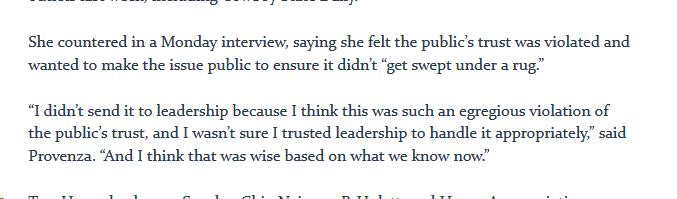
She further claimed that although House Rule 22-1 outlines a formal complaint procedure, she chose not to use it and instead exercised what she said was her First Amendment right to go to the media. She stated she did not trust a private internal process to produce the full truth and believed the public deserved to know.
As The Open Range Record has reported, Joint Rule 22-1 clearly lays out the procedure for an ethics complaint. Further, it is long-standing legislative procedure to follow rule 22-1. In addition, each member of the House voted to follow the rules of the legislature. Provenza admitted in a Cowboy State Daily article that she didn’t follow the rules.
But what followed raised a larger question about prudence and process.
Three Hours of Testimony
After more than three hours of testimony from witnesses, representatives, and individuals directly involved, a clearer picture emerged. The narrative initially presented in media reports — that something covert or improper had occurred — did not withstand scrutiny.
Testimony showed that:
- The checks were
lawful campaign donations.
- They were not
connected to pending legislation.
- There was no
exchange tied to any vote or legislative action.
- The distribution, while perhaps
unconventional in location, was not illegal or unethical under campaign
finance law.
Witness after witness testified to the integrity and character of those involved. Several spoke of the reputational damage and strain caused by the implication of wrongdoing. Families had fielded questions; constituents had expressed concern. Media coverage had amplified suspicion before facts were fully examined. By the end of hours of sworn testimony, it became evident that the event was not the nefarious incident it had been portrayed to be.
The Final Testimony: Rebecca Bextel
The final witness to testify was Rebecca Bextel, a Jackson, Wyoming resident. She explained that she had been in town for a separate event and walked onto the House floor with Representative Webber. She acknowledged that she had campaign checks in her possession. Those checks, she testified, were campaign donations from donor Don Grasso, agreed upon weeks earlier — on December 30th — well before the February legislative session events in question.
Bextel described in detail the timeline:
- Mrs. Bextel had dinner with Mr. Grasso and
his assistant in late December.
- She requested ten
campaign checks for candidates she believed would face competitive races.
- The donor agreed
and instructed his assistant to process them.
- A medical
emergency involving the assistant delayed issuance.
- Severe winter
storms delayed FedEx delivery.
- The checks ultimately arrived shortly before
session.
- Rather than mail them to candidates who would
be in Cheyenne for weeks, she brought them with her.
Bextel testified there was no connection to legislation, no discussion of votes, and no coordinated plan. Highway Patrol footage showed the entire interaction on the floor lasting roughly ten seconds.
Her stated intention was straightforward: deliver previously promised campaign donations so candidates could prepare early for upcoming races.
No
testimony contradicted that explanation.
The Impact of Public Allegation
The committee hearing underscored an important distinction: suspicion is not proof. When the photographs were released to the media before a formal complaint process was completed, the public narrative formed immediately. Headlines implied impropriety, social media amplified speculation, and political opponents weighed in. Yet after hours of sworn testimony, no evidence of wrongdoing emerged.
What did emerge was the toll. Reputations were questioned and integrity was publicly scrutinized. Strain was placed on relationships within the chamber and beyond it. In a legislative body governed by rules and procedures, those processes exist for a reason. They protect not only against misconduct — but against premature judgment.
A Matter of Prudence, Not Just Rights
Representative Provenza stated she exercised her First Amendment rights in going to the media. That is true. Elected officials retain those rights. But prudence and wisdom are separate from legality.
The issue before the House was not whether someone could speak publicly. It was whether doing so before completing internal investigative channels served justice — or undermined it. By the conclusion of testimony, the initial implication of corruption had been thoroughly examined and found unsupported.
A Final Reflection
Transparency is essential. Accountability is essential. Wyoming Citizens deserve to have both. The lives of many people were damaged, possibly irreparably, because of a lack of thoughtful consideration. Political power should be exercised in the open without the assumptions of the media or political opponents. But due process is important too. When allegations are broadcast before investigation, individuals can be painted as guilty before they have any opportunity to defend themselves. Even if exonerated, reputational damage lingers.
After more than three hours of testimony, it became clear that what had been spun as a shadowy exchange was, in fact, lawful campaign activity, protected by the U.S. Constitution, delayed by medical emergencies and winter storms.
Institutions are strengthened not by spectacle, but by discipline. Not by conjecture, but by evidence.
If we value integrity, we must protect it — both when exposing wrongdoing and when defending the innocent.