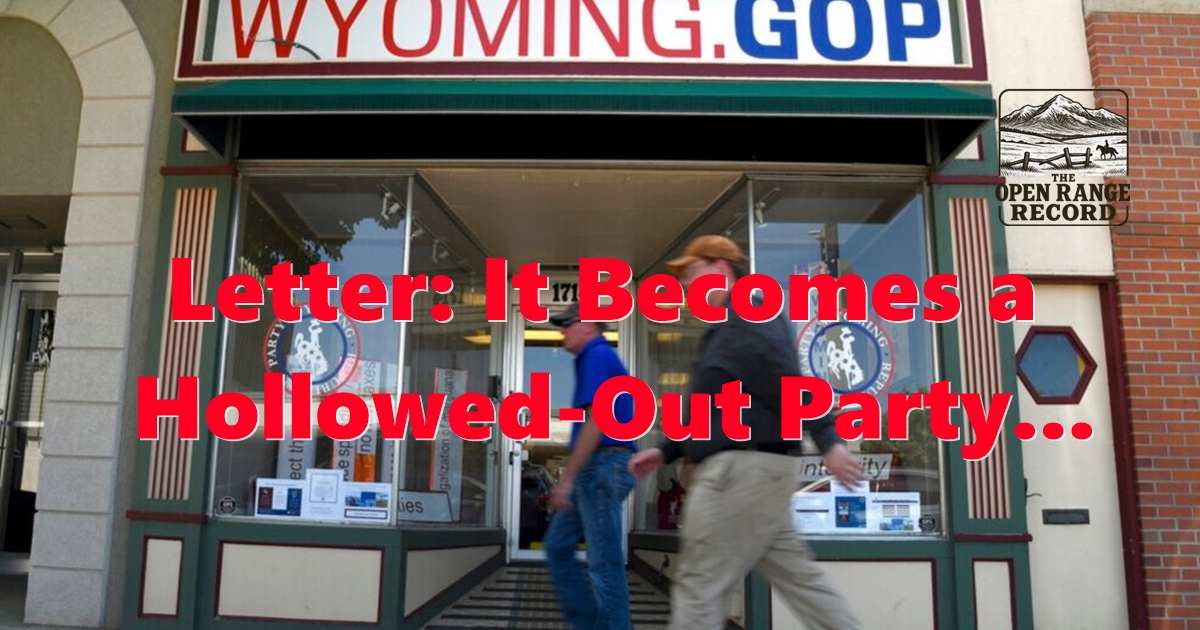
Wyoming Republicans are being told, with a straight face, that the party should be grateful for a system that lets just about everyone and his cousin participate in choosing the party’s nominees, while the party itself is expected to politely sit in the corner and applaud. That is not a healthy political structure. It is not a respectful one. And it is certainly not one that honors the basic idea of political association.
A primary election is supposed to be a nomination process. It is where a party chooses the candidates who will represent its principles, its platform, and its members in the general election. That is the theory, anyway. In practice, Wyoming’s state-driven system has turned the primary into something else entirely: the real election, the main event, the only contest that truly matters. By the time the general election rolls around, the outcome is often already decided, and everyone knows it.
That is not a coincidence. It is the predictable result of state interference.
When the state insists on controlling the rules of party participation, it does not merely regulate a process. It reshapes it. It weakens the party’s ability to define itself. It invites people into the nomination process who may have little or no real commitment to the party’s principles. Then, with a kind of bureaucratic smugness, it acts surprised when the party itself no longer has much power over its own future.
Well, yes. That is what happens when you take a private political association and treat it like a public utility.
The First Amendment says political association matters. The Fourteenth Amendment says the government does not get to casually trample constitutional rights because it has decided its preferred system is more convenient. Together, those protections mean a political party has the right to determine who belongs to it and how it chooses its nominees. That is not an exotic legal theory. It is basic constitutional common sense.
Yet in Wyoming, the party has too often been treated as if it were merely a branding exercise attached to a state-managed election machine. The state opens the process wide, narrows the party’s control, and then wonders why the party’s identity starts to blur. Apparently, if you let enough outsiders steer the ship, you should not be surprised when the crew loses the map.
The newly adopted Wyoming Republican Party bylaws are the first serious attempt to push back against that arrangement. They are not radical. They are not dangerous. They are not some wild attempt to overturn democracy, despite the dramatic language that will surely be deployed by people who seem to think “party self-governance” is a threat to civilization. In reality, the bylaws are a modest but necessary assertion of something very simple: the party should have a real say in who participates in selecting its nominees.
Imagine that. A political party wanting control over its own nomination process. How outrageous.
The truth is, if the Republican Party cannot control its own nomination process, then it is not really controlling anything at all. It is just providing a label for a state-administered procedure. The name remains Republican, but the authority does not. That is how a party gets hollowed out. Not with one dramatic blow, but with years of “helpful” interference, broadened access, and carefully managed rules that steadily erode the party’s ability to govern itself.
And that erosion has consequences. It creates a self-fulfilling system in which the primary becomes the only contest that matters, the general election becomes a formality, and the party’s own members are told that their role is to tolerate a process designed by others. That is not a victory for democracy. It is a retreat from it.
If Wyoming wants real political competition, it has to stop pretending that the current arrangement is normal. If it wants parties to mean something, it has to let them function like actual parties. And if it wants Republicans to remain responsible for Republican nominees, then it cannot keep forcing the party to surrender that authority to the state.
The new bylaws are not the end of the fight. They are the beginning. They are the first real step toward reasserting the constitutional rights that belong to political associations and toward pulling the party back from the heavy hand of government control.
That should not be a controversial statement. Then again, in politics, the obvious often becomes controversial the moment someone benefits from pretending otherwise.
Biffy Jackson
Uinta County