NEWS/OPINION
Wyoming’s 2026 legislative session opened with a striking divide, not between political parties, but within the state’s dominant one.
With only a small minority of Democrats spread between the House and Senate, the central conflict playing out at the Capitol is Republican versus Republican. It is a clash between competing visions of government itself: who it serves, how large it should be, and how accountable it must remain to the taxpayers funding it.
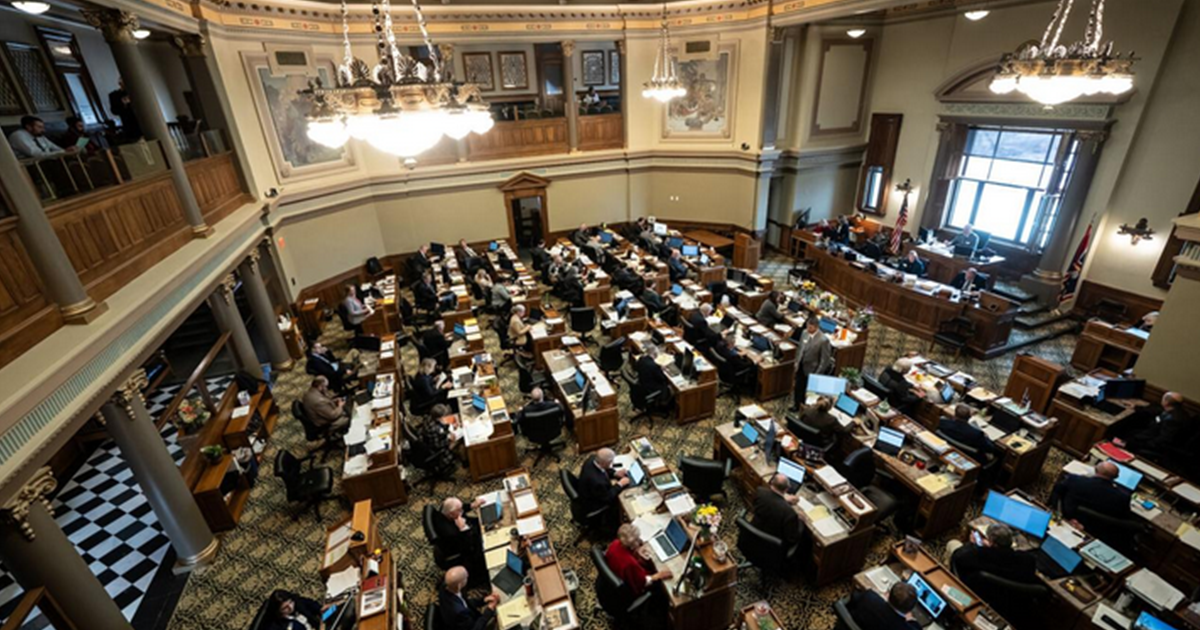
That divide was on full display Monday, as speeches from the executive and judicial branches were followed by a sharp Freedom Caucus response, and then by procedural votes that stopped debate on some of the session’s most consequential policy questions before they could even begin.
Three Branches, Competing Interpretations of Power
In his State of the State address, Governor Mark Gordon emphasized institutional stability, professionalized systems, and continued investment in state government. His remarks highlighted administrative efficiency, low error rates in public assistance programs, and the role of technology and state employees in preventing fraud, waste, and abuse.
The underlying message was continuity: Wyoming’s institutions are functioning, and measured government growth should be preserved.
That message hardened when the Governor referred to conservative lawmakers as “Club No,” a pointed jab at members of his own party who are openly pushing to rein in spending and cut back his proposed budget. The remark underscored a reality that has become impossible to ignore: the most consequential political divide in Wyoming is no longer partisan, but internal.
The Chief Justice’s State of the Judiciary address added another layer of tension. While much of the speech focused on court operations and access to justice, she directly addressed growing legislative criticism stemming from a recent abortion ruling. The Chief Justice framed that criticism as an effort to politicize the judiciary and warned against retaliation through budgetary or structural pressure.
Legislative critics see it differently. From their perspective, the controversy did not arise because lawmakers disliked a judicial outcome, but because the court crossed into policymaking, effectively legislating abortion policy from the bench, a responsibility constitutionally reserved to the Legislature. In that view, the dispute is not about punishing the judiciary, but about restoring separation of powers.
Those competing interpretations, executive defense of spending, judicial defense of independence, and legislative insistence on constitutional boundaries, set the stage for what followed.
The Freedom Caucus Pushes Back
Within half an hour, the Wyoming Freedom Caucus held a press conference responding directly to both speeches.
Caucus members rejected the premise that long-standing institutions should be insulated from scrutiny simply because they exist. They criticized unchecked spending, judicial overreach into policy decisions, and a governing culture they say has grown increasingly detached from working Wyomingites.
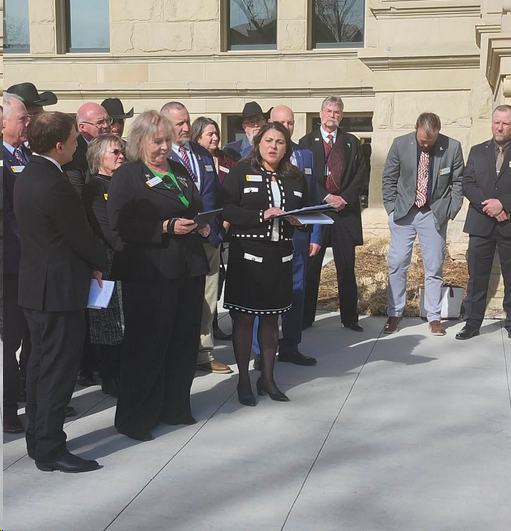
Unlike many long-time officeholders, Freedom Caucus members largely come from small business, trades, agriculture, and working-class backgrounds, not academia, not legacy institutions, and not professional political pipelines. Their focus is less on preserving government structures and more on affordability, accountability, and whether taxpayer dollars are being respected.
From that standpoint, Wyoming’s growing reserves are not evidence of good stewardship, but of over-collection. They argue that surplus funds should remain in citizens’ pockets whenever possible, rather than being absorbed into government budgets and savings accounts while families face rising costs.
That philosophical divide did not remain abstract for long.
From Rhetoric to Procedure
Later in the afternoon, the House and Senate took up consent agendas, a slate of committee bills drafted during the interim that required a two-thirds vote simply to be introduced.
Several high-profile bills failed to meet that threshold, killing them outright without hearings, debate, or public testimony.
Among them was one of the most consequential education measures of the session.
HB0110: School Finance Recalibration Blocked
House Bill 0110, the K-12 public school finance recalibration bill, failed to advance off the consent agenda.
HB0110 addresses Wyoming’s school funding model, a matter the Legislature is constitutionally required to maintain. Recalibration does not predetermine an outcome, but blocking the bill’s introduction prevents lawmakers, educators, parents, and taxpayers from publicly evaluating how education dollars are allocated.
That avoidance carries real consequences. If recalibration is not debated and resolved during the regular session, the issue does not disappear. School funding must still be addressed, meaning the Legislature risks being forced into a special session sometime this year (perhaps during campaign season) to deal with a problem it declined to confront now, at additional cost to taxpayers.
What drew particular attention was who voted to block introduction. Many of the “no” votes came from legislators with professional ties to education, current or former teachers, administrators, and others closely connected to the education system. Over the past several weeks, some of those same voices have publicly advanced their own characterizations of what the recalibration bill would do, while accusing others of dishonesty.
That makes the procedural kill especially troubling.
If lawmakers are confident in their position, the public debate should occur in the open. Parents, teachers, and taxpayers deserve the opportunity to read the bill for themselves, review the work of the recalibration committee during the interim, and decide who is accurately representing the facts and who is spreading misinformation.
Blocking the bill at introduction removes that choice from the public.
Calls to “fully fund education” ring hollow when the discussion required to do so is intentionally avoided, particularly in an election year, when recorded votes and public debate carry political risk.
Election-Related Bills Also Stopped
HB0110 was not the only bill blocked on the consent agenda.
Six election-related bills also failed to receive the
two-thirds vote required for introduction:
• HB0048 — Pen-and-paper ballots
• HB0049 — Prohibition of ballot drop boxes
• HB0050 — Prohibition of ballot harvesting
• HB0051 — Random hand-count audits of election results
• HB0053 — Poll watcher access and polling place observation
• HB0054 — Independent candidate requirements
Regardless of where one stands on these proposals, none were permitted to move
forward for committee consideration. There was no public testimony, no
opportunity for amendments, and no floor debate on election administration
policies that have drawn widespread public interest.
The same procedural tool used to block school finance recalibration was used to sidestep discussion of election processes altogether. All told, one side of the chamber blocked 18 committee bills from, not being voted on, but even talked about.
When Does the Public Get a Say?
At some point, Wyoming lawmakers will have to answer a basic question: why is honest debate treated as a threat?
These bills were not defeated on their merits. They were blocked before the public could hear them, before legislators had to defend their positions, and before voters could judge the arguments for themselves. That is not governance, it is avoidance.
Why can’t the Legislature have an open, on-the-record debate about how schools are funded?
Why can’t election policy be discussed in the light of day?
Why is procedure being used as a shield in an election year instead of policy
being tested in public?
The assumption behind these tactics is clear: that voters are not paying attention, will not read the bills, will not review the interim committee work, and will not notice who chose silence over transparency. That assumption is risky — and increasingly wrong.
If recalibration is unavoidable, then debate is unavoidable. School funding does not disappear because lawmakers refuse to discuss it; it only resurfaces later, more expensively and under greater pressure, often in the form of a special session taxpayers never asked for.
Wyoming does not lack engaged citizens. What it lacks, at times, is a Legislature willing to trust them with the truth.
If lawmakers believe they are right, they should be willing to make that case publicly, not hide behind consent agendas and procedural maneuvers. The people of Wyoming are not spectators in their own government. They are the ones paying the bills.
The only remaining question is when their representatives will start acting like it.