CHEYENNE — As the 2026 Wyoming Legislative Budget Session gets underway, a sharp legal debate has emerged regarding the use of taxpayer dollars to fund private professional associations. Internal research and a recent memorandum from the Legislative Service Office (LSO) suggest that hundreds of thousands of dollars are being paid annually by local governments to organizations that may lack the explicit statutory authority to receive those public funds. The scrutiny centers on whether these payments constitute an unconstitutional “donation” of public credit under the Wyoming Constitution.
A report prepared for Representative Scott Smith (R-Lingle) and circulated ahead of the 2026 session reveals that in fiscal year 2024, Wyoming local governments paid approximately $515,825 in membership dues to eight primary county government associations. At the state level, the figure is significantly higher, with agencies expending an estimated $3.2 million on association dues during the 2023-2024 biennium. While many of these payments are long-standing, investigators found that the majority of elected officials, including Cities, County Clerks, Sheriffs, Treasurers, and Assessors, lack direct statutory permission to use taxpayer funds for these memberships.
A Statutory “Short List”
Wyoming law is remarkably specific regarding who may join associations on the public’s dime. According to current statutes, only three distinct local entities are granted explicit authority:
- County Commissioners - W.S. § 18-3-522 Allows memberships for the "furtherance of good government."
- School Board Trustees - W.S. § 21-3-111(a)(x) Permits boards to join school board associations and pay dues.
- County Surveyors - W.S. § 33-29-305 Allows for certain professional memberships.
For officials such as the Wyoming Association of Sheriffs and Chiefs of Police or the Wyoming County Clerks Association, no such independent statutory shield exists. Instead, these groups often rely on the broader authority of the County Commissioners to pay dues on their behalf, a practice now being questioned by legal analysts.
The Constitutional Conflict
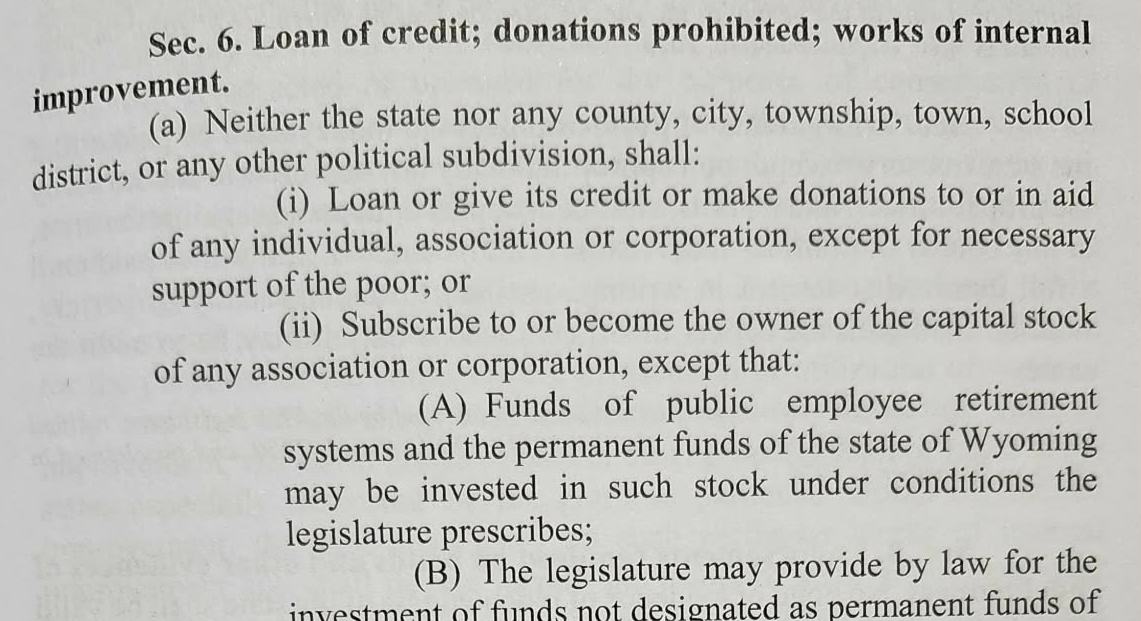
The legal challenge hinges on Article 16, Section 6 of the Wyoming Constitution, which prohibits the state or any political subdivision from making “donations to or in aid of any individual, association or corporation." The Wyoming Supreme Court has historically held in cases like Frank v. City of Cody that for a payment to a private entity to be legal, the government must receive “adequate consideration,” meaning a specific, contracted service in return. Without a fair exchange of value, such as a formal service agreement, the court viewed these transfers as unconstitutional gifts.
The current “membership dues” model rarely involves a formal service agreement. Proponents of a new bill, including Representative Marlene Brady (R-Green River), argue that without a procurement contract, these payments are essentially unconstitutional donations.
“Elimination of publicly funded associations prevents taxpayer dollars from being used to fund private entities that may prioritize their own interests,” Brady noted during the interim, highlighting concerns that these associations frequently use taxpayer-funded dues to lobby against legislative efforts supported by those same taxpayers.
The 2026 Legislative Effort
The proposed legislation would not ban officials from joining associations but would restrict the use of public funds for such memberships unless they follow strict procurement procedures. If passed, the bill would clarify that membership costs shall not be paid with county funds. Instead, associations would likely need to transition to a fee-for-service model, where they bid for specific training or legal services through a transparent contract.
The bill also seeks to address “travel and time” billing. Proponents argue that elected officials currently travel to private association events on the county’s clock and at the county's expense, an arrangement they contend is an inappropriate use of public resources for private association business.
As the session moves into its budget debates, the fiscal impact of these dues remains a central point of data. The LSO report indicates that for the 2025-2026 biennium, the Legislature has already approved over $138,400 in exception requests specifically for increases in professional association dues. The outcome of the proposed bill will likely set a new precedent for how “good government” is defined and funded in the Equality State, potentially ending a century of “membership-based” governance in favor of a stricter, contract-based approach.