NEWS/OPINION
The “People’s House.” Our Wyoming State Capitol is the seat of government, housing our Legislature, Governor’s offices, Secretary of State, and other administrative offices. While the governor has administrative authority over executive branch facilities and personnel, that authority does not extend over legislative spaces, judicial offices, or public forums traditionally open to citizens.
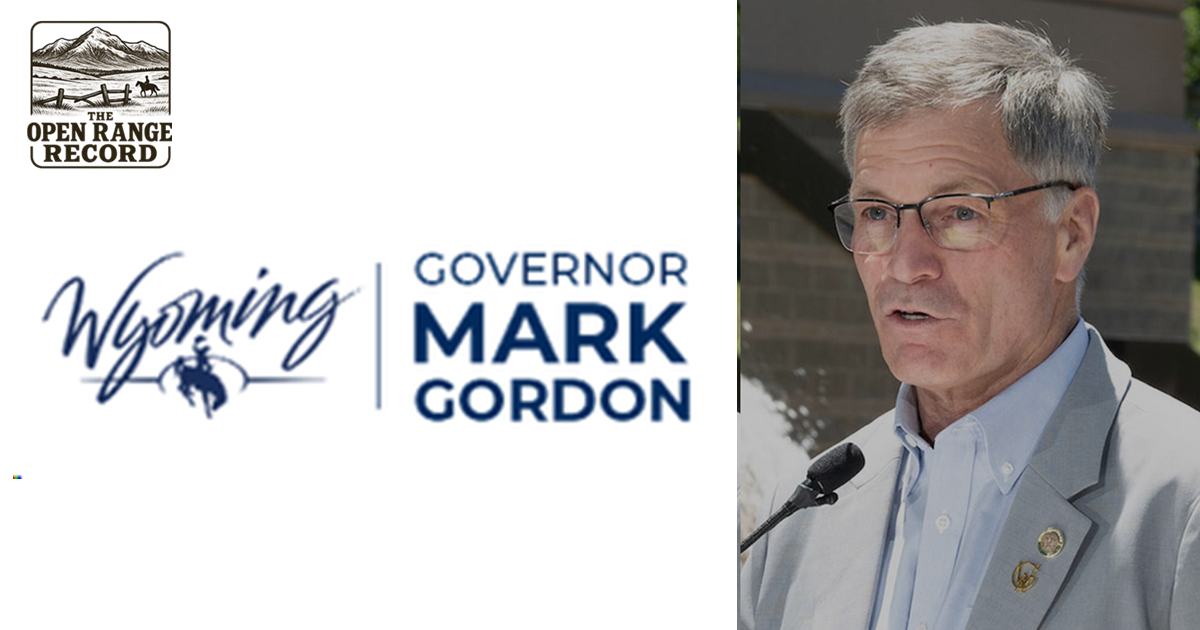
On February 17, 2026, Governor Gordon signed Executive Order (EO) 2026-01: prohibiting the solicitation, delivery, or acceptance of campaign contributions on property where state business is conducted, such as state office buildings and commercial buildings where the state leases offices, including the Wyoming State Capitol and Capitol Complex. This EO was in response to a campaign check being given to a legislator in the House chamber, after business was completed for the day.
If Governor Gordon’s executive order applies only to executive-controlled offices and agencies, he may have limited authority to regulate certain conduct. Public capitol grounds are public forums and are constitutionally protected. A blanket prohibition on campaign check exchanges, particularly if selectively enforced, could invite constitutional scrutiny.
The U.S. Supreme Court’s decision in Citizens United v. FEC (2010) fundamentally reshaped campaign finance law by holding that political spending constitutes protected speech under the First Amendment. While the government may regulate the time, place, and manner of political activity, it cannot impose arbitrary or viewpoint-based restrictions that burden core political expression.
A campaign contribution is a form of political expression. If Governor Gordon’s executive order effectively singles out political fundraising activity in public government spaces without a compelling governmental interest, it risks being challenged as unconstitutional. Restrictions designed to prevent corruption must be narrowly tailored. A sweeping ban raises the question: Is this about ethics or about optics?
In 2024, Gordon used his own personal PAC (Prosperity and Commerce) which was the largest fundraiser among Wyoming PACs at $290,350; keeping in mind, that Governor Gordon himself was not even up for re-election that year. Of that amount, $150,000 came directly from the governor himself. His PAC distributed campaign donations to numerous legislative candidates, totaling $105,000. He also personally contributed $33,481 to candidates across Wyoming.
These facts are significant. They demonstrate active and substantial involvement in shaping the composition of the Legislature through lawful campaign finance mechanisms. The question is not whether these donations were legal (they likely were), but whether the governor’s recent executive order banning campaign check exchanges in executive areas creates the appearance of selective ethics enforcement.
Where were these donor checks written? Where were campaign donations physically exchanged? Were any meetings, fundraising discussions, or contribution exchanges conducted on state property? These are fair questions voters may ask, not because contributing to campaigns is improper, but because leadership demands consistency.
Governor Gordon’s contributions to his PAC or to individual candidates, absent evidence of explicit quid pro quo agreements, fall under campaign finance, not bribery. However, when a governor characterizes certain fundraising practices as unethical enough to ban them on government property, the natural question arises: Is he implying that such exchanges inherently resemble bribery?
If so, does that implication extend to his own conduct? Or is the concern limited only to his political adversaries? The optics matter. An executive order framed as an anti-corruption measure, issued by a governor who personally infused $150,000 into his own political PAC and contributed tens of thousands more to candidates aligned with his policy goals, invites scrutiny under the principle of equal application of rules.
Selective Enforcement and “Rules for Thee, Not for Me” apply.
Critics argue that the executive order appears performative, a political gesture aimed at signaling ethical reform while targeting opponents. If legislators, lobbyists, or interest groups have historically engaged in fundraising activity on Capitol grounds without issue, why now?
Have lobbyists ever delivered contributions to legislators on state property? Have campaign events occurred at the Capitol or other state buildings? If so, were those activities deemed improper at the time? Selective enforcement erodes public trust.
The perception of “rules for thee, but not for me” undermines confidence in leadership. When a governor who actively funds legislative candidates aligned with his agenda issues restrictions that may disproportionately affect others, it creates the appearance of political maneuvering rather than principled governance.
This is not the first time Governor Gordon has faced criticism for executive action perceived as overreach. In 2025, he sought to restrict concealed carry to strictly defined public spaces within the Capitol complex, involving even the underground tunnel connecting the Herschler Building to the Capitol. The notion that constitutional rights fluctuate based on location, particularly in something as mundane as an underground tunnel struck many as patently absurd.
Constitutional protections, whether involving the Second Amendment or the First Amendment, do not evaporate in transitional spaces. This pattern raises broader concerns about executive attempts to regulate constitutional rights based on administrative preferences.
Political speech lies at the core of constitutional protection. Campaign donations, while regulated, are part of the political process. An executive order that broadly restricts the exchange of campaign checks in publicly accessible government buildings has already been ruled unconstitutional and should be judicially challenged.
For Wyoming voters and citizens, the core issue is not merely legality. It is integrity. Is Governor Gordon addressing genuine ethical concerns, or engaging in political theater? Are executive orders being used as tools of governance, or as instruments of partisan advantage?
The governor’s own substantial political contributions to candidates demonstrate a clear intent to shape legislative outcomes aligned with his goals. Governors nationwide support allies, but when such involvement coincides with new restrictions on fundraising activities in state facilities for his adversaries, it invites skepticism. Hypocrisy?
Ethics reform must be even-handed. If campaign checks are inappropriate in executive areas of the Capitol today, were they inappropriate yesterday? If fundraising on state grounds is problematic, should the restriction apply universally across all branches? Governor Mark Gordon’s executive order raises legitimate constitutional and ethical questions.
For voters and citizens, the issue is transparency. Ethical standards must apply equally. Constitutional rights must not hinge on administrative boundaries, political convenience, or utilizing government to restrict your opponents. Whether this executive order represents principled reform or political overreach will ultimately be judged not only in courts, but at the ballot box.
“Citizens of Wyoming deserve transparency in their government. They deserve confidence that the votes cast in their Capitol are grounded in policy and principle, not political or monetary transactions. This executive order is about protecting public trust.” Governor Mark Gordon (WY)