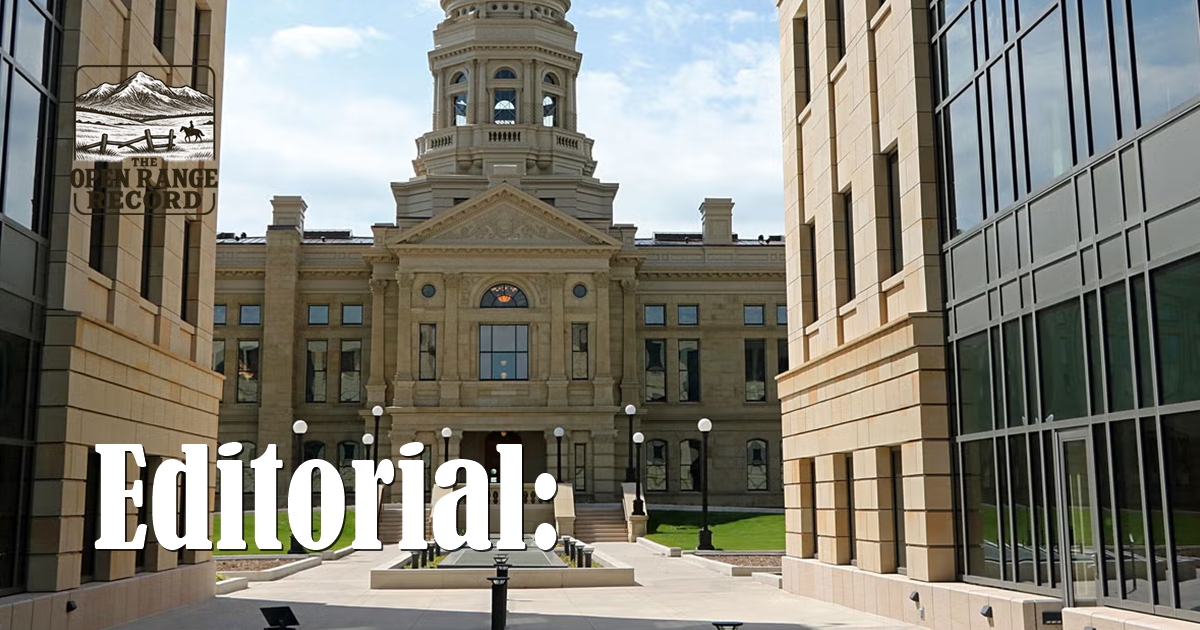
Wyoming has one of the most bizarre election laws still on the books—a statute that effectively tells a political party it cannot publicly support its own candidates during the most important election in the state. They can recruit people to their party, convince candidates to run, help register voters, hold campaign events, and espouse their platform. But they can’t tell you who agrees with their platform.
Wyoming Statute 22-25-104 prohibits a political party from spending money “directly or indirectly in the aid of the nomination of any one person as against another person of the same political party running in the primary election.” Violating the law isn’t just a regulatory matter. It carries criminal penalties of up to six months in jail and a $1,000 fine.
A Constitutional act cannot be criminalized. Yet this law does precisely that: it uses the power of the state to suppress an exercise of free speech. A private political organization can identify its principles in a platform and encourage people to register with the party. But once multiple candidates enter a primary, Wyoming law says the party itself must remain silent. It cannot spend its own private money telling voters which of those candidates actually support the party platform—the platform political parties are legally allowed to create.
Political Parties are not government agencies. They are private, voluntary associations protected by the First Amendment. Like any other private organization, they possess the right to speak, associate, and advocate for the ideas and individuals they believe best represent their mission.
The First Amendment was written to protect political speech, especially when it is inconvenient. Before the Revolutionary War, the British treated assemblies of three or more people as potentially unlawful if authorities decided they threatened the peace—when the government decided that speech was threatening.
James Madison himself treated peaceable assembly as a fundamental natural right essential to political liberty and the ability to petition government—precisely the kind of activity British authorities had sought to control or suppress in the colonies. In practice, Wyoming’s law is no different: it uses the power of the state to muzzle a private group’s ability to communicate its own principles.
This is Settled Law
In Eu v. San Francisco County Democratic Central Committee (1989), the United States Supreme Court struck down a California law that prohibited political parties from endorsing candidates in primary elections. The Court concluded that forcing political parties into neutrality violated both their freedom of speech and their freedom of association.
Rather than merely limiting endorsements, it criminalizes speech and the expenditure of party funds to support one candidate over another of the same party. In effect, the state is telling political parties they may have a platform—but they cannot tell voters which candidates support it. That doesn’t make any sense.
For most statewide and legislative offices, the primary election is the only one that matters. Whoever wins the party nomination frequently wins the general election. It is bizarre that Wyoming law ensures there is no scrutinizing of candidates in the primary election by the group that is best suited to evaluate them—the party itself. It doesn’t make any sense that the grassroots organization that developed the party platform is legally barred from evaluating who is abiding by that platform.
This law was clearly written by people who wanted to use the Republican brand but not abide by Republican principles; and certainly not be held accountable to them.
If the Sierra Club can endorse candidates, if labor unions can spend money supporting candidates, if chambers of commerce can publish scorecards, why can’t a political party identify which candidates truly represent the principles of that party?
In Wyoming, most “associations,” at least partly, operate on taxpayer dollars—the sheriff’s association; the Wyoming County Commissioner’s Association, Wyoming Association of Municipalities. These groups are legally allowed to endorse candidates with tax dollars. Yet, political parties, who operate entirely on private funding, cannot.
At its core, this statute compels speech through silence. It compels a private political organization to remain silent during the very election where its voice is most relevant. In the end, political parties must tacitly agree that anyone who claims to be a Republican is a Republican and therefore follows the platform—a proposition that is patently absurd.
The First Amendment exists precisely because government does not get to decide who gets to speak, and who does not—or when, most importantly, that political speech becomes inconvenient for those in power.
When the state threatens jail simply because a political party wants to tell its voters which candidates best represent their platform, it should alarm everyone. If it is true that there’s no limit to the state’s power to silence speech in an election, there’s no limit to its ability to regulate speech anywhere else. That is exactly why the First Amendment was written. Private organizations, like private Citizens, have the right to freely assemble and to freely speak. And it’s not for the government to dictate who, when or any of the subject matter; but Wyoming’s government fails this with impressive consistency.