In Wyoming, school funding debates tend to follow familiar lines. Property taxes, teacher salaries, and the divide between rural and urban districts dominate the conversation. The arguments surface, fade, and return each legislative session.
Earlier this year, something different entered that debate. Buried inside a school finance recalibration bill was a provision that had nothing to do with classrooms. It focused instead on insurance. For a brief moment, it exposed a system most Wyoming residents rarely see—one that quietly connects school districts, cities, and public agencies across the state through a shared financial structure.
It raised a simple question: How did something this large operate with so little public attention?
At the center of the system is the Wyoming Educators’ Benefit Trust (WEBT) alongside the Wyoming School Boards Association Insurance Trust (WSBAIT). On paper, they are self-funded insurance pools designed to help school districts manage the cost of employee health benefits. In practice, they are more complex.
The system was created in 1995 with a specific goal: to control rising insurance costs so more funding could remain in classrooms. Instead of purchasing insurance independently, districts joined together to pool risk, stabilize expenses, and build reserves over time. The model was built for Wyoming’s realities, where small populations and rural distances make sudden cost increases difficult to absorb.
Participants are not simply customers. They help govern the system, contribute to it, and build it over time. The scale becomes clear in district budgets.
In Uinta County School District #1’s published budget, employee benefits account for more than $9.3 million annually. That represents roughly one third of what the district spends on instruction and about 13 percent of its total budget. The district’s Employee Benefit Fund maintains reserves exceeding $1 million and operates with internal transfers and financial adjustments.
Those reserves are not abstract; they are built from employer contributions, employee premiums, and years when claims run lower than expected. According to materials published through the Wyoming School Boards Association Insurance Trust, those reserves are owned by participating districts themselves, not the trust as a separate entity. In that structure, districts are not simply paying into a system—they are collectively building and maintaining it.
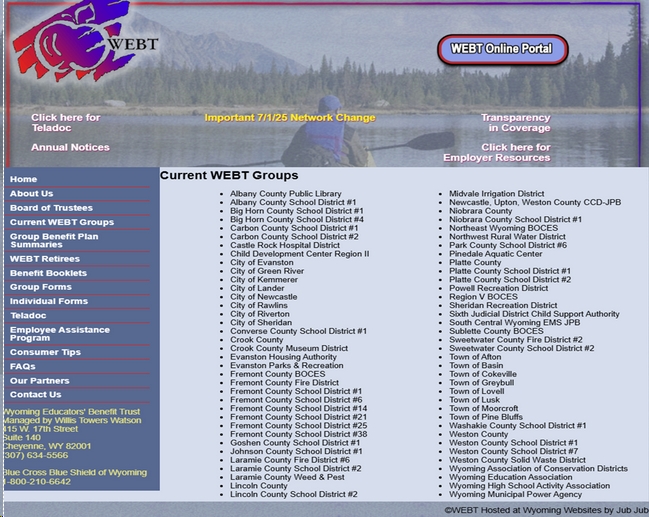
A review of participant listings from the Wyoming Educators’ Benefit Trust reveals something broader. The system is not limited to school districts. Cities such as Evanston, Green River, and Sheridan appear alongside multiple county school districts, as well as fire districts, irrigation districts, recreation boards, and statewide organizations. What emerges is not a narrow benefit plan, but a network of public entities tied together through shared financial infrastructure.
The more entities that participate, the more stable the system becomes, but stability comes with a consequence. The more interconnected a system is, the harder it is to unwind. Behind the trusts are additional layers.
Administration is handled through third-party providers such as UMR, a subsidiary of UnitedHealthcare. Data and compliance systems are managed through platforms like HealthSCOPE Benefits. Advisory support is provided by firms such as Willis Towers Watson.
Together, these layers form a structure that blends local governance with national infrastructure. It is not entirely local, and it is not entirely external. It is both.
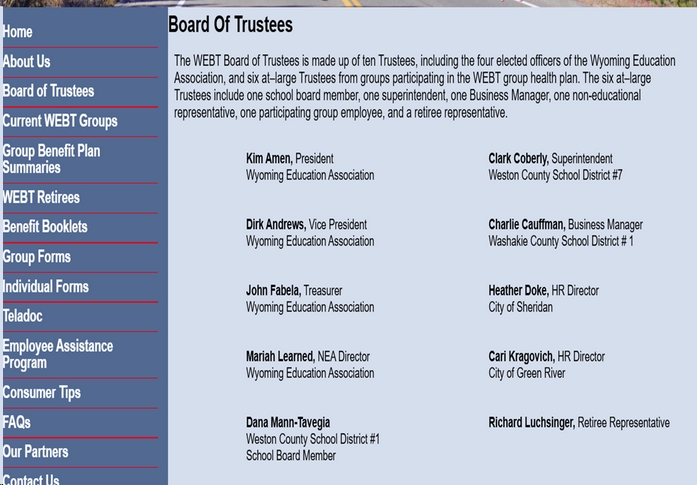
Governance adds another dimension. According to the WEBT Board of Trustees, leadership from the Wyoming Education Association holds formal roles within the system. That means the same organization publicly advocating education policy is also directly involved in overseeing one of its largest financial components. There is no evidence of wrongdoing, but the overlap is real.
Wyoming school districts do not all operate under a single model. In Sweetwater County School District #1, documentation shows a self-funded insurance structure where the district assumes financial risk and retains any surplus when claims run lower than expected. Other districts participate in pooled systems like WEBT, while some operate within more state-linked frameworks. The result is a landscape of different approaches to managing one of the largest cost drivers in education.
Financial records from other districts reinforce that pattern. In Sheridan County School District #2, budget documents show state funding accounting for the largest share of revenue, totaling nearly $34 million in actual collections—roughly double the district’s local revenue sources. At the end of the fiscal year, the district reported a positive net position of more than $3.1 million, indicating that revenues exceeded expenditures. The budget also reflects the use of internal transfers and statutory reserve categories, confirming that district finances operate across multiple funds and structures.
Public-facing summaries often present a simpler picture. In Sheridan County School District #2’s executive budget highlights, officials described a “healthcare transition” aimed at optimizing coverage while maintaining fiscal responsibility, alongside investments in staff compensation and student outcomes. The language is familiar—focused on stability, improvement, and efficiency. Behind those summaries, however, sits a more complex financial structure involving layered funding sources, reserves, and system-wide coordination.
The contrast is not contradictory, but it is revealing. The debate over school funding is often framed as whether districts receive enough money. But underlying that conversation is another question: how much control the state should have over how that money is structured and spent.
School districts publish budgets and undergo audits, and those records are publicly available. At the same time, major cost drivers such as employee benefits are often managed within locally governed systems that maintain their own reserves and financial frameworks. For some lawmakers, that raises questions about consistency and oversight. For districts, it reinforces the argument for flexibility and local control.
It is not a clear conflict, but it is a clear tension which came to a head during the 2026 legislative session. House Bill 110 included a provision requiring school districts to join the state-run health insurance plan. On paper, it appeared to be an adjustment. In practice, it represented something much larger.
The change would have required districts to leave systems built over decades and enter a centralized model managed at the state level, shifting control of a major cost driver out of local hands. The Wyoming Education Association publicly opposed the measure, stating, “No mandate to join the state health insurance plan.”
In survey responses collected by the Wyoming Legislature, multiple districts warned that joining the state plan would significantly increase costs. One district estimated increases between $500,000 and $700,000 annually, while another projected a 27.5 percent increase. Others described the proposal as cost prohibitive and warned it would have a significant impact on educational services.
The bill failed introduction on a 41–21 vote. Its failure did more than preserve the system; it revealed it. It showed how deeply embedded the insurance structure is within Wyoming’s public institutions, how many entities are tied into it, and how difficult it would be to replace. Because once a system like this is in place—funded, governed, interconnected, and relied upon—it does not simply adjust, it resists.
Wyoming’s school insurance system is not hidden. The documents are public, the structure is visible, and the participants are listed in plain sight. And yet, for many residents, it remains largely unseen.
That may be the most important point of all. Because when a system grows this large, this interconnected, and this central to public funding, it raises one final question: Who truly understands the systems shaping the cost of education—and who decides when, or if, they change?