Canyon Road was never just one company, one parcel, or one promise.
Canyon Road arrived in Kemmerer the way modern development often does, quietly at first, then all at once. It was wrapped in polished language, layered LLCs, glossy websites, and the sense of urgency that always accompanies federal money on the horizon. With housing shortages mounting, infrastructure stretched thin, and TerraPower on the way, citizens were told there was no time to slow down. The county had to move fast or miss the moment.
But when you slow the story down — when you line up the deeds, the liens, the mortgage release, the county resolutions, and the voucher that cut nearly a million dollars loose — you start to see something else entirely.
Not a housing project struggling to get started, but a financial structure that keeps moving forward even when the dirt doesn’t. And once you see it, you can’t unsee it.
Where Canyon Road really begins
Canyon Road Holdings, LLC did not originate in Wyoming. According to filings with the Wyoming Secretary of State, it was formed as a Delaware LLC in May of 2022. It reported that it began doing business in Wyoming on May 23 of that year. Its Wyoming registration followed shortly thereafter. That timing matters because Canyon Road didn’t step onto the scene alone.
Before the name “Canyon Road” became familiar in Kemmerer, another company was already acting as its public face: Rain Fire, LLC, fronted by David Jackson. Jackson spoke publicly in 2022 about helicopters, emergency response services, veteran-hiring pipelines, and large-scale contracts. He positioned himself as the kind of operator counties are often encouraged to trust: decisive, confident, impatient with bureaucracy.
But Rain Fire was never separate from Canyon Road. From the beginning, Jackson was listed as the registered agent for Canyon Road Holdings, LLC. And even after Jackson later disappeared from public view — after the promises unraveled and questions mounted — his name remained on Canyon Road’s official filings, including as recently as the 2025 annual report signed by another principal.
If Jackson had truly been cut loose, the paperwork never reflected it. That detail alone doesn’t accuse anyone of anything. But it does raise the first of many questions this story refuses to let go.
Two land deals, two very different trails
Canyon Road’s footprint in Kemmerer wasn’t acquired all at once. The first acquisition was the north parcel near the cemetery, purchased from Star One, LLC. The warranty deed was signed on May 6, 2022, and was recorded on May 23, 2022 — almost exactly when Canyon Road reported starting business in Wyoming.
This is the land where dirt would be moved later that year. The second acquisition — the one that anchors the entire financial story — came on August 30, 2022. On that day, Canyon Road Holdings acquired approximately 291 acres from 290, LLC, accompanied by a mortgage showing a stated purchase price of $3.8 million, with 290, LLC holding the mortgage.
Public records show that Jerry Greenfield, Lincoln County Treasurer, was a managing member of 290, LLC at the time of the transaction. That fact does not prove wrongdoing, but it does establish overlap. The same official responsible for county finances and grant processes was tied to the private entity financing the land that would soon become the centerpiece of county-backed development efforts. And that overlap never disappears from this story.
When the dirt moved — and the money stopped
In September and October of 2022, contractors began earthwork on the north Canyon Road parcel (the one acquired from Star One, LLC). Local companies did the work. Invoices were issued, and then payments stopped.
As a result, WyoD Construction and Chapin Construction filed liens against the property. These weren’t rumors, they were recorded facts — formal declarations that work had been performed and not paid for.
The liens were released in March 2023, confirming that the contractors were ultimately paid. The lien releases themselves, however, do not disclose who made the payments or how the obligations were satisfied.
Multiple individuals with direct knowledge of the transactions have stated that the liens were resolved through electronic transfer rather than by a paper check. Because lien releases do not require disclosure of the payer or payment method, the public record documents the outcome, but not the source of funds.
What the public record does not show is Canyon Road independently deploying clearly identifiable private capital before those obligations were resolved. Instead, it shows debts lingering then clearing without a documented source of funds.
One month later, in April 2023, a mortgage satisfaction was recorded and signed off by Jerry Greenfield, stating that the $3.8 million mortgage held by 290, LLC for Canyon Road Holdings, LLC, had been paid in full.
The sequence matters:
- Contractors went unpaid through late 2022.
- Liens were filed.
- Liens were released in March 2023.
- The mortgage was satisfied in April 2023.
What the public record does not show is Canyon Road independently deploying clearly identifiable private capital before those obligations were resolved. Instead, it shows debts lingering then clearing without a documented source of funds. That absence does not establish wrongdoing, but it does establish financial opaqueness.
The EMS pitch and the $500 million claim
At the February 7–8, 2023 Lincoln County Commissioners Meeting, David Jackson’s ambitions had grown. He appeared before the Lincoln County Commission proposing that Rain Fire take over emergency medical services in South Lincoln County, removing EMS oversight from the hospital district. He spoke of sweeping reforms and referenced massive financing, including a claimed $500 million arrangement involving the Cherokee Nation.
Commissioners responded cautiously. They noted that any such arrangement would require a written contract, legal review, and further discussion. No contract was approved. No public record substantiates the claimed $500 million financing arrangement. Cherokee Nation loan programs, which are structured and eligibility-based, are publicly documented elsewhere.
After the EMS pitch, momentum shifted
Following the February 2023 EMS presentation, Jackson’s public presence in Kemmerer began to recede. The proposals he advanced did not move forward. No contracts were executed. His appearances before local governing bodies became less frequent.
This period appears to mark an inflection point. Within weeks, contractor liens were resolved, the Canyon Road mortgage was satisfied, and Jackson’s role in public discussions diminished. By mid-2023, he was no longer publicly advancing projects in the community. The dirt stopped moving, but the project did not.
The City said no. The County kept going.
During the same period, the City of Kemmerer took a more skeptical approach. Jackson, through Rain Fire, leased office space in the former Kemmerer City Hall building. According to sources familiar with the arrangement, the lease later went into default before Jackson left town.
Jackson also sought to lease space at the Kemmerer airport to stage firefighting equipment and operate a helicopter fleet. City officials conducted due diligence and attempted to verify the contracts Jackson claimed Rain Fire held with government agencies. It ultimately declined to proceed when those claims could not be substantiated. In short, the City asked for proof and did not move forward without it.
Lincoln County followed a different track. Rather than coordinating assessments, the City and County moved forward on separate sets of railroad tracks, One demanded verification before commitment, the other continued engagement that would later translate into public financial exposure.
By mid-2023, Jackson vanished from public view. There was no public explanation, no formal separation, no amendment removing him from Canyon Road’s structure. He simply disappeared, and Canyon Road moved on.
The polished partners step forward
After Jackson faded from public view, Canyon Road did not collapse. It was rebranded. This is when Sean Coyle, Chris Mooney, and Mark Germaine emerged as the public-facing stewards of the project. Coyle is associated with Canyon Road Holdings, SNC Investment Partners, Cider Moon Investments, and Gateway Development – Kemmerer.
Mooney is likewise associated with Canyon Road Holdings and Cider Moon Investments. He has stated to sources that taxpayers were not funding infrastructure — a position that contrasts with the County’s later pursuit of grants, loans, and housing funds tied to the project.
Germaine is associated with Canyon Road Holdings and 18 Squared, an investment firm that markets projects using Opportunity Zone–style language focused on density and capital deployment, even though Kemmerer itself is not designated as a federal Opportunity Zone. The faces changed, though the financial structure did not.
When the County becomes the applicant
In early 2024, the Lincoln County Commission adopted a series of resolutions authorizing applications for state grants and loans tied directly to Canyon Road’s infrastructure. One resolution sought approximately $1.24 million from the Federal Mineral Royalty Capital Construction Account to fund engineering and design work, with “private funds” from Canyon Road and Gateway listed as the match. That application was denied.
Another resolution authorized submission of a $64.7 million construction loan application to the State Loan and Investment Board to build water, sewer, streets, and storm infrastructure supporting Canyon Road’s development. It was explicitly linked to economic development associated with TerraPower. That resolution was amended to a $17 million ask two weeks later.12
A review of publicly available SLIB agendas, packets, and meeting records from 2024 and 2025 does not show evidence that the amended $17 million application was ever formally submitted or considered.
This leaves these simple questions:
Was Canyon Road’s progress ever driven by private capital deployment?
Or was it tethered to public funding that never materialized?
When Federal relief was redirected to affordable housing
By late 2024, Canyon Road’s progress remained stalled. Private capital had not moved the project forward. That is when ARPA and Local Assistance and Tribal Consistency Fund (LATCF) money entered the picture.
LATCF funds had already been allocated internally for immediate county needs, including county road maintenance and approximately $300,000 for a new Road & Bridge snowblower, with total Road & Bridge–associated LATCF allocations exceeding $430,000.
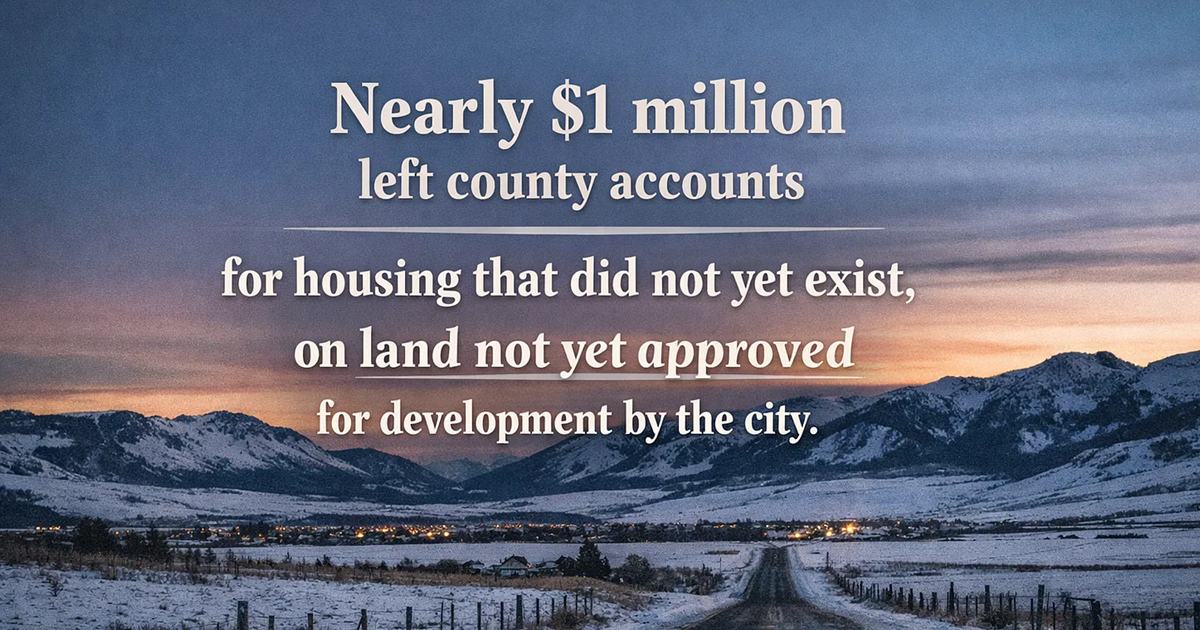
These were not idle dollars. They were budgeted for shovel-ready public purposes. Yet a voucher dated February 28, 2025, shows those same LATCF funds — roughly $820,000 — being aggregated and combined with ARPA funds to create a $934,980.90 payment to Canyon Road Holdings under an affordable housing agreement.
At the March 4–5, 2025 Commission meeting, the County Clerk asked whether costs previously allocated elsewhere could be amended. According to the official minutes, the Deputy County Attorney responded that the Treasurer had already reported the funds to the federal government and that changing uses would “draw a red flag.” By early March, the decision had already been operationalized.
The opportunity cost the County actually paid
The Road & Bridge needs did not disappear. Once the LATCF funds were reclassified and committed to affordable housing, the County was forced to purchase the snowblower using general reserve funds, shifting the burden elsewhere in the budget.
In effect, the County paid twice: first by losing flexibility in LATCF funds earmarked for immediate infrastructure, and again by drawing down reserves to meet unavoidable operational needs. By contrast, the nearly $1 million paid to Canyon Road Holdings has, to date, produced no immediate public benefit. No roads were improved; no infrastructure was installed. No housing units were built; no construction jobs were created.
“Clerk Brunski further asked for clarification if the agreement will be amended to back off the cost of the snow blower that was obligated. Austin Dunlap, Deputy Attorney, commented probably not based on the Treasurer’s explanation that he has already submitted the report to the Federal Government committing the funds to affordable housing and that amending it now would draw a red flag to change uses.”
Affordable housing on paper, not yet on the ground
The affordable housing agreement committed nearly $1 million in public funds to support six units. This comes to roughly $166,000 per unit, under a federal framework allowing affordability up to 120% of Area Median Income (AMI).
At the same time, Canyon Road’s original broader housing vision included small-lot, single-family homes priced around $400,000, with all-electric construction in a Wyoming climate. The affordability is narrow, and the execution remains theoretical.
Zoning, the letter, and what did — and did not — happen next
On May 27, 2025, the Kemmerer City Council approved zoning changes allowing higher-density development on two Canyon Road parcels — one rezoned from agricultural to multifamily use, and one from single-family to multifamily use.
On May 28, 2025, Canyon Road Holdings sent a letter to Treasurer Jerry Greenfield outlining a proposed construction timeline. According to sources familiar with the process, only a preliminary plat has been submitted. A final plat has not been submitted, no infrastructure installation has begun, and no visible construction has occurred. Canyon Road’s timeline letter promised movement. The ground has remained quiet.
Quick Explainer: ARPA and LATCF Funds
ARPA (American Rescue Plan Act)
Federal COVID-relief money sent to counties to stabilize budgets, support essential services, and address pandemic-related economic and housing impacts. These were one-time federal dollars, not recurring funds, and once spent, they’re gone. Counties were allowed flexibility, but ARPA funds were intended to address demonstrable public need — not speculative private development.
LATCF (Local Assistance and Tribal Consistency Fund)
Federal assistance created to help counties affected by changes in federal land and energy policy. LATCF funds were meant to support core public services and infrastructure in energy-impacted communities. It was not designed as a developer subsidy, especially for projects without approved plans or active construction.
Why it matters here:
Both ARPA and LATCF funds are public taxpayer dollars. When they’re used for private-adjacent development, the timing, approvals, safeguards, and performance requirements matter — because if a project stalls, the public money doesn’t come back.
County signals before the City conversation
At the October 21, 2025 Lincoln County Commission meeting, Mary Crosby, the County’s grant writer, discussed a potential land transaction near the Justice Center. She framed it as land positioning for future development rather than a finalized sale or manufacturer-specific project.
What the City said next — on the record
Public understanding of what followed comes largely from SVI Media morning interviews with Kemmerer City Administrator Brian Muir.
- In November 2025, Muir publicly referenced a modular home manufacturer, identified as Cuby.
- In December 2025, he stated that a preliminary plat for housing at the Gateway portion of Canyon Road had been approved — not a final plat.
- In January 2026, he again discussed housing, the manufacturer, and the possibility of a City land sale near the Justice Center.
A preliminary plat allows planning to continue. A final plat is required before infrastructure or construction can proceed.
An open question the record still doesn’t answer
Multiple sources familiar with early discussions have indicated that Mark Germaine, through Canyon Road Holdings, was initially involved in conversations about a modular home manufacturing facility.
The timeline is consistent:
- County land discussions first
- Manufacturer named later
- City land-sale discussion last
What remains unclear is how the land transaction is intended to work. Is Canyon Road assembling land to later sell or lease? Is the manufacturer negotiating directly with the City or County? If Canyon Road is an intermediary, what role does it play before a manufacturer commits?
Nothing in the public record had answered that question until the January 12, 2026 Kemmerer City Council meeting provided additional insight into where this may be heading. Stay tuned — I will publish a follow-up piece shortly.
The question that remains
No one disputes that Kemmerer needs housing. What remains unanswered is why it appears public money is moving before private investment without proof of performance. Why are county departmental funds reclassified after the fact, and why are reserve accounts being dipped into because money is moving from one funding source to a private company?