
Recently, I’ve paid thousands of dollars to obtain public records from the Town of Jackson and the City of Casper. After combing through countless documents, I’ve held three town halls to inform the public about what I learned.
One of the most disturbing things I discovered was how private East Coast and Japanese equity firms receive full property tax exemptions on supposed “low-income” housing complexes across Wyoming. This is due to misleading county exemption applications and secret organizational structures. Senator Cheri Steinmetz is now sponsoring a bill to definitively end this practice, which would never have been disclosed without the expensive public records requests.
However, the Town of Jackson continues to thwart the release of key pieces of information. They have even hired an outside legal firm to take up the fight. The town does not want you to know who or why someone requested an update to an operating agreement for a controversial housing complex built at the Teton County Fairgrounds, three years after it was initially signed.
They don’t want you to know how much we pay BlueLine Development to plow 45 town-owned parking spots. Or who got paid, and how much, in $4 million in “other costs” for a construction project. They have withheld countless documents related to the Mercill Condos project for unknown reasons.
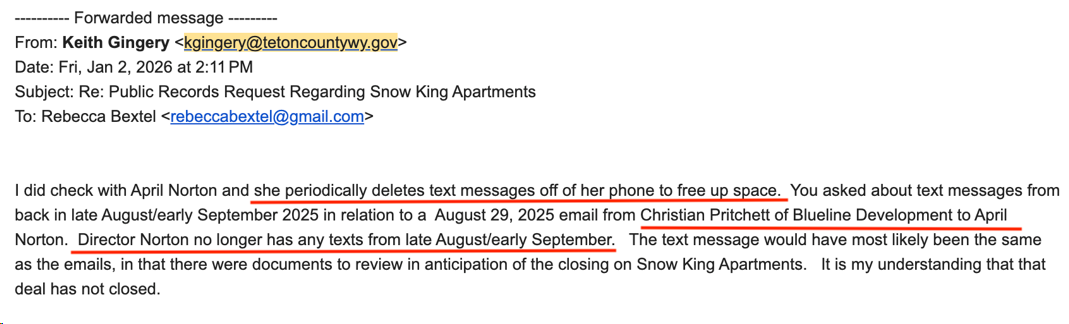
In the past, Teton County has released requested documents, but recently I was informed that the Director of our Teton County Housing Authority deleted all texts with BlueLine Development to “free up space on her phone,” though millions of dollars in real estate deals were conducted on behalf of the public. The county seems to have not taken a single step towards recovering the text messages from the carrier or cloud.
The most flagrant agency I have ever dealt with is the Wyoming Community Development Authority. Despite being a fully taxpayer-funded program, they recently released just three documents after an eight-month battle. At one point I was told I could pay $12,000 to see contracts and documents, but everything I am looking for would be redacted.
The WCDA does not want you to know how much these developers and consultants are being paid to facilitate “low-income” housing across Wyoming, or what the “low-income” requirements actually say. However, nearly every other state makes this information readily available. Information obtained online with HUD’s own website suggests this information can be accessed through the individual state housing authorities, yet the WCDA continues to stonewall.
The state’s ombudsman, Darlena Potter, has spent countless hours trying to broker the information on behalf of the public. Secretary of State Chuck Gray and Superintendent Degenfelder have sent emails requesting information. Recently, the WCDA’s Executive Director, Scott Hoversland, told Superintendent Degenfelder that she could access the contracts for $100 each, but all payment amounts would be redacted.
State Auditor Kristi Racines had a lengthy call with Director Hoversland over my public record requests to no avail. She also confronted Mr. Hoversland about the WCDA’s constant denials of requests on the 30th day deadline.
I was able to obtain two contracts from these housing projects through other local avenues. They revealed that BlueLine Development was paid $1 million to develop the Flat Creek Apartments, and $2 million to consult on the Hitching Post housing project in Jackson. In some cases, they even hired companies owned by BlueLine’s “developers” to construct the buildings, as was the case at the Juniper Ridge Apartments.
The Casper Housing Authority is nearly as bad as the WCDA. They have been blocking requests for months and have seemingly even tried to intimidate private citizens who have spoken publicly about their housing projects. The only document the CHA has produced was a redacted operating agreement for the Liberty Square Apartments, which is currently owned by Boston Financial and managed by the CHA. This contract requires the CHA to complete property tax abatement applications and appeals.
The Wyoming Supreme Court has been clear that “state agencies must act in a fishbowl” (see Laramie River Conservation Counsel v. Dinger). In other words, the Wyoming Public Records Act requires governmental entities to disclose virtually all operations and documents with few – and narrowly tailored – exceptions.
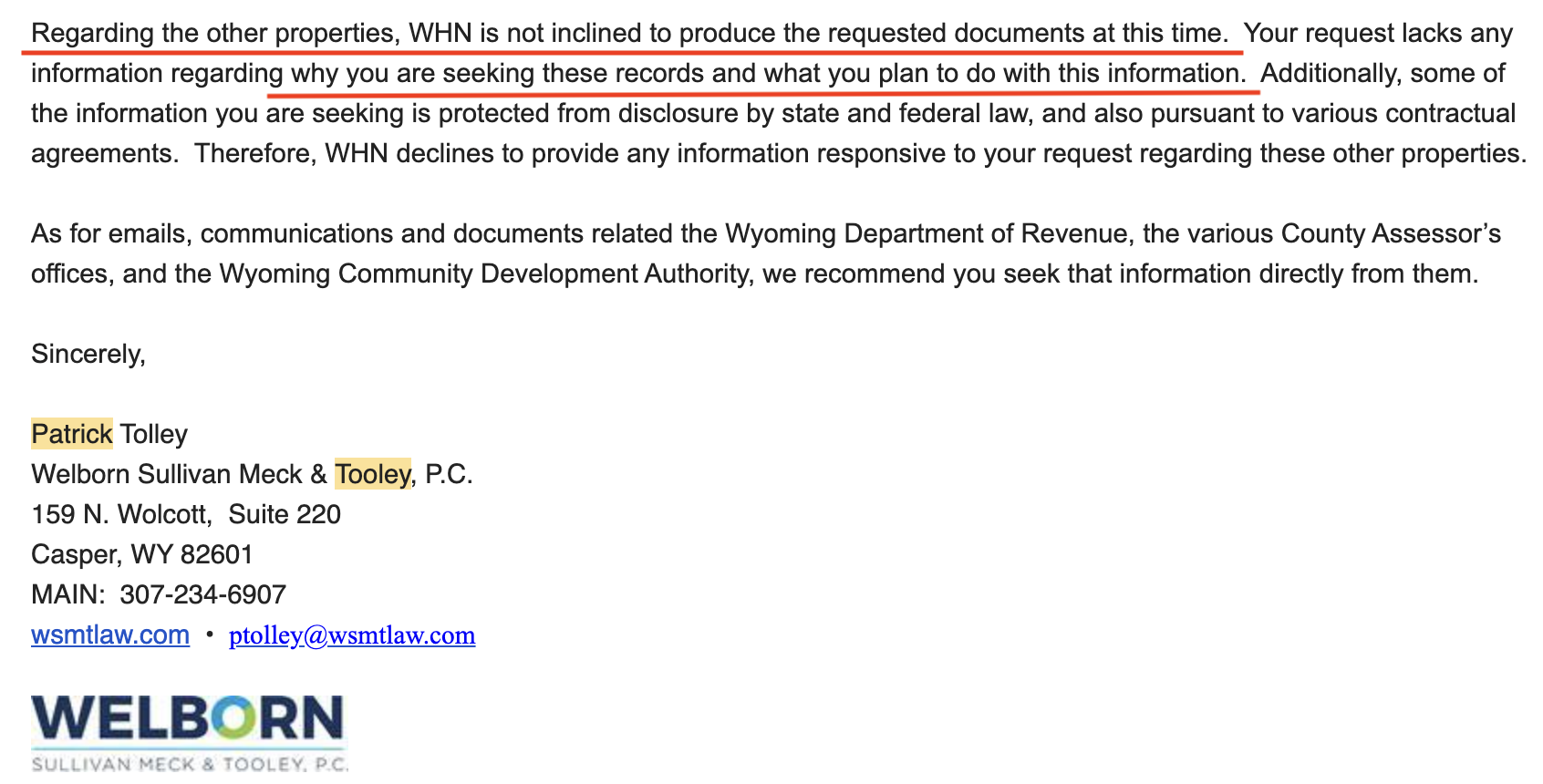
Current state statutes require the agency for whom the request is made to acknowledge receipt within 7 days, then the information must be produced within 30 days. If this is not adhered to, a complaint can be filed with the ombudsman, but Ms Potter has no enforcement mechanisms.
So, what currently happens when an agency does not comply? Nothing. This forces the public into expensive legal fights through the courts. I have already spent thousands of dollars on legal fees, however my court cases with the Town of Jackson, Teton County, Wyoming Community Development Authority and Casper Housing Authority are just getting organized.
I am pushing for legislation to require those individuals to be held personally accountable when they do not comply with the Wyoming public records statutes. I am also asking for the plaintiff’s legal fees to be covered when the courts rule in their favor. More must be done to strengthen the public’s ability to know what their government is up to.
Editor's note: Rebecca Bextel is a part owner of The Open Range Record.