NEWS
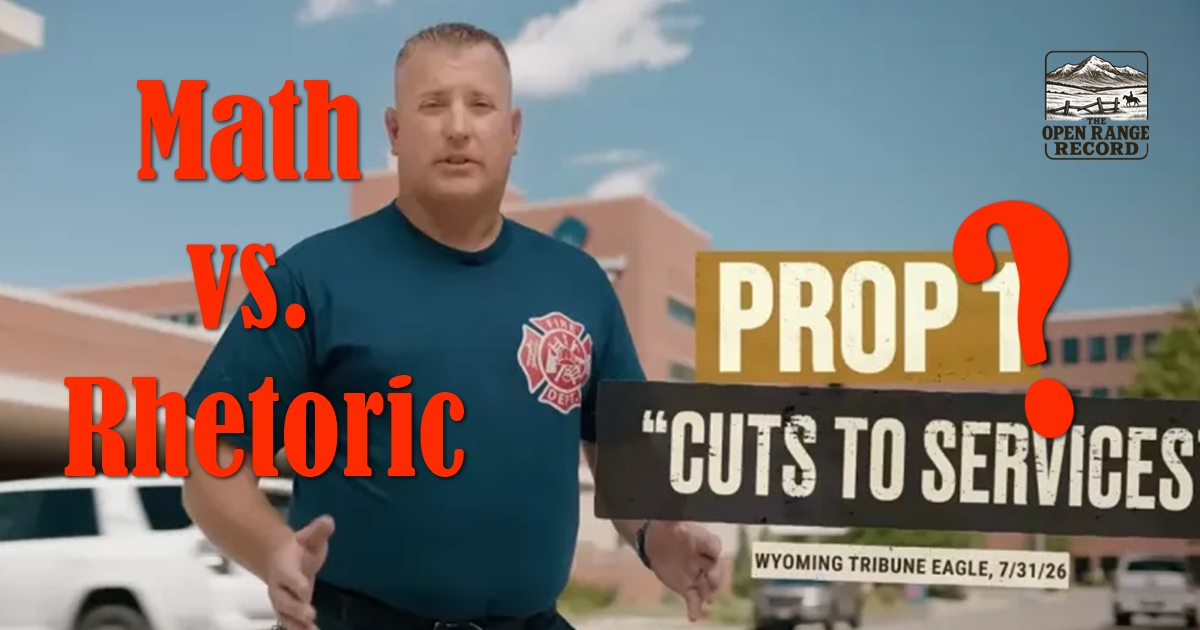
As the November election approaches, Wyoming voters are facing intense opposition campaigns regarding Proposition 1, a citizen-initiated ballot measure that proposes a fifty percent property tax exemption on primary residences. Opponents warn that cutting residential assessments will cripple local government services and leave county budgets in ruins. However, a direct examination of the underlying mathematical framework and recent county revenue shifts presents a very different picture.
Under Proposition 1, the proposed tax reduction applies specifically to primary, owner-occupied single-family homes and their surrounding land. It does not extend to commercial operations, industrial developments, mineral production, second homes, or corporate rental portfolios. Wyoming calculates residential property taxes by taking the fair market value, multiplying it by the state assessment rate of 9.5 percent, and then applying local mill levies. For a single-family home valued at $300,000 in a county with a standard 68 mill levy, the current assessed valuation sits at $28,500, resulting in an annual tax bill of $1,938.00.
Under Proposition 1, the exemption cuts that assessed valuation in half to $1,4250, which reduces the annual bill directly to $969.00. This delivers targeted financial relief to working families and fixed income seniors who have faced rapid valuation increases in recent years.
Opponents argue that halving primary residential property assessments will force drastic cuts to essential county functions. Yet this warning ignores how Wyoming structures its local tax base. In most Wyoming counties, primary residential property makes up only a fraction of total assessed valuation, while commercial properties, industrial facilities, utilities, and mineral production account for the vast majority of local revenues.
Because Proposition 1 leaves these non-residential property classes completely untouched, the broader commercial and industrial tax collection base remains fully intact. Furthermore, county reserves and school funding mechanisms rely heavily on state revenue sharing and mineral severance distributions rather than residential property taxes alone.
When county agencies claim they are facing severe budget crunches, the cause often lies in federal grant timelines rather than local property tax shifts. During recent years, counties across Wyoming received millions of dollars through the federal American Rescue Plan Act. Local governments used these temporary federal cash injections to expand operational budgets, fund equipment purchases, and support local projects.
As those federal relief dollars expire, local jurisdictions are experiencing automatic budget drops. In Hot Springs County, for instance, public discussions arose after officials had to trim $1.2M dollars from local budget projections. Research into county revenue sources revealed that the required reduction lined up directly with the loss of expiring federal funds, rather than any decline in local tax collections.
As voters weigh Proposition 1 on their ballots, isolating temporary federal relief shifts from structural tax policy reveals that the proposed fifty percent exemption provides targeted relief to homeowners without dismantling the foundational industries that fund Wyoming communities.