NEWS
Wyoming produces far more crude oil than we could ever burn no matter how many of us own pickups. Yet Wyoming drivers are paying roughly the national average for gasoline. As of September 25, regular gasoline averaged about $4.55 a gallon in Wyoming, compared with roughly $4.49 nationally. Diesel was above $6 a gallon. A year earlier, in Wyoming regular gasoline was still in the low $3 range.
It is tempting to explain the entire increase with Iran, the Strait of Hormuz, and a global crude market that has pushed oil prices higher. That explains why gasoline is expensive in 2026. It does not explain why Wyoming — one of the nation’s major oil-producing states — has no meaningful home-field advantage at the pump.
The answer begins with a distinction that often gets lost whenever Wyoming is described simply as an “energy state.” Crude oil is not gasoline. A barrel coming out of the ground in the Powder River Basin does not become regular unleaded at the Co-op in Sheridan merely because both happen to be in Wyoming.
Wyoming Has Plenty of Oil. Refining It Is Another Story.
Wyoming’s four operating petroleum refineries can process about 127,000 barrels of crude oil per day. These are: HF Sinclair’s refinery at Sinclair, with roughly 75,000 barrels per day of capacity; that company’s Casper-area refinery at Evansville, at about 31,000; Wyoming Refining Co. in Newcastle, at about 18,000; and Silver Eagle in Evanston, at roughly 3,000.
Wyoming crude production is more than twice that. State production averaged roughly 289,000 barrels per day in 2025, with monthly production during the first half of 2026 generally running between about 277,000 and 298,000 barrels per day.
Wyoming drivers, meanwhile, consume comparatively little gasoline. State figures put 2024 motor gasoline consumption at about 8.4 million barrels for the entire year — roughly 23,000 barrels per day. Colorado, on the other hand, consumed 151,000 barrels per day in 2024 while only producing roughly 49,000 barrels of refined gasoline.
That produces a striking statistic: Wyoming pumps more than 10 times as much crude oil as its residents consume in gasoline. But that does not mean Wyoming has 10 times more gasoline than it needs.
Like just about every other mineral Wyoming produces, most of that crude is sold into a much larger petroleum market. Gasoline and diesel prices are determined by the cost and availability of refined products, not simply by the amount of crude oil being pumped inside state lines. Wyoming exports wheat, too; that does not make bread free in Cheyenne.
The Rockies Are a Fuel Cul-de-Sac
Wyoming sits inside the Rocky Mountain refining district known as PADD 4, which includes Wyoming, Colorado, Utah, Montana and Idaho. It is a relatively small and isolated refining market. The entire region has roughly 653,000 barrels per day of operable crude capacity, concentrated in a limited number of refineries around places such as Salt Lake City, Billings, Denver, Sinclair, and Casper. When something goes wrong at one of them, it’s a much bigger problem than in other oil producing regions.
The Gulf Coast has an enormous refining system, extensive pipeline infrastructure, major ports, and access to marine shipments. If supply tightens in one place, fuel can often be brought in from somewhere else. The Rockies do not have that luxury. There is no tanker waiting off the coast of Thermopolis.
When a refinery shuts down for maintenance, suffers an outage, or simply cannot keep up with regional demand, replacement gasoline has to travel farther. Pipelines become more heavily utilized, and wholesale supplies tighten. The last gallon needed to meet demand becomes more expensive. When supplies struggle to meet demand in other regions, the gasoline that finally makes its way to Wyoming is much more expensive.
But this happens anytime there’s a disruption in other supply markets. Invariably, there are hurricanes on the Gulf Coast that damage refining capacity. Plants that produce flammable products have fires every once in a while. In other words, the conflict in Iran might be the weather in the petroleum market, but really, it’s the Rocky Mountains that determine the climate.
The Refinery Wyoming Lost
One of the most important changes to Wyoming’s fuel market happened six years ago. On June 1, 2020, HollyFrontier announced that it would stop processing petroleum at its Cheyenne refinery and convert the facility to renewable diesel. The last crude oil moved through the refinery on Aug. 3, 2020.
Wyoming did not stop producing oil. We lost part of our ability to turn crude oil into finished petroleum products. The old Cheyenne refinery had crude-processing capacity generally reported at between 48,000 and 52,000 barrels per day. Federal figures show Wyoming’s statewide petroleum refining capacity falling from roughly 168,500 barrels per day to about 126,000 barrels after Cheyenne stopped processing crude.
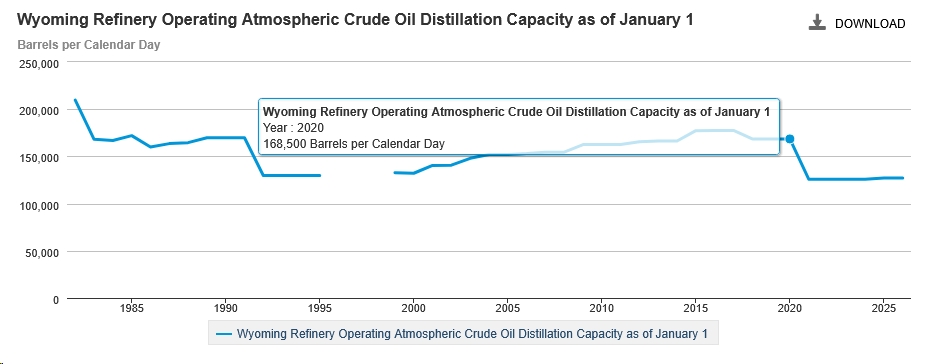
In practical terms, Wyoming lost roughly one-quarter of its petroleum refining capacity. The Cheyenne facility eventually began producing renewable diesel in 2022. But renewable diesel does not recreate the old refinery’s gasoline, jet fuel, and conventional diesel production. Much of the economic value of renewable diesel comes from selling the product into markets where low-carbon fuel credits command significant value, like California. Those markets are largely outside of Wyoming. The refinery conversion may have made financial sense for the company, but it reduced Wyoming’s gasoline production by 25%.
The Loss Did Not Cause Today’s Price — But It Matters
It would be too simplistic to say the Cheyenne refinery conversion caused $4.55 gasoline in September 2026. The refinery stopped processing crude during the historic collapse in fuel demand caused by COVID-19. Gasoline was cheap in 2020 because much of America was not driving. The consequences became more visible when demand returned.
By 2021, federal energy officials were already noting that the Cheyenne shutdown had reduced Rocky Mountain refining capacity by roughly 7 percent. Regional inventories tightened, and subsequent studies of Front Range fuel supply treated Cheyenne as the loss of an important local source of gasoline and distillates.
The demand did not disappear; the replacement barrels simply had to come from somewhere else. That means more fuel traveling greater distances through a limited pipeline and refining network. Wyoming’s remaining refineries did not expand enough to replace what disappeared in Cheyenne. The region entered the middle of this decade with less spare petroleum refining capacity than it had before 2020.
Then add the other pressures: Colorado’s specialized gasoline requirements along the Front Range, refinery conversions elsewhere in the West, limited pipeline capacity, and now a global oil-price shock. The result is what Wyoming drivers are seeing today.
It Isn’t the Gas Tax Either; Blaming it for High Prices is a Red Herring.
Wyoming’s gasoline tax is 24 cents per gallon, relatively low compared with many states. That is not what is keeping Wyoming gasoline near the national average. Geography has a lot to do with it. Supplying a high-volume station along a major metropolitan pipeline corridor is cheaper than moving smaller volumes long distances to rural communities, mountain towns, and tourism corridors.
That difference becomes particularly painful with diesel. Diesel is the bloodstream of Wyoming’s rural economy. Ranchers, truckers, farmers, construction companies, and nearly every business dependent on freight feel the increase. And when diesel rises, the cost eventually appears somewhere else — in groceries, building materials, livestock transportation, and anything brought into Wyoming on a truck.
Being an Oil State Is Not the Same as Being a Gasoline State
That is the central misunderstanding. Iran can move the benchmark price of West Texas Intermediate, but a barrel of Powder River Basin crude still has to be transported, refined, and transported again before it becomes regular unleaded at the Maverick in Douglas.
Wyoming’s problem is not that it produces too little oil. The state produces plenty. The problem is that crude oil and finished gasoline are different commodities sold in different markets. Wyoming sits inside a relatively small, isolated refining region with limited ability to replace lost supply. And in 2020, the state permanently traded one of its major petroleum refineries for a smaller renewable-diesel operation serving a different market.
Drilling more wells does not solve that problem, though we should. More refining capacity, more pipeline capacity, or more finished gasoline and diesel entering the Rocky Mountain market might. Until then, Wyoming is still an essential producer of just about every type of energy. It just isn’t a guarantee of cheap fuel.