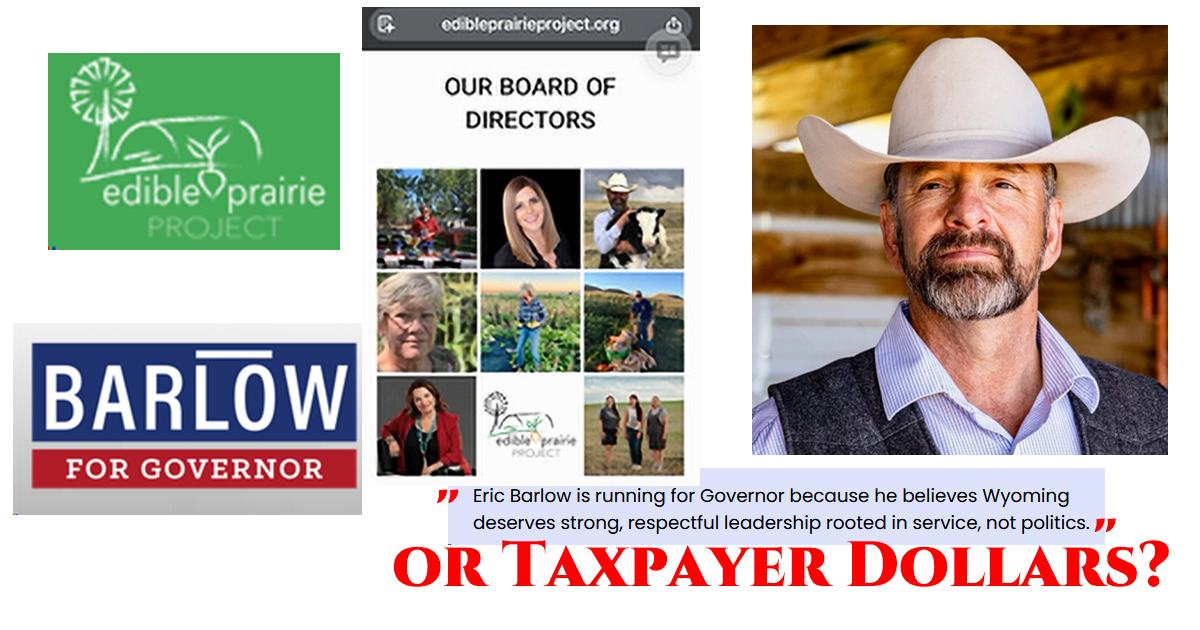
Wyoming’s nonprofit landscape is filled with good intentions, mission statements, and heart-tugging photographs of food baskets and smiling families. But when a sitting state senator running for governor is connected to a nonprofit that receives state-administered, federally sourced grant money and simultaneously promotes and sources food from that same senator’s private business, the public has a right to ask who is paying whom—and who is overseeing it.
This story centers on State Senator Eric Barlow, the Edible Prairie Project (EPP) in Gillette, and Gourmet Lamb of Wyoming, a lamb business operated by Eric and Kelly Barlow that EPP itself has publicly promoted as a local rancher partner. It also traces how federal relief dollars, philanthropic incentives, and state-linked programs converge in Wyoming’s food-security ecosystem—often without the transparency safeguards the public expects.
Where the System Began
The food-procurement model that ultimately funded EPP did not appear overnight. According to the Wyoming Department of Family Services (DFS), the foundation for this program was laid during the 2022 Budget Session, when the Wyoming Legislature authorized ARPA funds for DFS:
“During the 2022 Budget Session, DFS received funding through the American Rescue Plan Act (ARPA) for the purposes of assessing current food systems and identifying ways to improve the management and distribution of donated and publicly purchased food for needy children, families and elderly persons.”
That assessment did not merely study the problem—it designed a purchasing system.
It explicitly recommended:
“$1.4M for forward-contracts between Wyoming producers and food pantries or other food security service organizations.”
In the 2023 Legislative Session, the Legislature approved additional ARPA funding to implement those recommendations:
“During the 2023 Legislative Session, DFS received additional ARPA funding to implement these recommendations.”
At the time this framework was authorized in 2022, Eric Barlow was Speaker of the Wyoming House—placing him in a leadership role during the legislative creation of the very system his nonprofit and private business would later participate in.
The Public Money Trail
On May 29, 2025, DFS announced the Forward Contract Pilot Grant Program as part of a $2.4 million Food Security System Implementation Project. DFS listed eight recipients, including Edible Prairie Project, sharing $322,705 in pilot grant funds. DFS stated that the program is administered by Food Works Group, which distributes funds statewide.
Most significantly, DFS confirmed:
“This project is paid for with funds from the American Rescue Plan Act (ARPA) of 2021 and the Infrastructure and Jobs Act.”
So the pipeline is clear:
Federal ARPA dollars → Wyoming Legislature → DFS → Food Works Group → Edible Prairie Project. This is not private charity. It is government-administered federal relief funding.
The Board and the Business
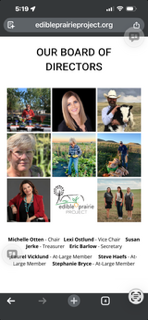
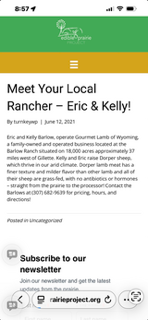
EPP publicly listed Eric Barlow as a founding board member and Secretary until his resignation in December 2025. During that same period, EPP promoted Gourmet Lamb of Wyoming, operated by Eric and Kelly Barlow, as a local rancher supplier.
EPP’s own materials explain its business model:
Unlike traditional food banks, EPP purchases meat and produce from local ranchers. Typically, they pay 80% of retail price, allowing the remaining 20% to be treated as a charitable donation by the producer.
Homegrown Stories further confirms:
EPP received a portion of the $322,705 state food grant specifically to increase local protein—such as lamb—in food baskets.
And it states plainly:
“EPP acts as a mission-driven bridge that uses private donations and grant funding to purchase products from local producers like Gourmet Lamb of Wyoming.”

So again, the documented facts show:
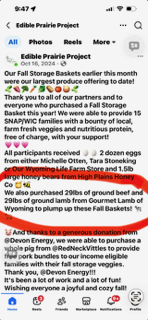
- A nonprofit receiving ARPA-backed state grant money
- With a sitting lawmaker as a board officer
- While sourcing food from that lawmaker’s private business
That is the definition of a governance red-flag scenario.
University of Wyoming and State-Linked Support
EPP also received a community-based research grant through the Equality State Research Network in partnership with the University of Wyoming, allowing it to offer free food baskets to SNAP families and study household food security. Because UW is a state institution, supported by public appropriations and federal research funds, this placed EPP within Wyoming’s state-supported food-security infrastructure, not merely the philanthropic sphere.
EPP also collaborates with UW Extension’s Cent$ible Nutrition Program, funded by state, federal, and university dollars.
The Wyoming Hunger Initiative – A Necessary Clarification
The Wyoming Hunger Initiative (WHI), associated with First Lady Jennie Gordon, has also awarded grants to EPP. However, WHI is not a state agency and does not receive legislative appropriations. According to Buckrail, it was funded through donations and partnerships, and in 2024 transitioned into an independent nonprofit.
That distinction matters. But WHI operates within the same food-security ecosystem as state-administered ARPA programs—meaning its dollars often stack with public funds to support the same organizations and vendors. It is this blending of private, philanthropic, and government-administered funding that makes transparency essential.
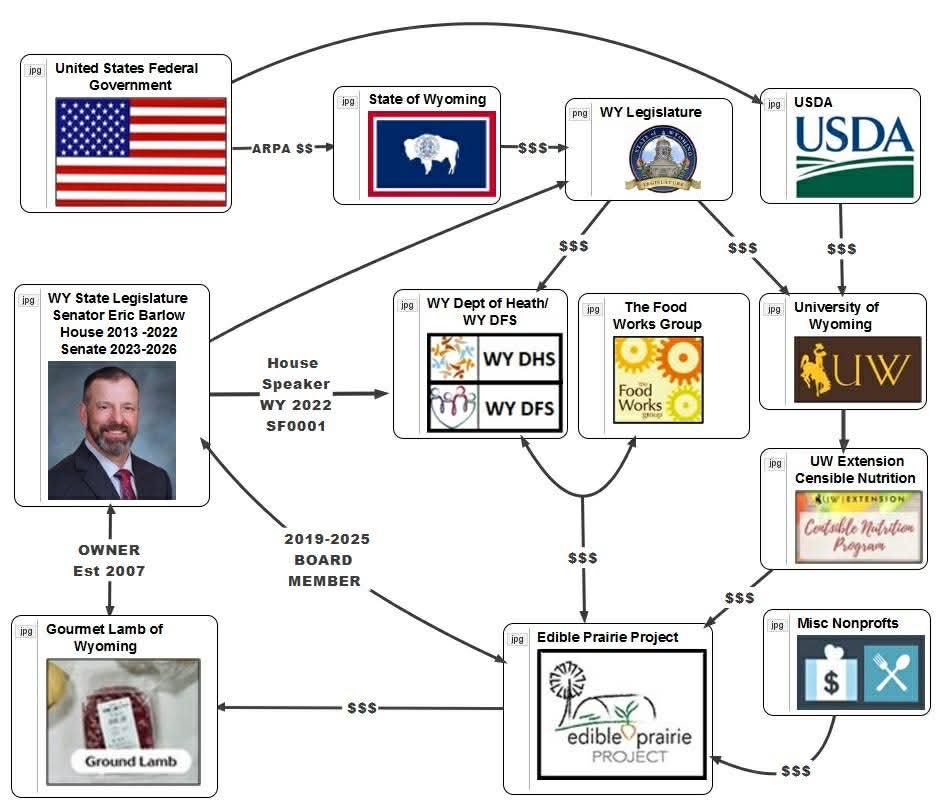
Why This Matters
This story is not an accusation. It is a documentation of a closed loop that Wyoming voters deserve to see clearly:
- The ARPA framework was approved while Eric Barlow was Speaker of the House
- His nonprofit later received funding from that same framework
- He served as a board officer of that nonprofit
- That nonprofit purchased and promoted food from his private ranching business
In any state, that combination triggers a simple expectation:
Show the paper trail.
Where are the conflict disclosures?
Where are the recusals?
Where are the independent approvals?
Because when public money, nonprofit governance, and political power intersect, transparency is not a courtesy. It is the public’s right.
Editor's Note: This is the first in a series of pieces on Edible Prairie Project.