ANALYSIS
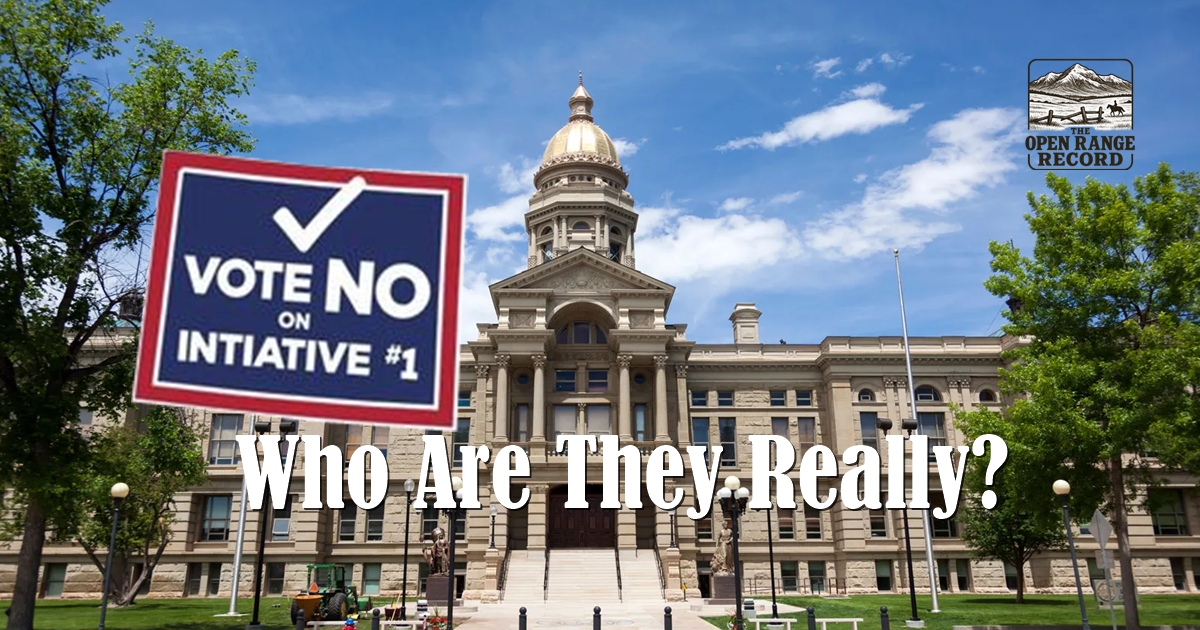
A well-funded coalition calling itself “Wyoming Vote NO on #1” is working overtime. Formed in June 2026 with an initial $50,000 from the Wyoming Education Association, and backed by the Wyoming Taxpayers Association, their message is simple and familiar: vote no on Proposition 1, the People's Initiative for a 50% Reduction in property taxes, or schools, fire, ambulance, and police will be put “on life support.” They warn that $125 million will be lost in year one and that nearly $200 million ripped from the budget. There will be a $700 million school deficit by 2030, with $1.4 billion gone over ten years.
According to their account, the sky is falling. It is the same script used every time taxpayers ask for meaningful relief. Let’s replace the fear with facts from the Wyoming Constitution, the Department of Revenue, and the state’s own fiscal structure.
Prop 1, the “People’s Initiative,” does one thing: it exempts 50 percent of the assessed value of a qualifying primary residence (the dwelling itself) from taxation. To qualify, the owner must have been a Wyoming resident for at least one year and have occupied the home for at least six months of the prior tax year. Only one exemption per owner or property is allowed. The land under the home is not exempted. Department of Revenue analyses put statewide revenue impact of about $125 million in the first year. Significant, but far from catastrophic. Let’s examine the full picture of Wyoming revenue.
Who Is Really Speaking for Taxpayers?
It isn’t surprising that the loudest voices against tax reduction are funded by the Wyoming Education Association (WEA). The WEA seeded the NO group with $50,000, according to the Wyoming Secretary of State website. The NO group is also supported by entities that benefit from higher tax collections. And how is it that a group calling itself the Wyoming Taxpayers Association advocates against property tax relief for primary residences?
Voters should examine the incentives of the group’s supporters carefully before they decide the sky is falling. Education is constitutionally protected in the state of Wyoming. Lowering and even eliminating property taxes will not affect school funding. Fire, ambulance, and police services are local priorities that communities value and fund. None of those priorities require homeowners to continue paying tax on the full market assessed value (FMV) of their residence. In fact, well over $148 million is set aside in every two-year budget for direct distribution to cover essential services. It’s a protection the state put in place to make sure such services are rarely interrupted.
Who’s NOT paying taxes
In the summer of 2025, the Revenue committee spent time on the topic of whether businesses and industries are paying their fair share of taxes. They discovered there are multiple exemptions for commercial properties in the form of Obsolescence. Obsolescence is a tax break for which businesses qualify when their assets no longer meet fair market value. This break is not available to homeowners.
- Functional Obsolescence Commercial and Industrial Exemptions totaling $187,010,386, per year.
- Economic Obsolescence for Commercial and Industrial in 2025 per the Dept of Revenue, was $714,014,177 per year.
Let’s look at the Data Center Sales Tax Exemption. When data centers spend more than $2 million in equipment purchases during a calendar year, they are exempt from paying sales taxes. Why isn’t the WEA asking for their share of those exemptions? Why are middle class homeowners, some on fixed incomes, the target of this taxation machine?
The Vote NO campaign plans to spend money “educating the public” through door knocking, mailers, and social media ads. It’s a coordinated propaganda effort built on fear. It relies on worst-case projections, selective numbers, and emotional appeals about schools and emergency services while offering no alternative for how Wyoming should prioritize spending or grow its broader revenue base.
This classic ploy is to gaslight voters into believing they will lose essential services. They repeat the claim incessantly hoping voters never examine the constitution, the state’s diversified revenue streams, the new direct-distribution law, or the track record of prior tax relief measures. This is not neutral education; it is advocacy designed to preserve higher collections by painting fiscal restraint as catastrophic.
How Wyoming Property Taxes Work
This is what the WEA and their friends expect voters to not know or understand. Under Wyoming law and Department of Revenue rules, residential property is valued at fair market value as of January 1 each year. That market value is then assessed at 9.5 percent. The resulting taxable value is multiplied by the local mill levies set by counties, school districts, cities, towns, and special districts. That produces your tax bill.
Roughly 60–70% of statewide property tax collections support K-12 schools. The rest funds counties, cities, community colleges, and special districts. Minerals are assessed at 100% productive value and industrial property at 11.5%, so residential homeowners are already on a lower fractional assessment rate than the state’s big revenue producers.
The Constitution Guarantees School Funding
The opposition’s central claim that schools will be gutted runs directly into the Wyoming Constitution. Article 1, Section 23 recognizes the right of citizens to educational opportunities. Article 7 is even more explicit. Section 1 requires the Legislature to establish and maintain “a complete and uniform system of public instruction.” Section 2 creates perpetual school funds. Section 9 directs the Legislature to “make such further provision by taxation or otherwise” as necessary to create and maintain a thorough and efficient system of public schools free of charge.
These provisions are not suggestions. They have been enforced by the courts for decades. The landmark Washakie County School District No. 1 v. Herschler (1980) and the subsequent Campbell County series of cases required the state to ensure funding is adequate, equitable, and cost-based—not dependent solely on local property wealth.
When local property tax revenue falls short of the foundation guarantee, the state steps in through the School Foundation Program. That program is fed by multiple streams: the 12-mill statewide property tax, federal mineral royalties, severance taxes, investment income from the Common School Permanent Land Fund, Permanent Wyoming Mineral Trust Fund, state royalties on school lands, and recapture from wealthier districts.
In short, the Constitution and the courts already require the Legislature to fill any gap. History shows Wyoming does exactly that. The NO group is misleading the public. Education funding is not in jeopardy.
Budget Growth and Real Revenue Reality
Wyoming does not live or die by residential property taxes alone. Our fiscal strength comes from minerals, investment earnings, and sales taxes. The Consensus Revenue Estimating Group reports and the Legislative Service Office’s fiscal profiles show that severance taxes, federal mineral royalties, and investment income from the state’s permanent funds deliver hundreds of millions of dollars. This often exceeds forecasts in strong years. The Permanent Wyoming Mineral Trust Fund and Common School accounts exist so temporary fluctuations in one revenue source do not collapse essential services.
Recent legislative property tax relief measures (the 4% annual increase cap and the 25% homeowner exemption) reduced collections without producing the doomsday scenarios predicted at the time. Local governments and school districts adjusted to the new budget. The state met its constitutional duty. Budget growth in other revenue streams and the existence of reserve accounts have repeatedly absorbed impacts far larger than the estimated effect of Prop 1.
Claiming a targeted homeowner exemption will put emergency services “on life support” ignores both the constitutional backstop and the diversification of Wyoming’s revenue base. It also ignores the fact that the Legislature retains full authority and the constitutional obligation to adjust other taxes, spending priorities, the 2026 Legislature’s direct-distribution or fund transfers if needed.
The Choice Before Us
Prop 1 doesn’t abolish property taxes. It doesn’t touch commercial, industrial, agricultural, or mineral property. It simply gives ordinary homeowners a 50% exemption on the assessed value of their primary dwelling. The land remains taxable. Qualification rules prevent abuse. And the Wyoming Constitution, courts, and decades of practice ensure schools will continue to be funded.
The “lost money” narrative treats every dollar of reduced residential property tax as a hole that can never be filled. As evidenced earlier, the lost money is in the exemptions for billion-dollar corporations. This isn’t how Wyoming’s fiscal system works. We have permanent funds, mineral wealth, investment income, and a constitutional mandate that the Legislature must meet. Growth in those other sources, combined with prudent budgeting, is how a low-tax state has long delivered essential services.
Vote YES on Prop 1. Give homeowners the relief they have earned. Trust the Constitution. Reject the predictable claim that any reduction in taxes must mean the sky is falling. Wyoming has proven, time and again, that it can keep its promises to both taxpayers and the next generation.