When student speech becomes controversial, who decides whether it is protected, and where does a family go when they believe those rights have been violated?
That question was at the center of the Senate Education Committee’s February 27, 2026 hearing on HB0159 – “Safeguarding Personal Expression at K-12 Schools,” sponsored by Representative Lien. After extensive testimony from lawmakers, education associations, the Wyoming Department of Education, a legal expert, and a Wyoming high school student, the committee voted 5–0 to advance the bill with amendments.
HB0159 seeks to codify student religious, political, and ideological expression protections into Wyoming statute while creating a defined state-level enforcement mechanism.
Codifying Equal Treatment
Representative Lien introduced the measure as “first, an equal treatment bill,” explaining that its purpose is to ensure students are not discriminated against based on viewpoint when schools permit expression.
She noted that federal guidance protecting student prayer and free speech was first issued under the Clinton administration, reaffirmed under the Obama administration, and affirmed again this month under the Trump administration. HB0159, she said, places longstanding bipartisan guidance into Wyoming law.
The bill creates two new statutory sections:
- W.S. 21-3-601, establishing protections for
student religious, political, and ideological expression in public K-12
schools.
- W.S. 1-39-125,
adding a liability provision under the Wyoming Governmental Claims Act for
violations of those protections.
These provisions define both the right and the remedy.
“Similarly Situated” Students
Under proposed W.S. 21-3-601, a student may not be discriminated against or penalized for engaging in religious, political, or ideological speech at the same time, in the same manner, and to the same extent as similarly situated students.
Representative Lien emphasized that this does not authorize disruption. It applies when a teacher opens discussion, assigns an open-ended paper, or otherwise allows student expression. If one student may speak, all “similarly situated students” may speak, regardless of viewpoint. In other words, all the students can speak.
Instructional Time and Amendments
Concerns arose regarding language referencing instructional time. Senator Olsen stated that before- and after-school gatherings seemed appropriate but expressed concern about unintended consequences if the bill permitted organized ideological activity during instructional periods. He suggested removing or clarifying that language. Representative Lien indicated she was amenable to amendment.
The committee ultimately adopted amendments replacing references to “instructional time” with “non-instructional time during the school day,” addressing concerns about preserving classroom instruction.
The most prevalent Wyoming Example
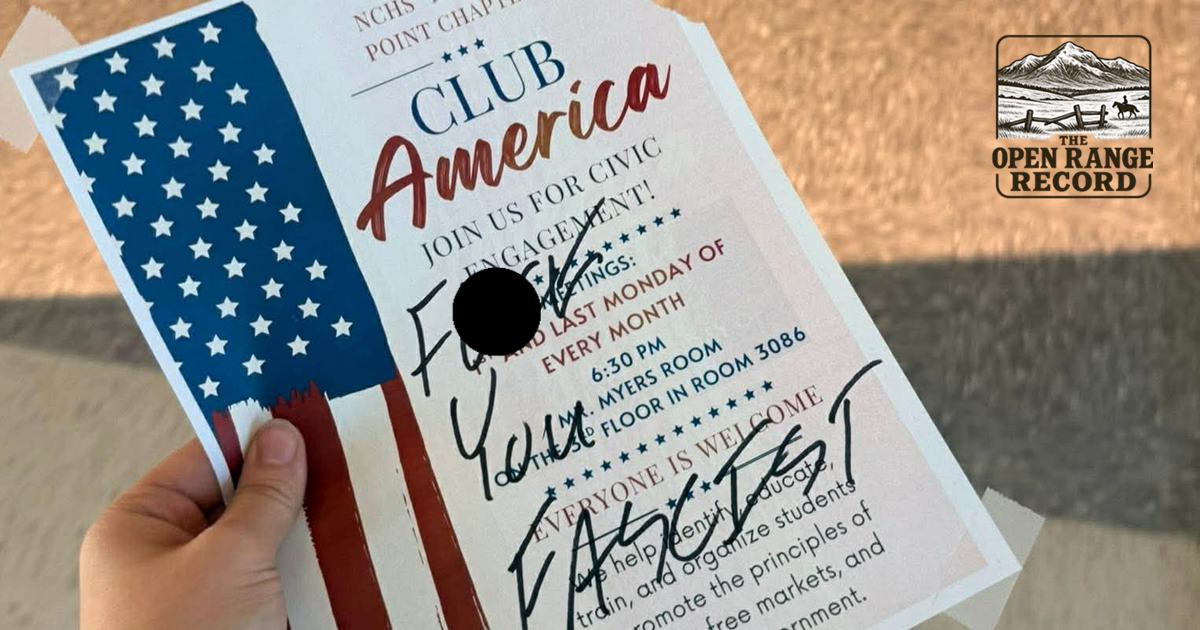
HB0159 maintains existing procedures for forming student clubs but requires viewpoint neutrality once a club is approved. Kylie Wall, a Wyoming high school senior, testified that her experience starting a Club America chapter inspired the bill. She stated that although her club received formal approval, it faced restrictions not applied to other organizations.
Wall testified that approved materials were removed, flyers were torn down, and threats were made against her and club members. She described intimidation, including a message carved into a bathroom fixture calling for death to the affiliated organization.
She stated that despite reporting incidents
and involving parents and authorities, she did not receive clear assurances of
protection. Wall
told the committee the bill would establish clear standards so student rights
are protected by law rather than left to administrative discretion.
Liability and State Court Access
The bill’s second statutory addition, W.S. 1-39-125, waives governmental immunity for violations of student expression protections. Senator Scott questioned whether such a waiver was necessary and asked whether state courts were already adequate.
Representative Lien responded that without a state statutory cause of action, students alleging First Amendment violations typically must pursue relief in federal court. HB0159 would allow claims to be heard in Wyoming district courts.
Senator Rothfuss raised concerns about potential expanded liability exposure to the state.
Administrative Process Discussion
Senator Olsen referenced a prior parental rights bill that included an administrative review process before litigation could proceed. He expressed interest in whether a similar administrative pathway should be included in HB0159, allowing disputes to move through a defined administrative process before reaching the courts.
Mr. Shanor of the Wyoming Department of Education testified in support of the bill. He stated that the Department frequently receives complaints from parents but is often limited to advising families to speak with their local school board. He expressed support for providing an additional avenue for redress in court when appropriate.
He indicated that having a statutory pathway could allow the Department to inform families that there may be another option available beyond local administrative processes.
Legal Standards and Case Law
Brian Farmer of the Wyoming School Boards Association referenced Tinker v. Des Moines, the 1969 Supreme Court decision allowing schools to regulate speech that materially and substantially disrupts school operations. Committee members noted that HB0159 includes language stating nothing in the section prevents schools from restricting speech consistent with constitutional standards.
Senator Scott made a statement after Farmer's testimony persuaded him to realize they need the bill.
Matt Sharp, Senior Counsel with Alliance Defending Freedom, testified online in support of the bill. He explained that the bill compiles existing Supreme Court precedent into statutory language, including:
- The “material and
substantial disruption” standard from Tinker
- The harassment
standard from Davis v. Monroe County Board of Education
- Exceptions for
unprotected speech such as obscenity, true threats, and fighting words
Sharp also addressed the bill’s damages provision, stating that statutory damages reflect recognition of constitutional harm rather than assigning a precise monetary value.
Dress Codes and Religious Expression
Representative Lien clarified that the bill does not override dress codes or modesty standards. Schools retain authority to restrict antagonistic symbols recognized by courts as disruptive.
Senator Rothfuss raised a question regarding head covering bans and whether a neutral policy might disproportionately affect certain religions. Representative Lien acknowledged safety concerns but questioned whether sincerely held religious expression could be restricted under First Amendment protections, suggesting further legal consultation.
Adopted Amendments
In addition to clarifying non-instructional time language, the committee adopted several technical amendments removing certain liability language, renumbering subsections, and deleting specific phrases for clarity and internal consistency.
Notably, the adopted amendments replaced references to “instructional time” with “non-instructional time during the school day,” addressing concerns about preserving classroom instruction. Additional changes removed certain liability language and adjusted subsection numbering to maintain statutory clarity and internal consistency. With these amendments, the bill was refined to reflect committee discussion while maintaining its core focus on viewpoint neutrality and student expression protections.
Unanimous Vote
After extensive testimony and amendment, the Senate Education Committee voted 5–0 to advance HB0159 in its amended form. The hearing reflected broad discussion about how Wyoming balances student speech, instructional integrity, liability exposure, and constitutional protections. With its unanimous committee vote, HB0159 now moves forward as a bill aimed at codifying viewpoint neutrality in Wyoming’s public schools while defining clear limits consistent with established Supreme Court precedent.