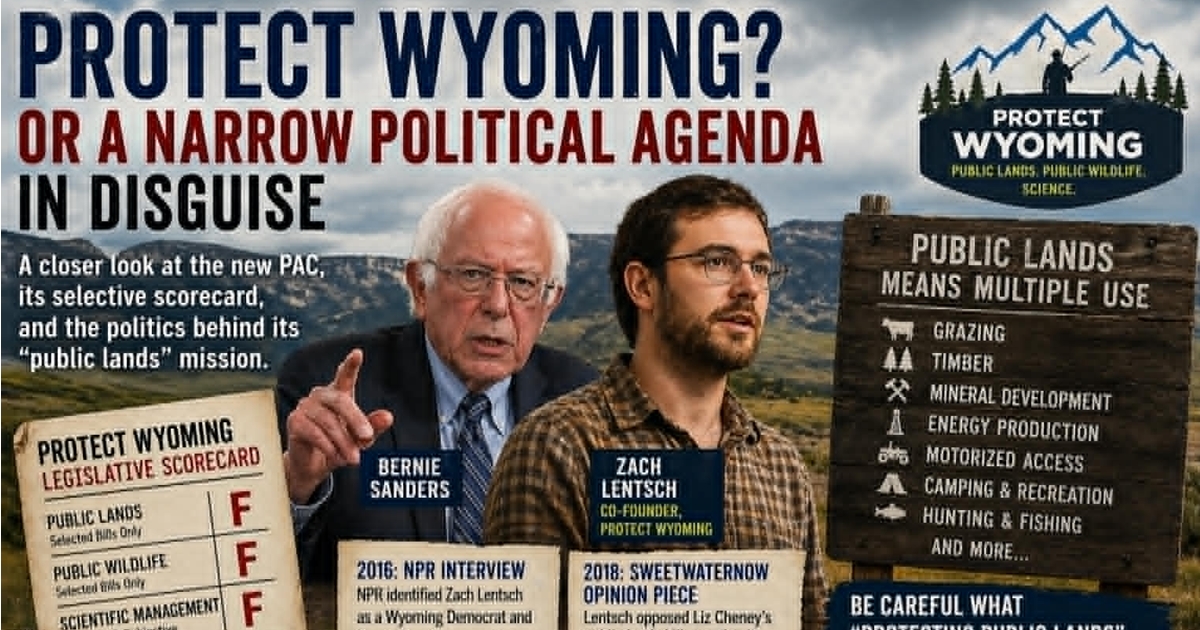
In Wyoming, the phrase “protecting public lands” can mean very different things to very different people. For some, it means hunting and fishing access. For others, it means habitat and wildlife protection. For many Wyoming families, it also means something larger and older: the principle of multiple use - grazing, timber, mineral development, energy production, recreation, hunting, fishing, camping, motorized access, and working lands sharing the same landscape.
That is why Protect Wyoming deserves a closer look. The organization presents itself as a public-lands PAC acting on behalf of Wyoming residents. But its own website, legislative scorecard, and the public record of one of its founders point to something much narrower: a political operation built around a specific protection-first view of public lands and aimed squarely at the 2026 primary election.
A PAC, Not Just a Public-Lands Group
Protect Wyoming is explicit about what it is. On its homepage, the group says it is a political action committee dedicated to “holding Wyoming’s legislators accountable & winning elections.” It also says it is “led by Wyoming hunters on behalf of all Wyoming residents,” and that its goal is to “educate and mobilize voters” around three values only: public lands, public wildlife, and scientific management.
On its “Plan” page, Protect Wyoming goes further. The group says it did not want to create “another advocacy organization.” Instead, it chose a PAC because that tool can do one job well: help win elections. It says its plan is to make sure every sportsman, sportswoman, and everyone who shares its values votes in the 2026 primary for candidates who will “protect Wyoming.” Instead of creating just “another advocacy organization,” they created a political action committee whose sole purpose is political advocacy.
Wyoming readers may hear the phrase “protect public lands” and assume something broader than what the group is actually selling. In this state, public lands are not just wildlife lands. They are also grazing lands, timber lands, mining lands, oil-and-gas lands, recreation lands, and working lands. Wyoming Game and Fish says nearly 48% of Wyoming is federal public land, with another 5.6% owned by the state. That is why so many Wyoming debates have long turned on multiple use rather than one preferred use at a time.
Protect Wyoming’s chosen values do not reflect that broader framework. The group is not scoring lawmakers on multiple use, working lands, grazing, timber, mineral development, or motorized access. It is scoring them on a much tighter three-part lane: public lands, public wildlife, and scientific management.
That is its right as a PAC, but it is not the same thing as speaking for “all Wyoming residents.” A lot of hunters and anglers may see the group’s branding and assume they are looking at a broad-based Wyoming public-lands coalition. The group’s own materials suggest something more specific than that.
Zach Lentsch’s Public Record Did Not Start with This PAC
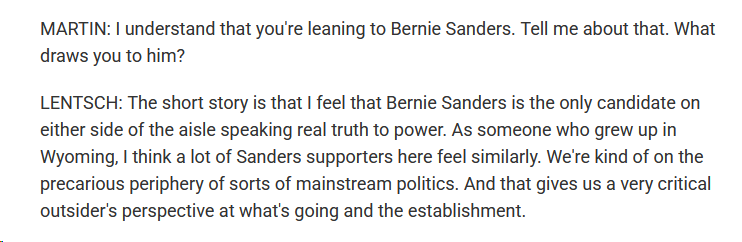
That narrower lane becomes easier to understand when viewed alongside the public record of Protect Wyoming co-founder Zach Lentsch. In 2016, NPR interviewed Lentsch ahead of the Wyoming Democratic caucus and identified him as a Wyoming Democrat and Bernie Sanders supporter. During that interview Lentsch told NPR,
“ The short story is that I feel that Bernie Sanders is the only candidate on either side of the aisle speaking real truth to power. ... We’re kind of on the precarious periphery of sorts of mainstream politics.”
That does not, by itself, prove his current party registration a decade later. But it does establish that one of the public faces behind this new PAC was publicly active on the political left. During the 2018 election, Lentsch was not registered to vote in Wyoming and didn’t vote in the General Election. In 2020 he was a registered as unaffiliated; and in 2022 he was a registered Republican.
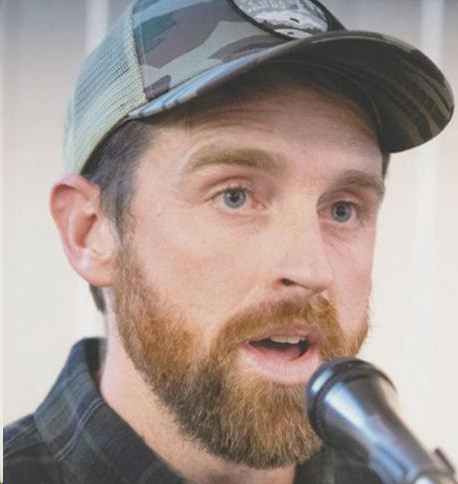
In 2018, Lentsch wrote an opinion submission published by SweetwaterNOW attacking then-Rep. Liz Cheney’s public-lands bill. In that piece, he argued Cheney’s proposal would gut local input, affect more than 4.4 million acres of public land, and open protected lands to drilling, mining, road construction, and development. He wrote that those lands had uses “beyond drilling rigs and roads” and strongly opposed efforts to remove what he described as necessary protections.
That article helps explain what kind of public-lands politics Lentsch was already practicing years before Protect Wyoming existed. He mentioned ranchers, but the substance of the piece centered on habitat, scenery, roadless protections, trout streams, hunting, hiking, climbing, horseback riding, and opposition to more drilling, mining, roads, and development. Ranchers got a mention. Grazing and agriculture did not get a real seat at the center of the argument.
In other words, the public record suggests that Lentsch’s view of public lands has long been protection-first, not broadly multiple-use.
The Wilderness Study Area Fight Was Bigger Than One Opinion Piece
The 2018 SweetwaterNOW piece also touched a much older Wyoming fight: Wilderness Study Areas, or WSAs. Those lands have been in federal limbo for decades. Wyoming officials have argued for years that WSAs were supposed to be temporary until Congress made a final decision, but in practice many remained under restrictive management for more than 30 years.
Lentsch framed Cheney’s bill as a threat to protections and local input. But the other side of that debate was that many Wyoming residents were already frustrated with land being treated as de facto wilderness generation after generation without final resolution. That context highlights the difference between two public-lands philosophies: one that prioritizes continued protection and one that insists Wyoming should not accept endless federal limbo in place of an honest multiple-use balance.
The Scorecard Is Selective by Design
Then there is Protect Wyoming’s legislative scorecard. The group says it scored lawmakers using bills from the 2025 and 2026 sessions under three categories: public lands, public wildlife, and scientific management. The list includes SJ0002 and SJ0009 for public lands; SF0118 and SF0051 for public wildlife; and HB0186, HB0286, and SF0025 for scientific management.
At first glance, that may sound straightforward, but it is not. On some measures, the group scores final floor votes. But on others, its own scorecard says lawmakers were penalized for sponsoring bills or for committee action, even when those bills never reached final passage.
For SF0118, the scorecard says the bill did not receive a final vote, but sponsors still received a -3. It is the same story for HB0286: no final vote, but sponsors were still penalized. For SF0051, the bill failed introduction and was never introduced on the floor or in committee. In other words, Protect Wyoming penalized legislators regardless of their final vote on the bill to give their preferred candidates a favorable score.
There is nothing unlawful or improper about a PAC making its own scorecard. But readers should understand what they are looking at: not a neutral report card, but a political grading system built around one organization’s preferred outcomes. The lawmakers who seem to take the hardest hits are not random. They are disproportionately the same grassroots conservative Republicans and platform Republicans who already sit on the opposite side of Wyoming’s internal political fights from Democrats and establishment Republicans.
The Phrase “Scientific Management” Is Doing a Lot of Work
Protect Wyoming also leans heavily on the phrase “scientific management.” But that phrase does more political work than the group admits. Take HB0186 from 2025. Protect Wyoming labels it anti-scientific management. The actual bill, “Bear coupons-game and fish,” was part of a genuine policy dispute over grizzly bear management, delisting, and state authority. HB0286, “Mountain lion hunting season-changes,” was another real policy dispute. Labeling one side of such debates “anti-science” does not settle the issue; it simply brands one side as legitimate and the other as backward.
It is also worth remembering that Wyoming wildlife management does not happen in a politics-free bubble. Commissioners are appointed through a political process, and directors are appointed. Agency science is important, but policy decisions still move through political structures.
If Protect Wyoming wanted its scorecard to function as a full measure of who is “pro-public lands,” one omission stands out: corner crossing. In 2025, HB0099, sponsored by Rep. Karlee Provenza and co-sponsored by a bipartisan group, sought to address corner crossing but died before full introduction.
In 2026, HB0019, “Corner crossing clarification,” passed the House on third reading and then died in the Senate. It was one of the most visible public-access fights of the session. It had real votes, and it went directly to the issue of access to public lands.
Yet it is absent from Protect Wyoming’s scorecard. The group has every right to choose its own metrics. But readers also have every right to ask why one of the state’s clearest access debates did not fit the story the scorecard wanted to tell. The part that didn’t fit is that some conservatives voted for a bill that is at the core of what Protect Wyoming claims to advocate for.
What This Scorecard Does - and Does Not - Measure
There are many lawmakers in Cheyenne who are pro-wildlife, pro-hunting, pro-recreation, and deeply familiar with public-land realities, including legislators tied to agriculture and working lands. Protect Wyoming’s scorecard does not attempt to measure that full picture. It does not score lawmakers on gun rights, property rights, election integrity, parental rights, or the Wyoming Republican Party platform.
It scores one narrow lane and uses that lane to sort lawmakers politically. That is why a legislator can be portrayed as a “champion” on Protect Wyoming’s scorecard while still being far to the left on other core issues. That may be useful for single-issue coalition building, but it is not the same thing as presenting a full measure of a Wyoming lawmaker’s record.
Author's Opinion: A Broader Conversation Wyoming Should Actually Have
None of this means public lands do not matter. They do. None of it means lawmakers should be immune from scrutiny. They should not. But Wyoming voters should be careful about branding that sounds broader than it really is.
“Protecting public lands” can mean many things in Wyoming. Protect Wyoming is clearly advancing one version of that debate and one side of the political spectrum. Its own website says it is doing so through a PAC built to win elections. Its scorecard shows a selective methodology designed to reward some lawmakers and punish others. And the public record of one of its key founders shows that this protection-first worldview did not suddenly appear in 2026.
That does not make the group illegitimate. But it does mean Wyoming readers should understand the lane it is operating in - and not mistake that lane for the whole road.