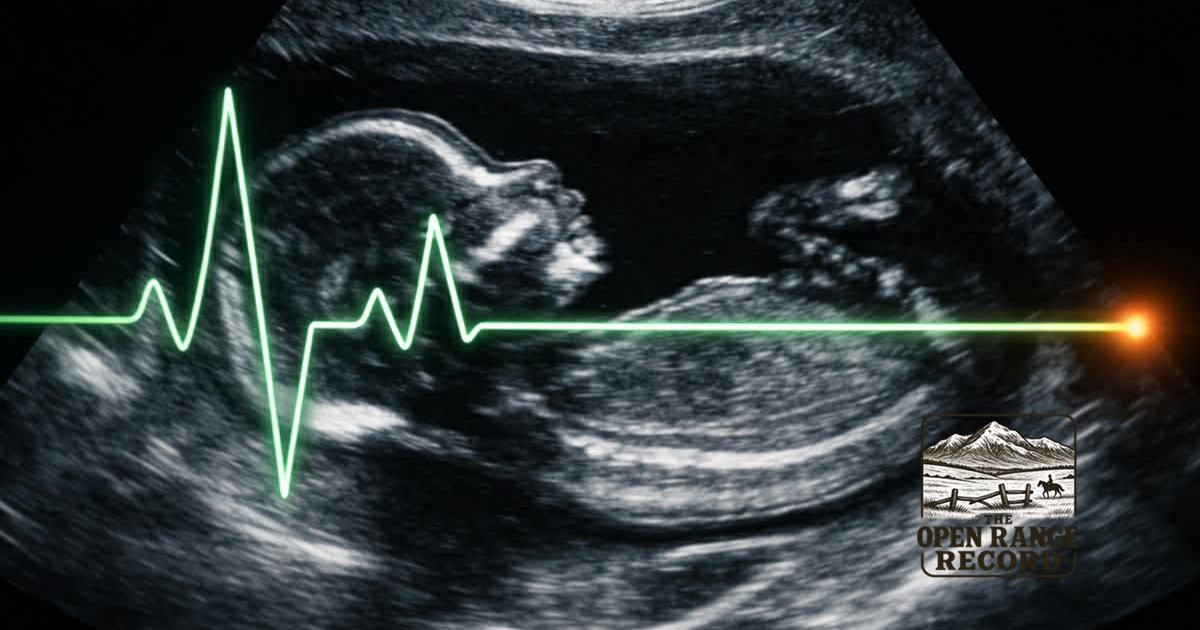
There are few sounds more intimate than the first flutter of a heartbeat. For some, it signals hope. For others, it signals complexity.
On February 27, 2026, that quiet rhythm became the center of one of the most consequential debates before the Wyoming Senate Labor, Health and Social Services Committee this session, as lawmakers considered HB126, the Human Heartbeat Act.
Sponsored by Representative Neiman, the bill was presented as a constitutional exercise of legislative duty, as he described it, “a line in the sand.”
Following recent Wyoming Supreme Court rulings interpreting Article 1, Section 38 of the Wyoming Constitution as protecting healthcare decision-making, Neiman argued that the Court also explicitly affirmed the Legislature’s authority to enact reasonable and necessary restrictions to protect the health and general welfare of the people. HB126, he said, operates squarely within that authority.
The bill would prohibit abortion once a fetal heartbeat is detectable, determined through standard medical practices such as ultrasound. It includes a medical emergency exception and applies criminal penalties only to intentional or knowing violations. Amendments adopted in the House strengthened the legislation, adding clarifications and protections for nurses and pharmacists to ensure they are not unintentionally subjected to liability. Supporters emphasized that the bill was carefully structured to address constitutional concerns raised in prior court decisions.
But beyond the legal framework, it was the testimony that
amplified the hearing.
“That Contradiction Should Make Us Uncomfortable”
One of the most striking testimonies came from Kylie Wall, a teenager and vice president of Students for Life at Casper College. “I didn’t arrive at my position casually,” she told the committee. “I spent a long time, especially as a student, listening to arguments from every side of this issue.”
She asked lawmakers to consider a straightforward scientific comparison. If scientists discovered an organism on another planet, one with organized cells, growth, responsiveness, and a detectable heartbeat, there would be no hesitation in calling it life. “We wouldn’t argue about dependency,” she said. “We wouldn’t say, ‘Well, it can’t survive on its own, so maybe it doesn’t count.’ We would be in awe. We would protect it.”
Yet when those same biological markers are found in the womb, she argued, language shifts. “It’s ‘just tissue.’ It’s ‘just potential.’ That shift isn’t scientific . . . it’s convenient.”
Her most pointed line drew quiet attention: “We pronounce death when the heart stops. But when a heart starts beating, we suddenly claim we don’t know what that means. That contradiction should make us uncomfortable.”
A Father, an Engineer, and an Ultrasound
Aaron Savar, an engineer and father of eleven, approached the issue from both professional and personal experience. “As an engineer, I look at data,” he said. “But I also have a unique perspective.”
Over the years, he and his wife have seen ultrasound after ultrasound, including one as early as six and a half weeks. He described seeing tiny arms, small fingers, movement, and a “fluttering heartbeat.”
“When you see an ultrasound, all you need to see is one.” Modern science, he said, has given society something previous generations never had. A window into the womb. With that visibility comes responsibility. He urged lawmakers not to lose sight of the human reality behind the data.
“It’s Still Human Life.”
Tony Gieser grounded his testimony in moral conviction. “If those cells were found on the moon or Mars, the scientific community would be overjoyed,” he said. The debate, he argued, exists because the life in question will become human.
“There really is no difference when it is killed in or out of the womb, five minutes after it’s born or seventy years old. It’s still human life.” He acknowledged difficult circumstances such as rape or incest but maintained that the value of life does not change based on the conditions of conception. He urged lawmakers to vote yes.
“We Forget the Mother’s Voice”
Opposition testimony carried emotional weight as well. Hannah Smart, speaking for the first time before a legislative committee, apologized for her nerves. “I’m so nervous. I’m so sorry.”
Acknowledging the deep divide surrounding abortion, she indicated that it's really, really hard to talk across the aisle. Genuinely and kindly, she indicated she really wanted to take seriously what the speaker said about recognizing life, “but what happens when it is taken to an extreme?” She stated, “maybe why the left is so afraid of fetal personhood, is because it becomes that we lose female personhood all together.”
“If we take that to an extreme, we forget about the mother’s voice completely.” She expressed concern that women’s autonomy could be overshadowed unless their lives are deemed in immediate danger. “It’s really important that we keep women’s voices in charge of the people that are inside their bodies at all times in order to create a society that values all life.”
Strengthened and Advanced
After testimony, the committee considered the bill as amended. Clarifications adopted earlier strengthened the measure, particularly in defining medical standards and protecting pharmacists and nurses from unintended liability.
In the final vote, Senator Crum was marked absent, Senator Scott voted no, and the remaining three members voted yes. HB126 passed out of committee and now advances to the next stage of the Senate legislative consideration. The question raised in that committee room remains; what does a heartbeat mean in law?