NEWS
CHEYENNE — For all the concern about how much water data centers will consume in Wyoming, the facilities already operating in Cheyenne use surprisingly little. The amount of electricity needed to power the next generation of those facilities, however, is another matter entirely.
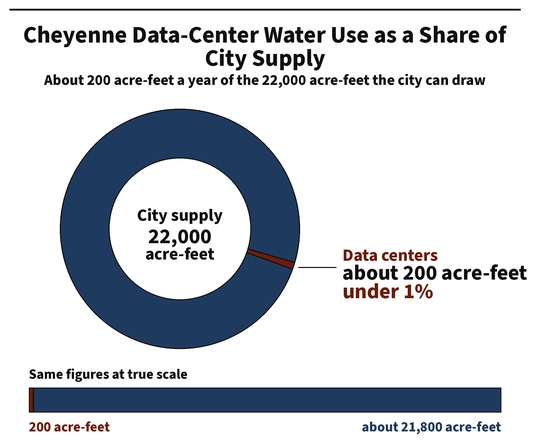
In May, Cheyenne Mayor Patrick Collins told lawmakers that all of the city's data centers combined use approximately 200 acre-feet of water annually. That's less than 1% of the 22,000 acre-feet the city has available to draw.
Compare that with the power plant approved south of Cheyenne, which could generate 2.7 gigawatts of electricity. Operating at full capacity for an entire year, that one facility could produce 23.7 billion kilowatt-hours of electricity. In 2024, Wyoming utilities sold just 17.2 billion kilowatt-hours to all their customers combined.
In other words, a single power plant associated with data center development could produce nearly 40% more electricity than Wyoming's utilities sold statewide in 2024. Some reporting has suggested the plant's capacity is three times Wyoming's electricity consumption, but federal electricity sales figures put that comparison closer to 1.4 times.
Understanding why these two numbers are so dramatically different requires a look at how data centers operate, why companies are choosing Wyoming and what the state stands to gain from their development.
Wyoming's Natural Advantage
Anyone who has felt the bottom of a laptop after several hours of use has experienced, on a considerably smaller scale, one of the biggest challenges facing data center operators: getting rid of heat.
Nearly all the electricity consumed by computer servers is converted into heat. Companies can remove it using cool outside air, evaporating water or electrically powered cooling equipment. Which method they choose makes an enormous difference in how much water a facility consumes.
If a data center relied entirely on evaporation to remove heat, it would require approximately four-tenths of a gallon of water for every kilowatt-hour of heat it needed to dissipate.
But Wyoming has something going for it that many other parts of the country don't — its weather.
Microsoft says its Cheyenne facilities are designed to operate without cooling water when outside temperatures are below approximately 85 degrees. Over the past decade, Cheyenne averaged just 188 hours a year above that temperature.
By comparison, Northern Virginia, home to the nation's largest data center market, averaged 409 hours. Phoenix averaged 3,093. For much of the year, Wyoming's climate allows nature to do some of the work that would otherwise require water or additional electricity.
How Much Water Will They Actually Use?
There is a distinction between how much water existing data centers consume and how much developers say their proposed facilities will consume.
In 2022, Microsoft reported that its Wyoming facilities used 0.23 liters of water for every kilowatt-hour of computing. The national average in 2023, according to Lawrence Berkeley National Laboratory, was approximately 0.36 liters.
At Microsoft's reported rate, a megawatt of computing operating continuously for an entire year would consume roughly 530,000 gallons of water. To put that into perspective, a full service restaurant uses that amount of water in approximately 3 full months of operation.
Many of the newer facilities, however, are designed to use considerably less. Rather than relying on evaporation, developers are turning to closed-loop cooling systems that circulate a mixture of water and glycol. The liquid absorbs heat from computer equipment, carries it to outdoor cooling equipment and is then recirculated.
Think of it as a vastly larger version of the cooling system in a vehicle. Once the system is filled, relatively little additional coolant should be necessary under normal operating conditions.
For the development known as Project Jade in Laramie County, the county commission chairman said the initial filling of the system would require about as much water as 23 homes use annually. Maintaining it would require the equivalent of about three homes each year. Prometheus Hyperscale estimates that its proposed Evanston campus will consume as much water annually as approximately 15 homes. Those figures are projections, however, not actual water consumption records. And closed-loop systems come with their own set of challenges.
Removing heat without evaporation can require additional electricity during hot weather. Generating that electricity can also consume water elsewhere. The national average for water consumption associated with electricity generation was approximately 4.52 liters per kilowatt-hour in 2023, according to Lawrence Berkeley National Laboratory.
There are also occasions when cooling systems must be drained or flushed.
Earlier this year, a contractor working at a Meta facility discharged 801,475 gallons of flush water into Cheyenne's sewer system. After a rare bacterium appeared, the city halted the supply of reuse water. Cheyenne's Board of Public Utilities now requires new facilities to haul away their flush water.
Who Keeps the Lights On?
Perhaps the most significant question for Wyoming residents is whether the enormous electricity demands of data centers will eventually show up on their own utility bills. Wyoming has already taken some steps intended to prevent that from happening.
In 2016, state regulators approved a special electricity rate structure for Microsoft through what is now Black Hills Energy's Cheyenne utility. Under that arrangement, customers requiring 13 megawatts or more must have backup generators the utility can operate. For electricity requirements above 35 megawatts, Microsoft assumes the risk of fluctuations in market electricity prices. The utility still collects a fee that includes a return on equity.
The Wyoming Legislature went a step further in 2019, passing a law allowing utilities to enter into special contracts with customers requiring more than five megawatts of electricity. The law prohibits shifting the costs of those agreements to other customers. Any profits or losses associated with the contracts belong to the utility's owners.
Other companies are looking to generate their own electricity rather than rely entirely on existing utilities. Google, which acquired the Project Jade site from Crusoe on Nov. 6, says its first step will be a 702-megawatt fuel-cell power plant equipped with carbon capture technology. Prometheus Hyperscale plans to power its Evanston facility with natural gas engines and turbines without connecting to the electrical grid.
Generating electricity on-site may help insulate residential customers from the costs of new development, though it does not eliminate questions about emissions or natural resource consumption. Project Jade's permits also do not prohibit a future connection to the electrical grid.
What Does Wyoming Get Out of the Deal?
For more than 15 years, Wyoming has offered substantial tax incentives to attract data center development. Those incentives come at a cost. Since 2010, qualifying data centers spending at least $2 million annually have been exempt from sales taxes on equipment such as computer servers, cooling systems and backup power equipment.
According to the Wyoming Department of Revenue, the state forwent approximately $166 million in sales tax revenue between 2010 and 2022. The department's most recent report also illustrates the difficulty of measuring the economic benefits of those incentives: only two of five data centers responded to its survey.
Supporters of the exemption argue that Wyoming must compete with 35 other states offering incentives to the industry. Whether Wyoming is receiving sufficient economic benefits in exchange for an exemption estimated to cost approximately $22.6 million annually remains a question for policymakers.
Data centers do, however, pay taxes on the electricity they purchase. The Department of Revenue estimates that a customer consuming 100 megawatts or more could generate approximately $7 million annually in electricity-related sales taxes.
That potential revenue has already caught the attention of Wyoming lawmakers.
On Nov. 9, a legislative committee voted 8-2 in favor of directing 40% of the electricity tax revenue into a highway trust fund. The money could help address the Wyoming Department of Transportation's projected $500 million funding shortfall. Sen. John Kolb, however, favors using the state's existing mineral trust fund rather than establishing another fund.
Microsoft says its operations contributed more than $11 million to Laramie County's tax base in 2025 and describes itself as Cheyenne's largest taxpayer.
Where Lawmakers Stand
More recently, lawmakers have disagreed over how the revenue generated by data centers should be distributed and how the facilities should obtain their electricity.
In February, legislation directing taxes collected from large electricity consumers to cities and counties received a 17-13 vote in the Senate, falling short of the two-thirds majority needed for introduction. Governor-elect Eric Barlow supported the measure, while Nethercott opposed it.
A separate proposal allowing companies other than traditional utilities to sell electricity directly to large consumers received a 31-30 vote in the House. It also failed to meet the two-thirds requirement for introduction. Larsen supported the bill.
Wyoming Residents Aren't Convinced
While lawmakers and economic development officials have generally welcomed the industry, Wyoming residents appear considerably less enthusiastic.
A University of Wyoming survey released this fall found that 70% of Wyoming residents oppose the development of additional large artificial intelligence data centers. Opposition crossed party lines, with 61% of Republicans and 90% of Democrats opposed.
Cheyenne LEADS chief Betsy Hale has suggested there has been “more fear-mongering” than facts in discussions surrounding the industry.
Despite considerable public opposition, the Cheyenne City Council rejected a proposed one-year moratorium on data center development by an 8-1 vote in May. In July, following more than five hours of debate, the council voted 6-3 to approve Microsoft's 3,460-acre annexation.
Wyoming is hardly alone in its skepticism. Nationally, voters supported restrictions on data center development in 40 of the 41 local ballot measures considered during the Nov. 3 election, according to Ballotpedia.²⁷
Questions That Remain Unanswered
Among the proposals considered by Wyoming lawmakers is one from Rep. Ken Chestek that would limit water consumption to 0.2 liters per kilowatt-hour of computing. Rather than requiring companies to adopt a particular cooling technology, the proposal would establish a standard they would have to meet.
“The data centers have choices,” Chestek said.
The Select Water Committee declined to sponsor the proposal, citing concerns about equal protection and how such restrictions would compare with the treatment of other water-intensive industries, including agriculture and mining.
Rep. Gary Brown, R-Cheyenne, remains skeptical of developers' assurances about closed-loop cooling systems. “We don't live in a laboratory,” Brown said.
But water is only one part of the discussion. The electricity requirements of proposed developments are enormous, and the tax incentives extended to the industry are substantial. How that electricity is generated, who pays for it and how much Wyoming ultimately receives in return may prove to be just as consequential as the amount of water these facilities consume.
The answers will become clearer as proposed facilities begin operating and company projections can be compared with actual consumption, tax revenue and economic benefits.