NEWS
With nearly 29 million acres of farmland and ranchland, more cattle than people, and a healthy population of wild game, Wyoming ought to be able to put together a respectable Thanksgiving dinner without importing anything from its neighbors. But could we pull off a traditional Thanksgiving dinner using nothing but Wyoming-grown ingredients? The answer depends somewhat on how good a shot you are, whether you saved your Halloween pumpkin, and how particular your relatives are about cranberry sauce.
First, Catch Your Turkey
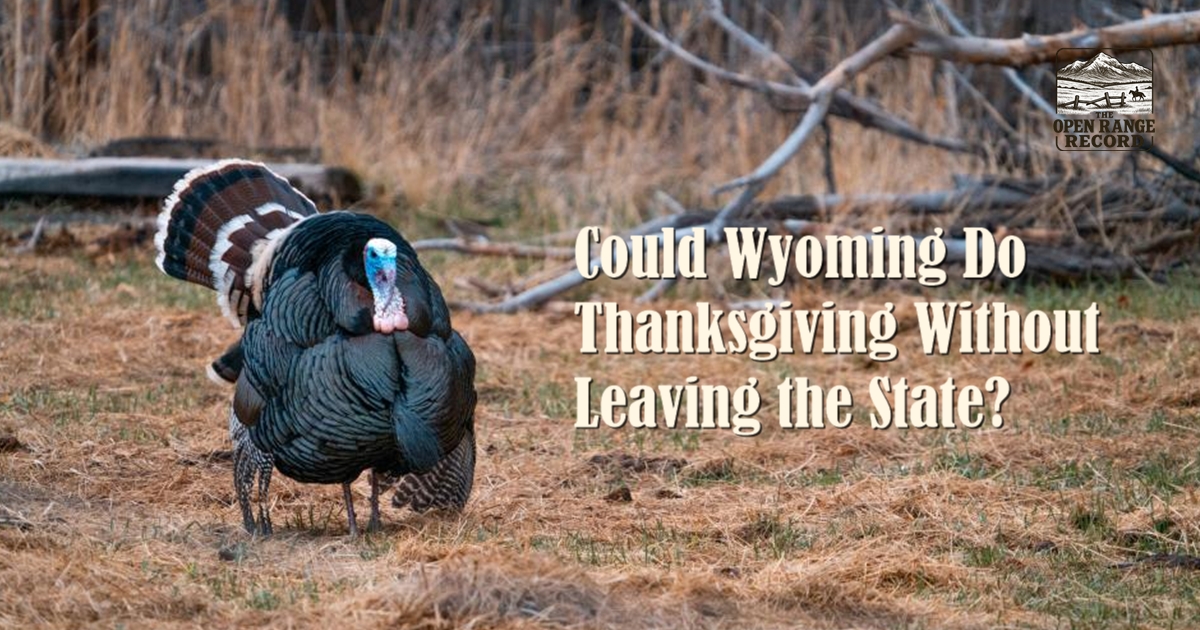
Wyoming isn't a significant producer of commercial turkeys. Minnesota, North Carolina, Arkansas, and Indiana collectively raise more than half of America's turkeys. But depending on just how traditional you want your Thanksgiving dinner to be, Wyoming has plenty of the irritating birds running around.
Wyoming hunters harvested a record 5,072 wild turkeys this spring, thanks in part to a rather unusual trade made more than 90 years ago. In 1935, Wyoming traded sage grouse to New Mexico for 15 Merriam's wild turkeys. The birds were released on the George Waln Ranch in Platte County. By 1947, Wyoming's wild turkey population had grown to more than 1,000. The descendants of those original immigrants now inhabit numerous parts of the Cowboy State.
Of course, if you didn't get a turkey this year, Wyoming has more than a million cattle. Nobody should be terribly disappointed if Thanksgiving dinner turns out to be prime rib. If that's the dinner of choice, Wyoming is in good shape.
Pass the Mashed Potatoes
Despite living next door to a state that has practically trademarked the potato, Wyoming grows a fair number of its own. Approximately 1,000 acres were devoted to potatoes in 2025. There shouldn't be much difficulty finding something to mash.
Nor should there be a shortage of milk and butter to put in them. Wyoming dairy cows produced approximately 28.9 million gallons of milk in 2024. That's roughly 49 gallons for every man, woman, and child in the state.
Sweet potatoes, however, present something of a problem. Wyoming's growing season isn't particularly well-suited to commercial sweet potato production. North Carolina produces more than half of the nation's crop. You might have to settle for a second helping of regular mashed potatoes.
The Great Green Bean Shortage
Things get a little more interesting when we get to the green bean casserole. According to the USDA's 2022 Census of Agriculture, 14 Wyoming farms grew green beans. Their combined acreage amounted to just three acres. For perspective, Wyoming devotes nearly 29 million acres to agriculture, and just a little more than the size of two football fields to green beans.
If everyone in Wyoming insists on having green bean casserole, we may have to establish some sort of rationing system. Pinto beans, on the other hand, are another matter entirely. In 2022, Wyoming farmers harvested more than 31 million pounds of dry edible beans.
Perhaps it's time to introduce a uniquely Wyoming Thanksgiving tradition: pinto bean casserole. Getting Grandma to part with her green bean casserole recipe, or convincing dinner guests to eat it, however, might prove more difficult than growing the green beans themselves.
Dinner Rolls? No Problem
Wyoming farmers harvested approximately 2.67 million bushels of winter wheat in 2025. A bushel of wheat can produce roughly 60 pounds of whole wheat flour. That's enough raw material for an extraordinary number of dinner rolls, not to mention stuffing, pie crusts, and the flour needed to thicken the gravy.
Sugar shouldn't be a problem either. Wyoming farmers harvested nearly a million tons of sugar beets in 2025. Between the wheat, sugar, and dairy products, Wyoming has the agricultural ingredients for a fairly impressive bakery.
A Slight but Serious Problem with the Cranberries
If your Thanksgiving dinner simply isn't complete without a gelatinous, cranberry-flavored cylinder bearing the unmistakable ridges of a tin can, you're probably going to have to rely on another state. Wisconsin produces the majority of America's cranberries, followed by Massachusetts. Wyoming isn't really a significant cranberry producer.
However, Wyoming does have chokecherries. Anyone who has spent an afternoon picking them and a considerably longer evening cleaning the kitchen knows they make excellent jelly. A little homemade chokecherry sauce might be a perfectly acceptable Wyoming substitute for cranberries.
Don't Throw Away That Halloween Pumpkin
In 2022, Wyoming had 15 farms harvesting a combined 15 acres of pumpkins, up from 10 acres five years earlier. Using a typical agricultural yield of 2,000 pumpkins per acre, Wyoming's entire reported crop would amount to approximately 30,000 pumpkins.
Assuming each pumpkin produced enough puree for two pies, and each pie was cut into eight slices, Wyoming could theoretically produce 60,000 pumpkin pies — enough to provide dessert for roughly 81% of the state's population.
That's an optimistic calculation, particularly since Wyoming's reported pumpkin acreage includes pumpkins grown for decoration rather than pie filling. Nevertheless, if we planted a few more acres of pie pumpkins, cut the slices a little thinner and convinced a few people to have seconds on the mashed potatoes instead, we might just make it.
On the other hand, lots of people grown their own pumpkins—some of which set records. If we’re all nice to our neighbors, perhaps the pie won’t be an issue anyway.
Whipped cream, of course, definitely wouldn’t be a problem.
And Now, the Wine
Believe it or not, there's no need to call California. Wyoming may not immediately come to mind when someone mentions wine country, but the Cowboy State has its own vineyards producing grapes hardy enough to survive Wyoming winters.
Table Mountain Vineyards near Huntley got its start in 2001 as a University of Wyoming student research project. Today, the vineyard boasts approximately 10,000 grapevines growing on nearly 10 acres, with a dozen different varieties of grapes.
In Big Horn County, Mustang Mountain Vineyard near Lovell has more than 800 grapevines representing four varieties of grapes. The family-owned operation began planting grapes in 2010. Not all wine made in Wyoming is made from Wyoming grapes. Jackson Hole Winery, for example, sources its grapes from California and Washington. Imports into Jackson may be as Wyoming as anything.
But whether we're serving wild turkey or prime rib, there is something grown and bottled right here in Wyoming to accompany dinner. Considering that Table Mountain alone devotes more than three times as much acreage to grapes as the entire state devotes to green beans, we might have an easier time filling the wine glasses than the casserole dish.
The Wyoming Thanksgiving Dinner
With a little ingenuity, Wyoming could put together a Thanksgiving dinner consisting of wild turkey or prime rib, mashed potatoes and gravy, homemade dinner rolls, pinto bean casserole, chokecherry sauce, and pumpkin pie topped with whipped cream. And we could wash it all down with a glass of Wyoming wine.
There is, however, one complication. Growing the ingredients and turning them into the products found on grocery store shelves are two entirely different things. Wyoming-grown wheat, milk, and other commodities may travel outside the state for processing before returning to Wyoming kitchens.
A 2025 University of Wyoming Extension study estimated that Wyoming's local food sector contributes $24.4 million to the state's economy. Researchers calculated that shifting just 5% of Wyoming residents' at-home food expenditures toward locally produced food could generate a net increase of $36.3 million in the state's gross domestic product. There may be some real economic opportunity hidden in our hypothetical Thanksgiving dinner.
In the meantime, Wyoming residents have plenty to be thankful for. We live in a state that produces an abundance of food, and we live in a country where farmers thousands of miles away can supply the things we don't grow ourselves.
And, if you’ve ever tried a wild turkey for Thanksgiving, you might be willing to forego tradition altogether and opt for the prime rib that Wyoming has in abundance. There’s something to be said for tradition, but there may also be something to doing away with it. Regardless of what’s on the table, one thing is for certain; we all have an incredible amount to be thankful for.