NEWS
Among the beans, onions, tomatoes, and a couple of peppers that every Sunday pot of chili requires is a pound of hamburger that now costs almost as much as a steak did a few short years ago. One pound of 93% lean burger sold for $11 over the weekend—not a ribeye or a T-bone, burger. Granted, that’s a higher end package of meat. But even its 80% lean counterpart was selling for $5.49 per pound. The reason for the high price of beef is a combination of processing capacity, a concentrated meatpacking industry, and familiar Wyoming market disadvantages.
Wyoming has nearly two cattle for every man, woman and child living in the state. With approximately 1.16 million cattle and fewer than 600,000 residents, that sounds like beef prices should be cheap here.
But Wyoming consumers know otherwise. On November 22, a pound of 85% lean ground beef was priced at $5.49 at Albertsons in Sheridan. The 93% lean variety cost more than $11 per pound. That's a considerable amount of money for hamburger in a state where raising cattle is one of its largest agricultural enterprises.
So why does beef cost so much in Wyoming? The answer involves more than drought, declining cattle inventories, or federal import policies. Wyoming's beef industry has a structural problem, potentially exacerbated by limited competition at the processing level of the supply chain. And the problem bears a striking resemblance to another familiar Wyoming frustration: gasoline prices.
Wyoming Raises Cattle. Other States Process Much of the Beef.
Wyoming produces substantial quantities of crude oil, yet motorists pay gasoline prices influenced by regional refining and distribution markets. Some Wyoming oil is refined elsewhere, while the state also maintains its own refineries.
The cattle industry operates similarly. Wyoming ranchers primarily operate cow-calf businesses, raising young cattle that are subsequently sold to feedlots for additional growth. According to a Wyoming Business Council beef industry study released in 2020, cattle commonly leave the state as calves or yearlings, frequently heading to feedlots in neighboring states before being sold to meatpacking companies.
Once slaughtered, the meat enters national wholesale and distribution networks. Some eventually returns to Wyoming grocery stores, although not necessarily to the communities where the animals originated.
Transportation adds expenses, but the larger issue is that Wyoming's cattle are sold into a national market. The state's abundance of livestock doesn't automatically create a separate, less expensive supply of retail beef for its residents. Much like gasoline, producing the raw commodity doesn't guarantee a discount on the finished product.
What Are Wyoming Ranchers Actually Getting?
Recent Wyoming livestock auctions provide a useful illustration of the difference between cattle prices and retail beef prices. According to Buffalo Livestock Marketing's November 18 sale report, 44 steer calves averaging 551 pounds sold for $4.46 per pound of live weight, bringing approximately $2,459 per animal. Another 26 steers averaging 470 pounds sold for six dollars less.
Heifers also commanded substantial prices. A lot of 51 heifers averaging 503 pounds sold for $4.23 per pound, bringing approximately $2,127 per animal. But the same auction produced significantly different results for slaughter cows. A lot of 17 cows averaging 1,236 pounds sold for $1.29 per pound, or approximately $1,595 per animal.
A young feeder steer is generally purchased for additional growth and future beef production. An older slaughter cow is ordinarily purchased for immediate processing, with much of its meat entering the ground-beef market. The prices reflect different animals, markets, and economic expectations. And neither can be directly compared with the price of a pound of hamburger.
Recent Reporting Misses a Larger Issue
A recent Wyoming media article highlighted a report showing that ranchers were receiving nearly 20% less for cows used in ground beef following President Donald Trump's expansion of certain beef import quotas. The article raised a legitimate concern: Cattle prices had declined while grocery shoppers were seeing comparatively little relief.
But that explanation oversimplifies what is happening in the cattle market. The reported declines primarily concerned cull cows—older breeding animals sold for slaughter—not the feeder calves that constitute a major portion of Wyoming ranchers' annual production.
Furthermore, cattle prices fluctuate seasonally. A price decline following a policy change doesn't establish that the policy caused the entire decrease. The problem gets worse when the relative lack of meatpacking competition is figured in.
The USDA's November 2026 Packers and Stockyards report found that four companies handled 81% of federally inspected steer and heifer slaughter in 2025. But for cows and bulls, the four largest processors accounted for just 43%.
In other words, the segment of the industry most directly relevant to the reported cull-cow price declines is substantially less concentrated nationally than the finished-steer market. That doesn't mean that competition is sufficient or that the import policy had no effect. It most certainly did. But it demonstrates why treating all cattle markets as interchangeable produces an incomplete explanation.
The more fundamental question is what happens to prices as cattle move through the processing and retail system—and whether competition within that system is sufficient to transmit cost savings to consumers.
Four Companies Dominate Finished-Cattle Processing
America's major fed-cattle processors include JBS, Tyson Foods, Cargill, and National Beef. Together, those companies handled approximately 81% of federally inspected steer and heifer and 43% of cow and bull slaughter in 2025. That concentration creates two competing economic effects.
Large processing plants operate with substantial economies of scale. Processing thousands of cattle daily allows companies to spread labor, equipment, refrigeration, and other expenses across enormous production volumes. But fewer competing buyers can also mean less competition when producers sell finished cattle.
The USDA acknowledges that concentrated livestock markets can create opportunities for large buyers to exercise market power, potentially affecting prices paid to producers. There is also a distinction between a processing company's gross margin and its profit. The difference between what a company pays for cattle and receives for beef must cover substantial operating expenses.
Nevertheless, limited competition can affect how prices are established, particularly when supply conditions change. For Wyoming ranchers, the concern is not simply that four companies dominate national processing. It's that the state's limited alternatives make participation in that national system difficult to avoid.
Wyoming's $148 Processing Disadvantage
One of the most revealing findings comes from a recent beef industry study. Researchers identified a problem that receives comparatively little attention: the value of animal byproducts. Major meatpackers sell hides, organs, fats and other materials into other commercial markets. That revenue helps offset processing costs. Wyoming's smaller processors often lack access to those markets and may instead pay to dispose of materials larger companies can sell.
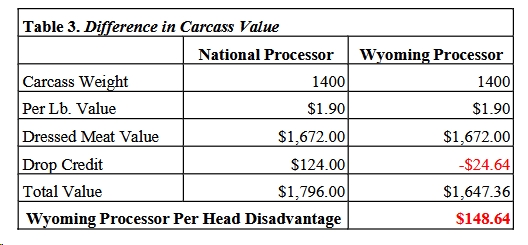
The study calculated that differences in byproduct revenue and disposal expenses alone created a $148.64-per-animal disadvantage for Wyoming processors compared with major packing operations. That figure was based on conditions examined in the 2019 study, not current 2026 prices. Nevertheless, it illustrates a structural obstacle. Put simply, Wyoming meat-packers must send animal byproducts to the landfill where larger companies can sell them.
The study also estimated Wyoming's annual slaughter capacity at approximately 21,320 animals at the time. Even expanding local slaughter capacity doesn't automatically eliminate the disadvantage. Processing facilities require sufficient volumes of slaughter-ready cattle, skilled employees, dependable customers, and access to commercial markets.
A small Wyoming processor may produce excellent beef while still facing substantially higher costs per animal than a major plant in Nebraska. That makes competing exclusively on price difficult.
Where Does the Consumer's Dollar Go?
The USDA publishes farm-to-wholesale and wholesale-to-retail beef price spreads to track how the value of cattle changes through the supply chain. Those figures provide a more meaningful comparison than placing the live price of a slaughter cow alongside the retail price of hamburger.
A finished steer weighing approximately 1,400 pounds might produce around 550 pounds of packaged beef, depending on how the animal is processed. But that beef includes steaks, roasts, ground beef, and other cuts with dramatically different market values. The difference between the animal's purchase price and its total retail value accounts for processing, transportation, distribution, operating costs, and business margins. It cannot automatically be characterized as profit.
However, the existence of legitimate processing costs doesn't eliminate questions about competition. When cattle prices decline but retail beef prices remain high, the important issue is whether the difference reflects higher expenses, delayed price adjustments, changing margins, or the exercise of market power. Determining that requires examining wholesale and retail prices separately.
Plenty of Cattle Doesn't Mean Cheap Beef
Wyoming's situation is further complicated by the shrinking national herd. The USDA counted approximately 86.2 million cattle and calves nationwide at the beginning of 2026, one of the lowest inventories in decades. Wyoming's own herd declined from 1.22 million to 1.16 million head over the preceding year. Fewer animals, continued consumer demand, and rising production expenses contribute to elevated prices throughout the country.
But those factors alone don't explain why producing so many cattle offers Wyoming consumers so little apparent advantage. The state raises the animals, but much of their subsequent economic value is created through feeding, slaughter, processing, and distribution elsewhere.
Expanding Wyoming processing could retain more of that value locally, increase marketing opportunities for ranchers, and offer consumers additional choices. Whether it would lower retail prices depends on whether those operations could overcome their substantial cost disadvantages.
Wyoming's beef-pricing problem isn't simply about how many cattle are raised or what happens during a 90-day federal import program. It's about the economic structure connecting ranchers to consumers, the limited alternatives available within that structure, and the degree of competition at each stage.
Wyoming has plenty of cattle. What it doesn't have is a separate Wyoming market price for beef. And until more of the supply chain can operate competitively within the state, having two cows for every resident won't necessarily make hamburger any cheaper.