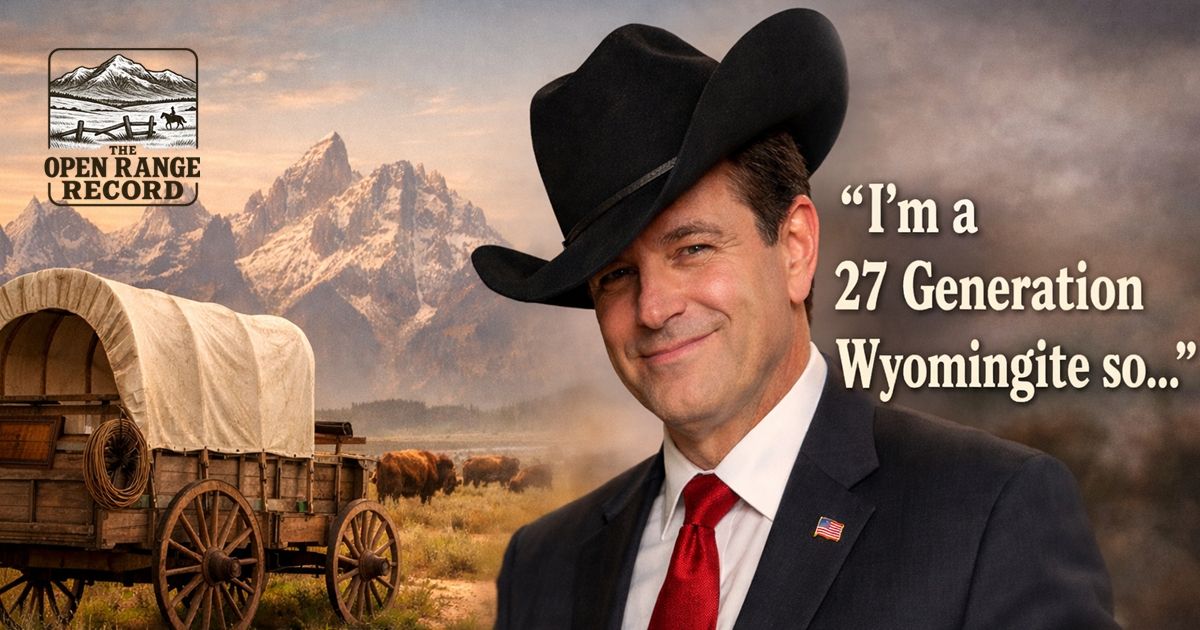
CHEYENNE : For much of the 2026 election cycle, a specific rhetorical defense has emerged from the traditional wings of the Wyoming establishment. It is the appeal to residency tenure. Candidates and officials frequently cite their status as fifth- or sixth-generation Wyomingites as a primary qualification for leadership. The underlying argument is that a deep family history within the state confers a superior right to direct its future.
However, recent data from the U.S. Census Bureau and the Wyoming Economic Analysis Division reveal that this "Old Wyoming" demographic is not only a numerical minority but is also statistically inconsistent with the very logic of the argument.
According to the latest figures from the 2024 to 2025 American Community Survey (ACS), less than half of the people living in the Equality State were born here. The data shows that approximately 42.4 percent of residents are Wyoming-born, while over 57 percent were born in another U.S. state or abroad. In a state of roughly 588,000 people, the "native" population is now the minority. This demographic shift has created a significant gap between the rhetoric of the political class and the reality of the constituency.
The focus on being a fifth- or sixth-generation Wyomingite is a common point of pride, yet the math of statehood limits the weight of this claim. Wyoming achieved statehood on July 10, 1890, exactly 136 years ago. Given that a standard generation is defined as 25 to 30 years, a family that arrived during the initial pioneer push of the 1890s would currently be on its fifth or sixth generation.
While these families represent the bedrock of the 1890 settler era, they comprise a statistically small portion of the current population. Data on housing tenure shows that the average Wyoming resident has lived in their current home for approximately 14.2 years. When accounting for those born in the state, the estimated average time any given resident has lived in Wyoming is roughly 26.4 years. This suggests that the majority of the current voting population arrived in the state during the late 1990s or early 2000s, making them first- or second-generation residents.
If the length of a family's history within the state’s borders is the primary benchmark for political legitimacy, the current "native" rhetoric faces a major logical hurdle. Archaeological and historical data from the Wyoming State Historic Preservation Office confirm that indigenous tribes, including the Eastern Shoshone and Northern Arapaho, have occupied the region for over 13,000 years.
The Eastern Shoshone were well established in the Wind River Valley for centuries before the 1834 founding of Fort Laramie or the 1890 statehood. If tenure is the premise for the right to rule, the 136-year history of settler families is eclipsed by the 13,000-year history of the native tribes. Despite this, the group most frequently claiming a superior voice based on "being here first" is often the group whose ancestors arrived during the territorial or early statehood period.
The data also reveals an irony in the current struggle for control in Cheyenne. The Wyoming Freedom Caucus, which recently secured a majority in the Wyoming House with 34 of 62 seats, draws its greatest strength from high growth counties with the highest rates of out-of-state migration.
- Crook County: +9.3 percent growth since 2020.
- Lincoln County: +8.2 percent growth since 2020.
- Sheridan County: +7.5 percent growth since 2020.
These counties are being reshaped by a domestic migration surge from more ideologically rigid individuals leaving "blue" states. This influx has created a situation where newcomers are often the ones unseating long-term, "traditional" residents by labeling them as not conservative enough.
The evidence suggests that the "Old Wyoming" gatekeeping effort is being conducted by a group that is numerically shrinking. While the rhetoric focuses on 1890 roots, the state’s actual character is being directed by a majority of residents who have lived in the state for less than three decades.
If the "right to rule" is based on tenure, the data shifts the conversation toward indigenous history. If it is based on the majority, the data shifts it toward the newcomers. By attempting to use residency length as a shield against political change, the establishment is relying on a minority status that no longer aligns with the Wyoming of 2026.

Data Disclaimer: Statistics regarding birthplace, housing tenure, and migration flows are derived from the U.S. Census Bureau’s 2024 to 2025 American Community Survey and the Wyoming Economic Analysis Division. Historical dates regarding statehood and tribal settlement are sourced from the Wyoming State Archives.