NEWS
For years before any formal agreement existed, Sheridan County rural fire districts responded to fires deep inside Montana under an informal practice that provided essentially free service for the first 12 hours of each incident. Local taxpayer-supported resources covered those “short-duration” calls with virtually no public accounting of the personnel, apparatus hours, or funds expended, and with no automatic recovery from Montana jurisdictions. The practice continued until Sheridan County commissioners approved a written Mutual Aid Agreement with Big Horn County, Montana, in 2026 that codified the same 12-hour free period.
Fire Warden Chris Thomas has described the longstanding, and until recently, completely informal, reciprocal approach: agencies generally did not invoice one another for the first 12 hours. A clear example of this is the February 15, 2026, Wyola grass fire. The Tongue River Fire District and Dayton Fire Department responded to a request from Big Horn County, Montana, and BIA Fire. The fire was located on Little Horn Road, roughly two miles west of Wyola on the Crow Reservation—approximately 23 miles north of Ranchester and fully inside Montana, with virtually no realistic possibility of it threatening Wyoming.
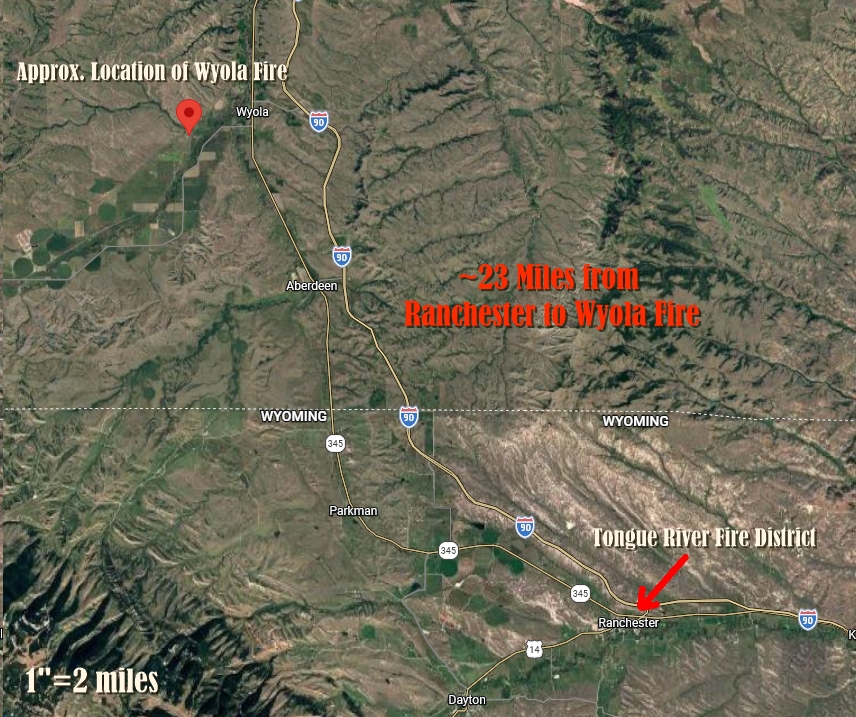
Public reporting and district statements treat the response as mutual aid, and Thomas confirmed that there would be no invoicing because it lasted less than 12 hours. The Wyola fire occurred a full 6 months before any formal agreement had been signed between Sheridan County, WY and Big Horn County, MT or the Crow Reservation. When The Open Range Record asked Sheridan County Fire Warden Chris Thomas for an accounting of costs for the Wyola fire, he only said, “That fell within the 12-hour mutual aid period.”
It is not a question of whether fires should be fought. They should. The question is who is paying the bill and are those costs being accounted for. Fire districts have been some of the most vocal opponents of Proposition 1, claiming that it represents a threat to their budgets. So too does unaccounted work in another state. Under the mutual aid agreement, Wyoming and Sheridan County fire districts could fight fires for an entire summer in Montana with no compensation. If, indeed, Proposition 1 is a threat to fire budgets, taxpayers should have an accounting of the costs of this years-long and largely informal mutual aid agreement.
The Open Range Record repeatedly asked Tongue River Fire District Chief Jeff Barron for comment on cost accounting for fires fought inside Montana. We asked, The Open Range Record is “working on a piece concerning fire services provided to Big Horn County, MT by Sheridan County fire districts. Have you ever invoiced Big Horn County for your fire district responding to a fire that is strictly contained within Montana? If so, for what fire and what was the dollar amount?”
Barron did not substantively respond to our repeated request. He replied, “can’t wait for your article, [sic] I wish you and Dave, the best of luck on this article.”
Other documented 2026 responses include the July Frisbie Fire near the border, the September Davis Coulee/Shoulder Blade Fire, and the October Border Fire. Thomas recalled only one Montana deployment that year—Davis Coulee—for which billing was submitted through the state process. Across these incidents, and except for the Davis Coulee fire, public records show virtually no detailed accounting of the Sheridan County resources committed or the taxpayer dollars expended in any fire fought under the informal, and later formalized, mutual aid agreement.
Throughout this investigation, The Open Range Record was unable to locate itemized costs for any of the fires fought under the informal agreement. Chief Barron, whose department responds to most of the fires in question was non-responsive. The Sheridan County Commissioners noted that these costs were under the purview of individual fire districts.
On September 1, 2026, the Sheridan County Commissioners re-approved the county-to-county Mutual Aid Agreement (an earlier version had been approved in April). Section 9 states that “All activities performed by the Responding Party under this Agreement will be at no cost for the first twelve (12) hours of each incident.” After that window, the parties negotiate in “good faith” for expenses.
The agreement is open-ended until terminated with 30 days’ notice and contains no rate schedule. It is between the two counties; independent fire districts are not automatically parties to the agreement. In other words, while Sheridan County has a loose mutual aid agreement with Big Horn County, fire districts, who operate mostly independently from the County Commissioners, do not. Thomas told The Open Range Record that Chief Barron is working on an agreement for his district but nothing has been signed yet.
The October 6, 2026, Border Fire shows the practical outcome of the practice. Sparks from a BNSF Railway train started multiple fires spanning from Parkman, Wyoming, toward and beyond the state line. Tongue River, Dayton, Goose Valley, Clearmont, and other local resources responded. Thomas said the incident ended inside the 12-hour window, so no interagency invoice was generated. Asked about billing the railroad, he said the districts “haven’t decided” whether to pursue BNSF—even though the cause is documented as train sparks, making a claim against the railroad straightforward and BNSF would likely pay the invoice immediately.
Rural districts have been vocal about perceived budget pressure. Barron said in a letter to The Sheridan Press that Tongue River’s operating budget is in the $78,000 range. Officials have discussed limited apparatus reserves, high replacement costs for Type 6 engines, and the potential additional impact of Proposition 1. Chief Barron, after the Wyola response, noted that the districts answer calls across county and state lines “on a shoestring budget.” If that is true, an accounting of costs becomes all the more necessary.
Barron told the Casper Star Tribune on October 14, “I have to react to what’s on pen and paper today, and the reality is I’m looking at half the budget coming on July 1.” He offered no reasoning why his budget would face such deep costs if the ballot measure passes. Additionally, there is no accessible accounting, on paper, of the costs of what Chris Thomas characterized as “90% of the calls we respond to.”
However, it’s clear that Sheridan County fire districts have operated for years, until this year’s formal agreement, on what is little more than a handshake and virtually no accounting of costs for numerous fires lasting less than 12 hours. It’s difficult to ascertain the required size of a budget when there has been little to no accounting of what is actually spent in fighting 90% of the fires Sheridan County fire districts respond to.