NEWS
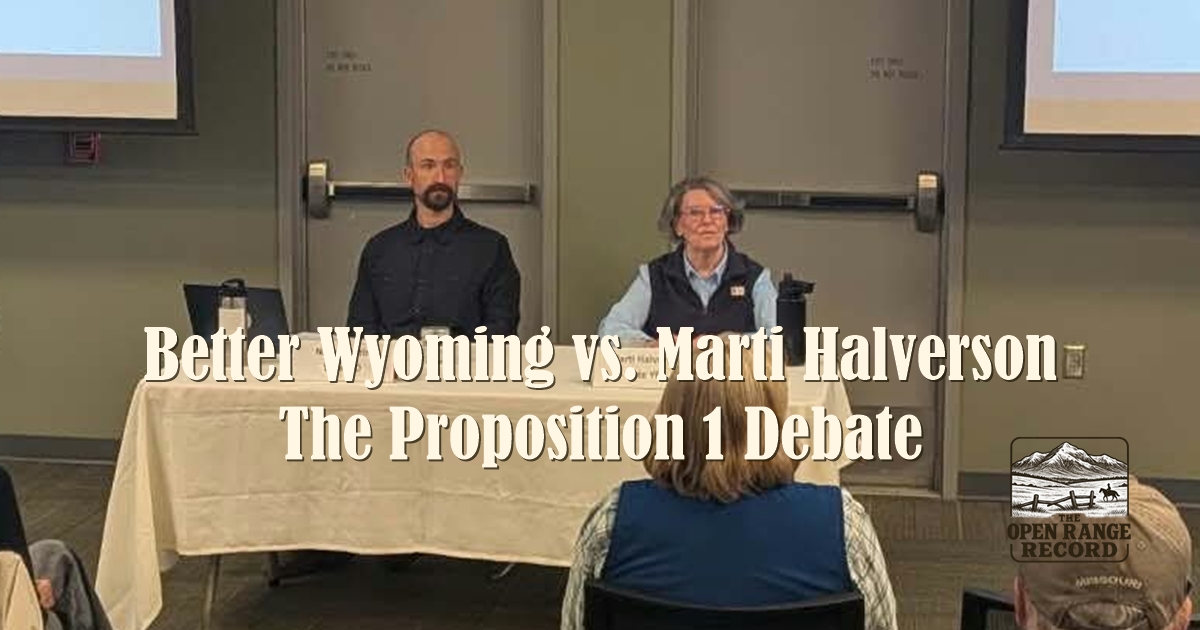
At the October 14 Proposition 1 debate, Marti Halverson asked how much Wyoming government could afford to give back. Nate Martin asked the audience to imagine what it might lose.
Halverson, a former state representative from Lincoln County, brought figures about property taxes, government revenue, and accumulated reserves. Martin, executive director of Better Wyoming, brought children’s playgrounds, Paw Patrol, breast cancer, and an injured firefighter into his argument.
Public services matter, but so does whether a family can afford to remain in its home. A debate about taxes requires more than placing beloved services and terrible tragedies on one side and homeowner relief on the other.
Citizens did the work to put this on the ballot
Three applicants: Brent Bien, Rich Weber, and Cheryl Aguiar, organized the initiative. In May 2024, organizers delivered 44,650 signatures to the Secretary of State’s office after roughly eight months of work by 315 volunteers. The Secretary of State verified 30,251 valid signatures and certified the initiative on January 2, 2025. Proposition 1 is the first initiative to reach the Wyoming ballot in 30 years. The organizers believed legislators had not delivered sufficient property tax relief. Bien and Aguiar publicly credited the petition campaign with putting pressure on the Legislature.
Martin gave the audience a different account. “Proposition 1 is a Freedom Caucus proposal,” he said, comparing it to “the nasty leftovers stuck into the back of the fridge” that voters should discard. He had just celebrated the Freedom Caucus’s August primary setbacks. Now he was asking listeners to treat the initiative as the next part of that political cleanup.
Political support from Freedom Caucus members does not turn a citizen sponsorship into Freedom Caucus authorship. Those signatures were submitted months before the November 2024 election that gave the conservative caucus its opportunity to lead the House.
Martin’s description was disingenuous. He packaged opposition to Proposition 1 with opposition to conservative lawmakers, inviting listeners to reject the citizens’ proposal on the strength of their dislike for the Freedom Caucus.
A firefighter’s injury became part of the tax argument
Martin said Laramie firefighters were suing the city over inadequate funding and staffing. He then described a firefighter who had broken his back the previous year, said he would never walk again, and mentioned his young children. Dylan Schilt who was gravely injured on February 28, 2025, when a massive chimney structure collapsed during a house fire. Martin did not explain that a tax cut caused it, and he supplied no evidence connecting the two.
Governor Mark Gordon signed Senate File 69, creating the 25 percent homeowner exemption, on March 4—four days after Schilt was injured. Although it applied to the 2025 tax year, the law had not been enacted when Schilt was injured. That accident cannot demonstrate that this law had already reduced collections and staffing beforehand.
By June 26, 2025, Cowboy State Daily reported that Schilt had walked out of inpatient rehabilitation under his own strength, although his recovery remained difficult and incomplete. If Schilt was the firefighter Martin meant, the claim that he would never walk again disregarded a recovery publicly reported more than a year before this debate.
A firefighter’s suffering deserves accuracy and respect. Inviting a connection to tax relief without demonstrating it seemed to cross a line.
Halverson challenged the size of the claimed crisis
Proposition 1 would not cut all Wyoming property taxes in half. It targets qualifying primary residential structures, leaving land and other categories of taxable property outside that exemption.
Halverson said residential property taxes averaged 8 percent of total county revenue statewide, making a reduction of half that share roughly a 4 percent adjustment. For Lincoln, Teton and Albany counties, she cited 14 percent and an approximately 7 percent adjustment. For Campbell and Niobrara, it would amount to 3 percent and approximately 1.5 percent respectively. However, her question was straightforward: What portion of the government’s entire budget is actually at stake?
Martin emphasized that some special districts rely heavily on property taxes. Even a district funded entirely by property taxes would not automatically lose half its revenue: Its tax base may include minerals, businesses, land and homes that do not qualify. A credible closure warning needs that district’s numbers.
Halverson’s approximately $5.8 billion reserve figure also has a foundation. The Department of Audit’s FY2025 compilation lists $2.55 billion in county cash and investments, $1.57 billion for first class cities, $349 million for smaller towns and $1.38 billion for special districts—a combined $5.847 billion. About $895 million was classified as non-spendable or restricted and $865 million as committed. The remaining $4.09 billion is not automatically surplus.
Martin defended savings for major purchases. Halverson distinguished legal restrictions from priorities chosen by local officials. Every balance deserves examination, even though finite savings cannot permanently replace annual revenue.
Local officials still choose their priorities
When Martin cited library closures and reduced hours, Halverson pointed to county commissioners. Wyoming law provides for county library funding, while appointed library boards control and expend the library fund. Those decisions have identifiable local decision-makers.
When commissioners approve raises, reserve money for discretionary projects, or fund economic development arrangements with private businesses, those choices belong in the same discussion as a proposed library reduction. Why does one expenditure take priority over a service officials say they cannot afford?
Halverson emphasized that independent special districts have their own boards and revenue restrictions; commissioners do not control every district’s spending, but neither should essential services become the automatic examples of what taxpayers will lose while other spending escapes examination.
Laramie’s own November 24, 2025, work-session packet complicates Martin’s account of earlier relief. The city said it had anticipated the initial decreases and had not needed to cut services because of them. Property taxes represented 7 percent of its FY2026 General Fund forecast.
The application deadline was extended to March 1. Homeowners who assumed the exemption would continue, would lose it by missing the deadline; others no longer qualified under the occupancy requirement. Either could produce a higher bill without an increase in value or mill levy.
A journalist asked whether application barriers could also limit participation in Proposition 1 and reduce its revenue impact. “I mean, hypothetically, that seems like it’s probably true,” Martin answered, before emphasizing that the state fiscal estimate excluded local losses.
Lincoln County residents deserve the same comparison: exemption totals, taxable values, levies and budget projections. Did taxable value returning to the rolls affect spending decisions? Martin had admitted that this was true.
Teton wealth and the organization behind the message
The debate took place in Teton County, whose 2024 per capita personal income was $532,903, the nation’s highest according to Wyoming’s Economic Analysis Division. That average does not describe a typical working household.
Near the end, Halverson described outside investment firms buying Wyoming property and driving up values. Martin acknowledged her point: “I’m glad, Marti, that you brought up the fact that we have private equity coming in here.”
He then argued that lower property taxes would attract more wealthy buyers and speculation. They disagreed about the remedy but recognized pressure from outside investment. Existing homeowners can face the tax consequences of surrounding wealth without receiving the investment income that creates it.
Nate Martin’s Better Wyoming has connections to Teton’s philanthropic wealth. Its website lists Liz Storer, president and CEO of the George B. Storer Foundation, on its board. IRS-derived grant databases report substantial foundation support for the organization. Martin’s organization is supported by philanthropic wealth and opposes broad homeowner relief while its director identifies wealthy newcomers as part of the problem.
The questions Martin did not resolve
Halverson acknowledged the risk of lawmakers shifting taxes elsewhere. Martin favored taxing luxury home sales; Halverson preferred a purchase tax over recurring property taxation. Proposition 1 enacts neither alternative.
Martin made people fear this exemption without demonstrating the catastrophe he described. Halverson’s challenge remains: Show the revenue, explain the reserves and justify the priorities before telling homeowners there is nothing left to give.
The Open Range Record reached out to Marti Halverson for a statement on the debate:
“The community organizer claimed Prop 1 was “reckless and fiscally irresponsible”. He wrongly claimed Prop 1 would add to the 25% for a 75% hit - even the N&G had to correct him. Many sob stories. I presented precise data and facts. Judging from audience reaction, Jackson folks are NOT buying the gloom and doom.”