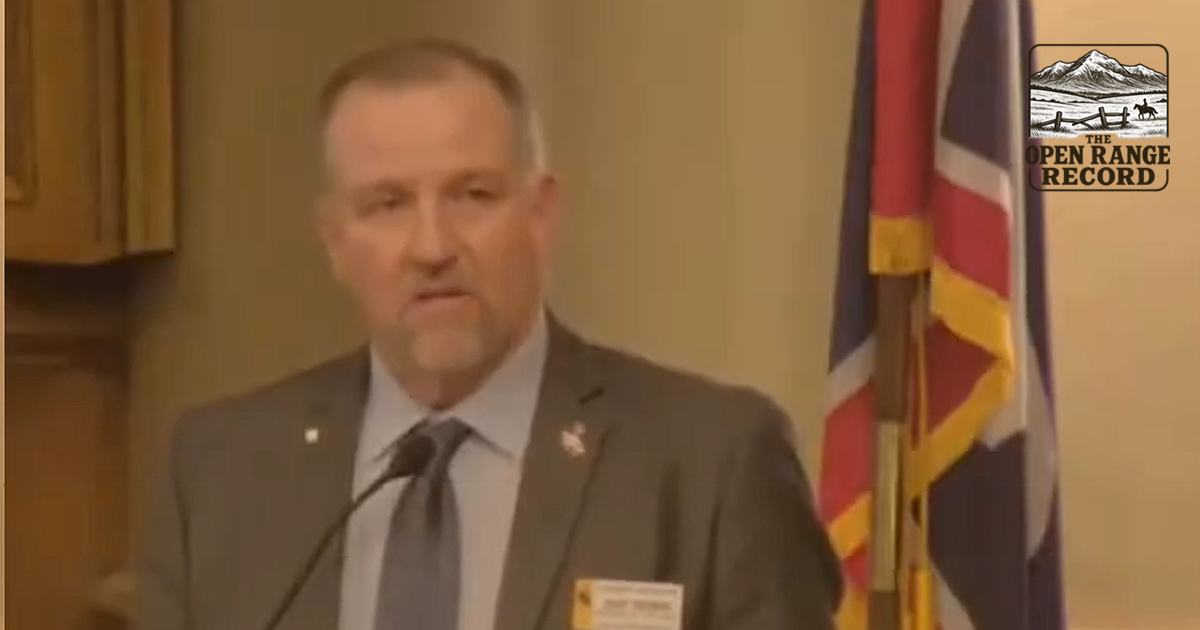
Editor's Note: The quotation below, “I have publicly said I welcome the investigation and my conscience is clear. My heart is pure. I did nothing wrong. Made a stupid innocent mistake… I take responsibility for that,” is mis-attributed to Rep Darin McCann. It was actually said by Rep Joe Webb.
By the time
the Wyoming House gaveled in, the room already felt different. You could hear
it in the way members spoke—measured at first, then sharper. You could see it
in the way they watched one another. Everyone understood that what had started
as a moment—a photo, a question—had turned into something much bigger.
And underneath it all was a quieter truth: This didn’t blow up because of what
happened. It blew up because of how it was handled.
The Night the Process Broke
There is a
way these things are supposed to work. A concern is raised; leadership reviews
it; facts are established. If something is wrong, it’s addressed. That’s the
process.
Speaker Chip Neiman said it plainly on the floor: “If there was a complaint, it
was brought to leadership… we’d look into it… figure out if there’s something
there there and then proceed.”
Then he said the part that hung in the air: “It didn’t go to the media first.” But, this time, it did.
And from that moment on, the House wasn’t managing a situation—it was reacting
to a narrative already forming outside the building.
The Open Range Record published a detailed report showing that Rep Karlee Provenza and Rep Mike Yin violated the Joint Rules of the Wyoming Legislature (page 24) from the very beginning of this controversy.
Optics Took the Lead
No one
denied the obvious. The image looked bad. That’s what gave it power. That’s
what made it travel. But once it was out, members weren’t debating facts
anymore—they were responding to public perception before the facts had been
fully established.
Representative Darin McCann, the man in that moment, stood up and did something
not everyone in politics is willing to do: “I have publicly said I welcome the
investigation and my conscience is clear. My heart is pure. I did nothing
wrong. Made a stupid innocent mistake… I take responsibility for that.”
It was one of the few moments that felt human in a room that had become
intensely political.
The Emotional Center of the Night
Speaker
Neiman didn’t speak like a man delivering a prepared statement. He spoke like
someone carrying the weight of it. “From my perspective I want this over
yesterday… I think we owe it to this house for this to be over yesterday.”
Then the reality of what had already happened came through: “Now I’ve got
people at home… angry at me because I’m taking bribes… and I’m not.”
And the line that cut to the core of it all: “This could have been solved…
instead we went from A to Z.”
That’s what the room was grappling with. Not just what happened—but how quickly
it escalated past the point of control. There was a moment on the floor when
the noise dropped. Not completely—but enough. Because for a few minutes, this
wasn’t about rules, or motions, or procedure. It was about people.
And in that moment, Representative Mike Yin stood out. He didn’t come across
like someone trying to win. He came across as someone who understood what had
happened—and what he had done. “There are definitely people who will not speak
to me on this floor anymore… there are consequences to what I did.”
You could feel that. It wasn’t polished; it wasn’t political. It was honest.
And in a room that had turned defensive and divided, that kind of honesty
mattered. He didn’t dodge the legal side either. He laid it out plainly—what
could happen, what the risks were, what the Constitution says.
You may agree with him or not, but he showed something that night that the
public rarely sees: accountability without theatrics.
Where the Room Turned Cold
Not every moment carried that same weight. Representative Karlee Provenza approached the situation differently—precise, procedural, focused on constitutional implications. She made it clear she did not intend to accuse anyone of bribery.
She already had. During her original motion on Feb 12, 2026, Provenza called for an "ethics" investigation and referenced Wyoming Constitution Article 3, section 42 and 43--both of which are about bribery. Provenza later admitted in an article printed by the Cowboy State Daily that she intentionally bypassed Speaker Neiman in contravention of the Joint Rules and long-established practice in the Wyoming Legislature.
But by the time those words were spoken, the story had already moved far beyond intent. Because what people saw wasn’t a technical argument. They saw:
• a photo
• a headline
• and a narrative that had already taken shape.
And what
many members were looking for in that moment wasn’t another legal explanation.
It was acknowledgment of what had been set in motion—and for many in the room,
that acknowledgment never fully came.
What many were looking for wasn’t just a legal clarification—it was a clear
recognition that her actions had consequences. That’s the disconnect.
The House
had a choice: Wait for law enforcement to do their investigation, or act on its
own. It chose to move forward. The motion to pause the investigation failed.
But by then, the real turning point had already happened. It wasn’t the vote.
It was the moment the issue left the chamber via a photograph taken by
Provenza.
What
happened on that floor didn’t happen in a vacuum. It landed in a political
environment that has been building for months—arguably years. And when you step
back, you begin to see why this didn’t stay contained.
The Network That Already Existed
Public
records show that Better Wyoming operates as a policy and advocacy organization
in the state, with an affiliated entity, Better Wyoming Action Research,
engaged in advocacy and messaging.
Better Wyoming’s own website lists board members including:
• Wyoming Rep Liz Storer, President & CEO of the George B. Storer Foundation
• Nate Martin, Executive Director of Better Wyoming²
Public grant data shows the Storer Foundation has provided significant funding—including grants exceeding $200,000—to Better Wyoming–related entities.
Public commentary and reporting have also identified Nate Martin as the spouse
of Representative Provenza. These are not hidden connections. They are
publicly documented relationships.
Liz Storer,
speaking on the rule change regarding campaign donations, said:
“Thank you Mr. Speaker for the rule. I think the importance is two things. It’s
about honoring the space where we all work and also the period of time that the
session takes place where we have a lot of legislation in front of us. I am
just really cognizant of the fact that campaign contributions really need to be
divorced from the legislative process, and I think that’s what we are trying to
do here. I really make some clear lines so I think this is appropriate,
especially given recent events.”
That statement, on its face, is about separating campaign money from
legislative work. But in the context of what’s already on the public record, it
raises a larger question. Because while direct campaign contributions are
visible, traceable, and regulated—funding that moves through advocacy
organizations operates differently.
Public records show that the George B. Storer Foundation has provided
substantial financial support to Better Wyoming–affiliated
entities—organizations that actively engage in political messaging and public
advocacy. So while the rule being discussed focused on drawing a clear line
around campaign activity inside the chamber, it left open a broader reality:
Political influence doesn’t disappear; it just moves. Not through envelopes on
the floor—but through organizations, messaging campaigns, and public
narrative-building that happen outside it.
And that’s where some members—and many observers—are beginning to ask harder
questions. Not about whether influence exists, but about how it operates, where
it flows, and who it ultimately benefits.
The Messaging That Was Already Happening
Better Wyoming Action Research hasn’t just been observing the Legislature, it has been actively defining it. On its own public-facing materials, the organization presents the Freedom Caucus as a coordinated political bloc and encourages voters to identify and track legislators associated with it.
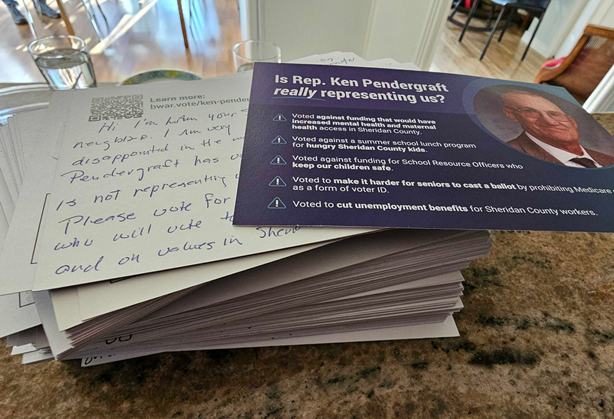
That effort has included:
• published materials attempting to categorize legislators
• issue-based messaging tied to voting behavior
• and broader outreach, including digital campaigns seen by Wyoming residents
Even a cursory examination of reporting shows that Better Wyoming's own website about members of the Wyoming Freedom Caucus isn't correct.
That kind of messaging matters, because when a label is applied often enough,
it becomes the lens through which everything else is viewed.
The Media Amplification
And once
that narrative is established, it doesn’t stay confined to advocacy groups; it
moves. Coverage from outlets like Cowboy State Daily and WyoFile has
consistently focused on internal divisions within the Republican majority and
questions about governance.
That doesn’t mean every story is wrong, but it does mean that framing matters.
Because when coverage repeatedly emphasizes dysfunction, division, and
conflict, it reinforces a broader perception over time.
So when this incident surfaced, it didn’t enter a neutral media environment. It
entered one where the storyline was already familiar, and that’s what gave it
speed.
When that
photo hit, it didn’t land in neutral territory. It landed in a narrative that
was already in motion: That Conservatives—often broadly grouped as “Freedom
Caucus”—are divided. That they can’t govern--that something isn’t working.
Whether that narrative is fair or not—it exists. And when this moment hit the
public, it didn’t create a new story; it reinforced an existing one. A photo
became proof, a question became an accusation, and a moment became
confirmation.
A Party Divided—and a State Watching
What Wyoming
voters are seeing right now isn’t simple. It’s not Democrat vs. Republican.
It’s deeper than that. It’s a party wrestling with itself—over direction, over
leadership, over what the future of Wyoming looks like. Those tensions didn’t
begin this week; they’ve been building for years.
For example, look at education funding. The recalibration required to keep
Wyoming’s system current hasn’t been completed since 2010.
That delay spans multiple legislatures, multiple leaders, and multiple
opportunities to act. So the pressure we’re seeing today didn’t appear
overnight. It was built over time, and the narrative in the media is that the
Freedom Caucus is cutting funding and laying off teachers too.
Final Thoughts
At the end of the day, this didn’t have to happen. A concern could have been raised. Leadership could have reviewed it, and facts could have been established before headlines were written.Instead, a moment was pushed into the public first—and everything that followed was shaped by that decision. Now the House is dealing with the fallout:
A criminal investigation.
A divided chamber.
A narrative already taking hold.
And that narrative—fair or not—is what voters will carry into the next election. But here’s what shouldn’t be lost in all of it: The tension we’re seeing today didn’t start with the 68th Legislature, and it won’t end with it either. Because when process is bypassed, when optics outrun facts, and when narratives take hold before truth catches up—the damage doesn’t just fall on one person or one moment. It lands on the credibility of the entire institution.
Once that starts to erode, it’s a lot harder to rebuild than it was to break.