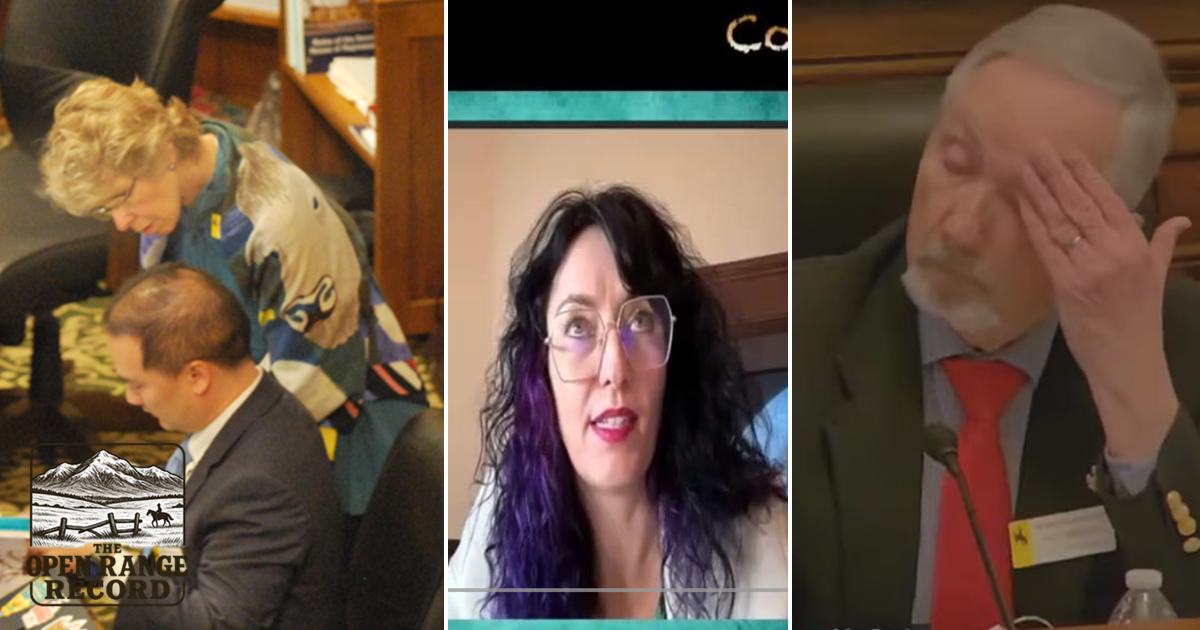
February 9, an incident on the Wyoming House floor unfolded in a matter of minutes. According to sworn testimony, the interaction occurred around 5:20 p.m. and lasted approximately ten minutes. It was brief, contained, and observed in real time. What followed was not.
Within 48 hours, that same moment had become a statewide media story, reported by WyoFile—an outlet where Representative Karlee Provenza has previously contributed as an author. Coverage continued into February 12, expanding the reach of the narrative.
What stands out in that sequence is not just the speed, but the time gap.
There was no public reporting on February 10. That absence sits directly between the incident and the media surge that followed.
According to her own testimony, Representative Karlee Provenza did not keep the matter to herself after observing the event. She stated that she immediately showed the photograph she had taken to Chief Clerk Katie Talbot, asking for what she described as a “gut check.” In that moment, the situation moved beyond a personal observation and into an official legislative office.
The Open Range Record has reported that Provenza had an entirely different story in an interview with the Cowboy State Daily.
From there, she was directed to consult with the Legislative Service Office. Provenza testified that she spoke with LSO staff, including Matt Obrecht, bringing the matter into a legal and procedural setting. At that point, the issue had already reached both administrative and legal channels within the legislature.
She also confirmed that she spoke with other legislators and showed the photograph to Representative Liz Storer. By the end of the evening on February 9, the incident had been shared across multiple layers of the institution—administrative, legal, and political.
There were clear opportunities at each of those points to initiate a formal internal process. Instead, the information moved outward through conversation and consultation. Then came February 10.
Despite the level of internal awareness established the night before, there were no headlines, no public statements, and no visible reporting. The story did not appear in the press. From the public’s perspective, nothing had happened.
But internally, the situation had already been seen, discussed, and evaluated by multiple individuals in positions of responsibility. That makes the silence on February 10 difficult to ignore. On February 11, the silence broke.
The story appeared in WyoFile and the Cowboy State Daily, and coverage continued into February 12. In less than two days, a ten-minute interaction had become a statewide narrative.
The transition was immediate. What had not been public at all the day before was suddenly everywhere. That shift raises a straightforward question: what occurred between February 9 and February 11 that moved this from internal knowledge to coordinated public reporting?
The roles of the individuals involved add another layer to that question.
According to Provenza in her committee testimony, Chief Clerk Katie Talbot was one of the first people shown the photograph. In her position, she operates within the framework of House rules and procedure. Matt Obrecht, through the Legislative Service Office, provides legal guidance and is charged with advising legislators on compliance with those same rules.
Both were consulted directly, according to Provenza. Both were in positions to understand not only what had occurred, but how it should be handled. Neither was called to testify. If the issue at hand involves conduct on the House floor and adherence to legislative rules, their perspectives would appear to be directly relevant. Their absence leaves a noticeable gap in the public record.
The context surrounding how the story moved outward is equally important.
Representative Liz Storer, who was shown the photograph before the story became public, has been publicly described as spending significant time opposing the Wyoming Freedom Caucus, according to a Bowdoin College profile. She has also given, through her George B. Storer Foundation, significant amounts of money to WyoFile and serves on the board of Better Wyoming, an advocacy organization.
Better Wyoming’s executive director is married to Representative Karlee Provenza. Provenza herself has contributed written work to WyoFile, one of the first outlets to publish the story.
Based on the reporting history of the Cowboy State Daily, had Provenza provided the infamous photograph to them, it would have been immediately published. From their history, CSD would not have waited a day and a half to break the story.
These connections do not require speculation to be relevant. They place the individuals involved, the outlet that reported the story, and the advocacy organization within the same overlapping network. When information moves quickly from internal circulation to public reporting within that network, the path it takes becomes part of the story.
The timeline itself is simple. A ten-minute incident occurred on February 9. It was immediately shared across internal legislative channels, including administrative and legal offices. February 10 passed without public reporting. On February 11 and 12, the story appeared across multiple media outlets and spread statewide.
The facts are not complicated, but the sequence—and the gaps within it—raise questions that have yet to be answered. The Special Investigative Committee is due to release their findings Tuesday, March 3, 2026. The facts considered here were not addressed in the Feb. 26 committee meeting.