ANALYSIS
CHEYENNE: Anyone who runs a ranch knows what happens when you let a neighbor park his broken-down junk truck behind your barn. The neighbor swears he will come haul it off next weekend. But if he has no scrap yard to take it to, that rusted-out iron is going to sit in your tall grass until your grandkids are running the place.
For the last fifty years, that is the same game Washington and the big power companies have tried to play with Wyoming over nuclear waste.
Right now, as TerraPower builds its brand-new Natrium reactor out in Kemmerer, the pressure to bring radioactive waste to the Cowboy State is heating up again. Academic papers are floating around the statehouse. Lobbyists are talking about hundreds of millions of dollars in easy cash. But history shows that every time this issue comes to town, everyday citizens have to stand by the gate to keep the state from getting stuck with everyone else's mess.
The push started back in the 1970s and 1980s. Federal scientists with the Department of Energy drove across Wyoming looking for deep, solid rock to bury spent nuclear fuel. They drilled into the granite in the Wind River, Laramie, and Bighorn mountains. They studied the deep shale in the Powder River Basin.
In 1986, the federal government decided to look elsewhere, picking places like Yucca Mountain in Nevada. Wyoming dodged a bullet, but the peace did not last long.
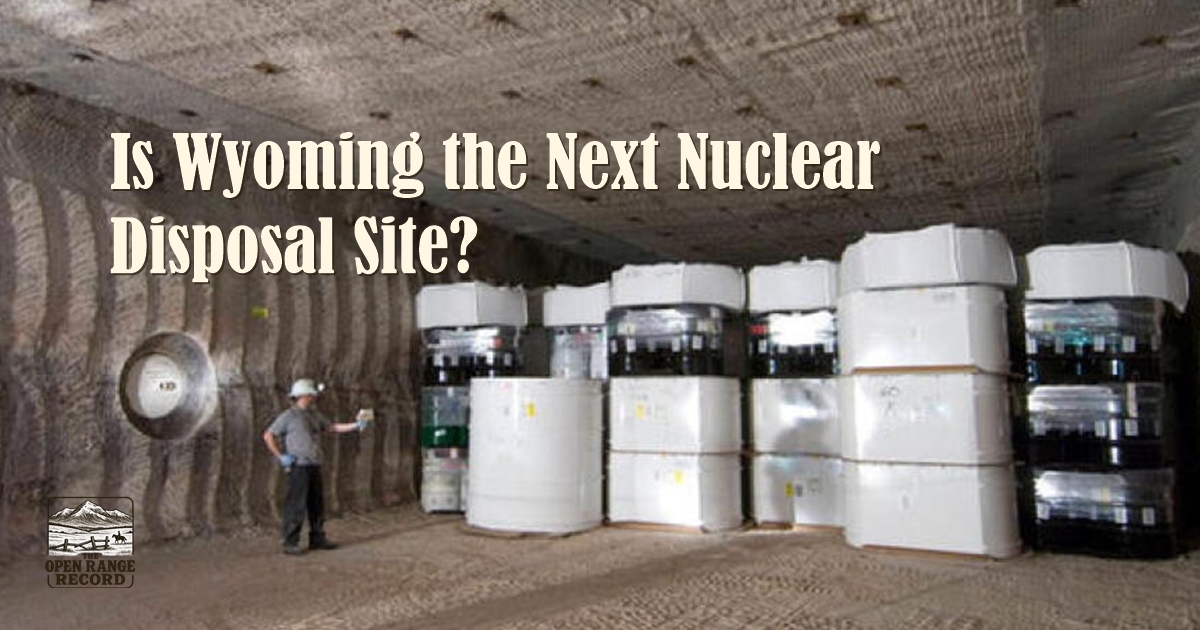
By the 1990s, the plan to bury the waste in Nevada hit a brick wall. That was when the federal government pulled out a checkbook. They offered big grant money to counties and rural towns if they would agree to build a temporary storage site, called a Monitored Retrievable Storage yard.
Leaders in Fremont County looked at the cash and thought about taking the deal. But in 1992, Governor Mike Sullivan stepped in and used his veto pen.
Governor Sullivan knew how the game worked. If the federal government built a temporary lot in Wyoming with no permanent home ready to take it, Wyoming would become the nation's default nuclear dump forever. He warned that taking in glowing spent fuel rods would kill Wyoming's tourism, hurt agriculture, and ruin the state's reputation.
Two years later, private investors tried to sneak through the back door with a private venture called the Owl Creek Energy Project.
The Wyoming Legislature responded by locking the deadbolt. In 1995, lawmakers passed the Radioactive Waste Storage Facilities Act. That law put up giant legal hurdles. It said no company could build a high-level nuclear waste site in Wyoming without clear approval from the legislature, full environmental reports, and absolute proof that the nation had a permanent dump ready to take the fuel.
Now, thirty years later, the big money men are knocking on the gate again.
Because Wyoming is leading the way on small advanced reactors, researchers at the University of Wyoming's School of Energy Resources have been running the numbers on temporary nuclear storage. Their recent studies show that hosting a centralized storage site could bring between ten million and six hundred and twelve million dollars into the state economy through jobs, taxes, and federal payouts.
The same university study points out a catch. A temporary storage yard does not even begin to save money over keeping the waste at old power plants until it runs for at least thirty-four years. Thirty-four years is not a quick weekend visit; that is half a lifetime.
To make matters more complicated, lawmakers are already debating new rules for microreactors and nuclear fuel parts. Proponents argue that Wyoming already produces coal, oil, gas, and uranium, so taking care of the entire nuclear supply chain is just smart business.
The warning from history has not changed.
The 1995 state law is still the main wall standing between Wyoming and billions of pounds of spent nuclear fuel rods from across the country. As lobbyists and politicians talk about big supply-chain dollars, Wyoming citizens are left asking the same question Governor Sullivan faced in 1992: if you take the neighbor's junk into your pasture, who is going to make him haul it away when the lease runs out?