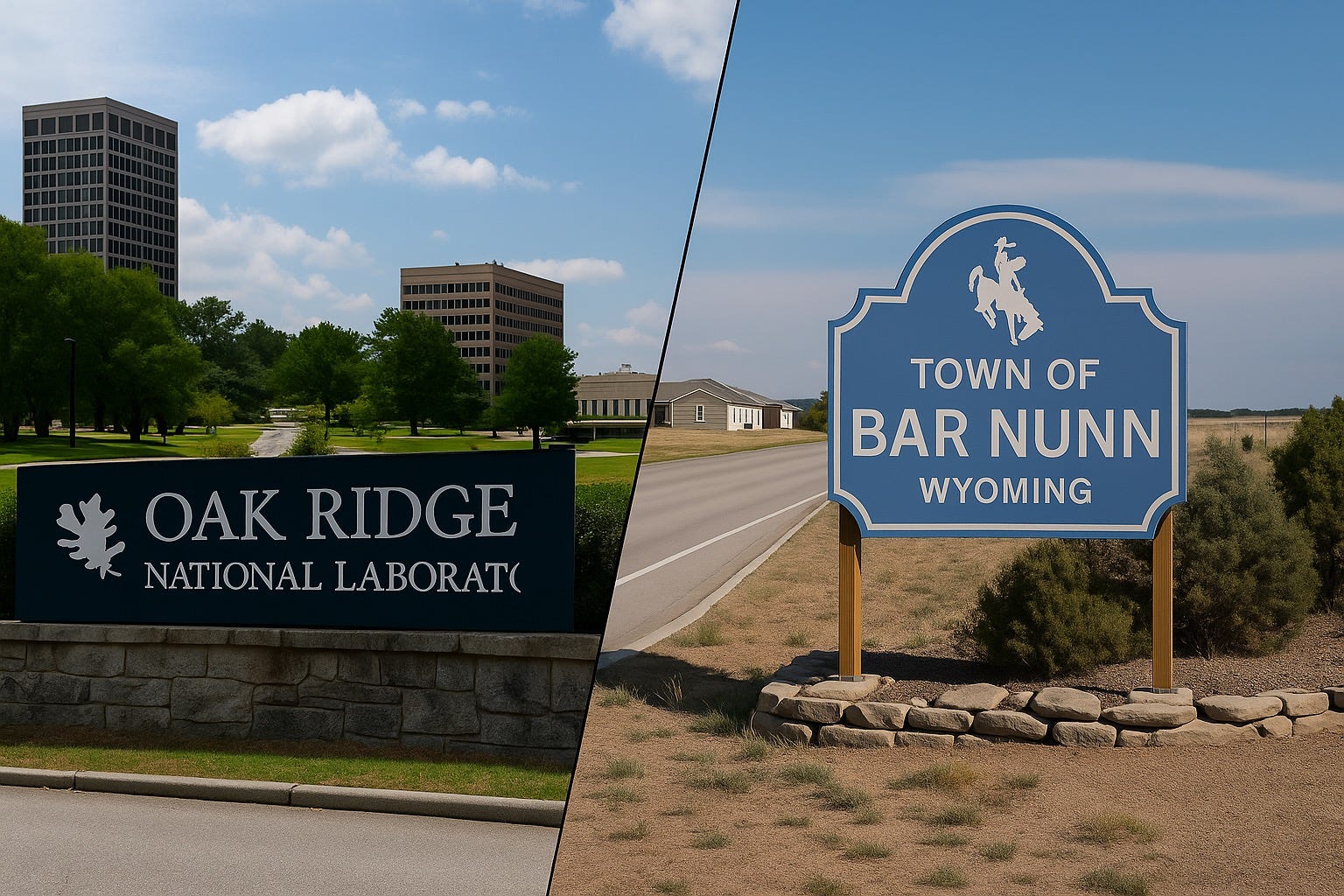
If Radiant’s proposal were only about building microreactors, the obvious place to do it would be Oak Ridge, Tennessee. That town was literally born for nuclear work. It hosts Oak Ridge National Laboratory and sits inside a region where the workforce, schools, and contractors speak nuclear as a first language. New nuclear investments keep landing there—TVA’s advanced reactor plans, enrichment projects, fuel-cycle pilots—because the infrastructure and talent already exist.
But when it comes to taking in other people’s spent fuel, Oak Ridge’s history says something loud: no.
In the mid-1980s, the U.S. Department of Energy tried to site a Monitored Retrievable Storage (MRS) facility in the Oak Ridge/Clinch River area to hold commercial spent nuclear fuel from around the country. Tennessee pushed back—hard. The governor formally opposed it in 1986; local and state resistance turned into litigation and politics; and the plan collapsed. Congress ultimately rewrote the law in 1987, and the Tennessee MRS idea was annulled.[1]
That stance didn’t come from fear of the atom—Oak Ridge runs on nuclear science. It came from the difference between doing nuclear and hosting other states’ waste.
To this day, Oak Ridge’s cleanup program routinely ships legacy waste out of state rather than inviting more in.[2] The culture is: do the work here, but don’t turn the town into a national dump.
Radiant knows this, too.
At a June town hall in Bar Nunn, company representatives admitted they had considered siting their facility in Oak Ridge, Tennessee, among other locations. Residents immediately shouted back: “Go to Oak Ridge!”[3] Cowboy State Daily later confirmed that Oak Ridge was indeed in the running—but Radiant’s only viable hope now is Wyoming.[4] In other words, Tennessee won’t take it, so Radiant is leaning on Wyoming.
Now zoom out to the national picture that Bar Nunn is being asked to ignore. Under federal law, the United States is supposed to open a geologic repository for commercial spent fuel. On paper, that’s Yucca Mountain. In reality, the project was halted in 2010; Congress has not funded it since; and no other repository is authorized.
GAO’s summaries are blunt: there is still no federal repository and DOE cannot even pursue an alternative under current law.[5] Translation: “temporary” storage has a way of becoming permanent.
So when Radiant says “we’ll just store spent cores at the manufacturing site,” ask the Oak Ridge question: for how long?
Tennessee already lived this movie and refused the role.
Wyoming’s lawmakers know the stakes, too: even this year, legislative notes and summaries emphasized that permanent storage remains not allowed in Wyoming, and proposals to loosen that have sparked intense public blowback.[6]
Put simply: Oak Ridge is nuclear-ready, but not a repository.
Bar Nunn is residential, without the nuclear workforce or infrastructure—and yet it’s the one being groomed to shoulder the waste while the federal repository doesn’t exist. That’s not “innovation”; that’s outsourcing the liability.
And let’s be honest about why. Radiant isn’t here because Bar Nunn is the best fit.
They’re here because Wyoming insiders courted them with subsidies, tax breaks, and promises made behind closed doors. These same politicians are laying the groundwork for a full nuclear pipeline—from uranium mining to fuel fabrication to waste storage—without forthrightly telling the public what’s really on the table. They think they can cut their deals in private, then spin it as “economic development” later.
But those days need to end.
Wyoming voters should remember, come next election, which legislators and top officials went along with this scheme.
If the Department of Energy had delivered the national repository it promised decades ago, communities wouldn’t be forced into these “interim” end-runs. But it didn’t.
And until Congress funds and authorizes a real repository, any plan that brings spent fuel “just for now” is really asking a town to sign up for indefinite storage.
That’s why Oak Ridge shut the door—and why Bar Nunn should slam it just as firmly.
Footnotes
[1] U.S. Congress, Nuclear Waste Policy Amendments Act of 1987; Tennessee Governor Lamar Alexander’s opposition to DOE’s MRS siting in Oak Ridge, 1986 (see DOE historical archives and Congressional Research Service summaries).
[2] U.S. Department of Energy, Oak Ridge Office of Environmental Management, Waste Cleanup & Disposal Reports, showing legacy waste routinely shipped to Nevada and other out-of-state facilities.
[3] Bar Nunn Town Hall, June 2025; reported by Cowboy State Daily, residents responding to Radiant representatives with “Go to Oak Ridge!”
[4] Cowboy State Daily, “Bar Nunn Residents Push Back on Storing Spent Nuclear Fuel from Microreactors,” June 16, 2025.
[5] U.S. Government Accountability Office (GAO), “Commercial Spent Nuclear Fuel: Congressional Action Needed to Break Impasse and Develop a Permanent Disposal Solution,” GAO-23-105, 2023.
[6] Wyoming Legislature, 2025 session committee notes and summaries regarding nuclear energy bills, highlighting continued statutory prohibition on permanent SNF storage.