In a bold and deeply clarifying move to address what experts are calling “the most Wyoming problem imaginable,” the House Freedom Caucus announced this week that it will now accept all Republicans into its ranks—no questions asked, no ideological tests required, and, most importantly, no paperwork that might accidentally reveal who anyone actually is.
The decision comes after years of growing confusion among Wyoming voters, many of whom recently discovered that a surprising number of their Republican neighbors are, in fact, Democrats. Or independents. Or possibly just people who wanted to vote in a primary and found the registration form emotionally flexible.
“It’s not deception,” explained one longtime voter while carefully not making eye contact. “It’s…strategic enthusiasm for procedural access.”
Political scientists have struggled to categorize the phenomenon, with early theories including “Reverse Partisan Osmosis,” “Ballot-Based Identity Fluidity,” and the more widely accepted “Well, It’s Wyoming.”
The issue came to a head when several candidates began noticing that their most enthusiastic Republican supporters were also attending Democratic fundraisers, volunteering for opposing campaigns, and occasionally arguing with themselves in public comment sections.
Faced with this existential blur, the House Freedom Caucus opted for a solution rooted in simplicity: eliminate the distinction entirely.
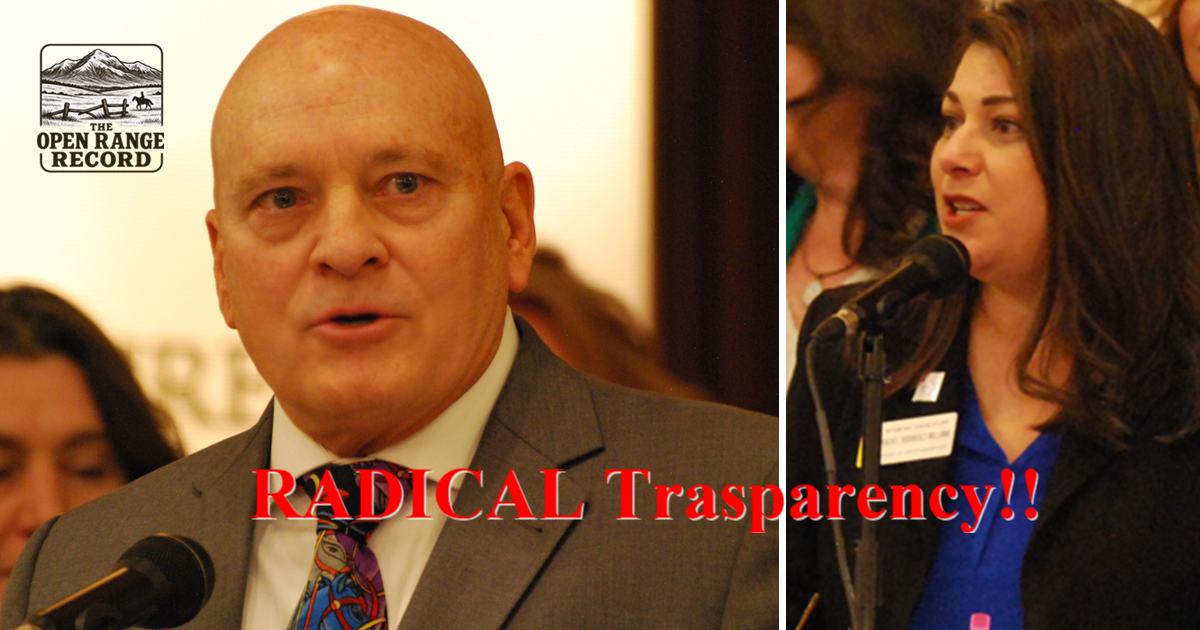
“If everyone is a Republican, then no one is secretly a Democrat pretending to be a Republican,” said a caucus Chairwoman Rachel Rodriguez-Williams, unveiling a new membership policy titled Operation Big Tent, or as John Bear called it, “No Seriously, Everyone Get In Here.” “Transparency has been achieved.”
Under the new rules, membership in the Freedom Caucus is automatic upon registration as a Republican, suspected registration as a Republican, or “having Republican-adjacent vibes.” A forthcoming amendment may extend eligibility to anyone who has ever said “well, I’m fiscally conservative, but—” before trailing off into ambiguity.
What Voters Can Expect
To help voters navigate the new landscape, the Secretary of State will distribute updated guides clarifying that:
• All Republicans are now members of the Freedom Caucus.
• Some Democrats are Republicans.
• Some Republicans are Democrats.
• Ogden Driskill, in an interview on the Cow Pie and in an effort to maintain the last shred of his credibility encouraged everyone to remain calm and continue voting as if any of this makes sense.
Freedom Caucus member Ken Pendergraft raised concerns that the policy could dilute the caucus’s ideological identity. However, fellow caucus member Steve Johnson countered that this presumes such an identity was still identifiable to begin with.
Meanwhile, voters have expressed cautious optimism.
“I used to worry about who was really who,” said one Sheridan resident. “Now I don’t have to. They’re all in the same group. It’s very comforting. Like a political lost-and-found, but nobody picks anything up.”
Jokingly, Governor Gordon sent out an email stating he was considering additional reforms, including a universal ballot labeled simply “Yes / No / Depends Who’s Asking,” and a pilot program allowing voters to register as “Surprise Me.”
Rachel Rodriguez Williams, Chairwoman of the Caucus brushed the criticism aside by pointing out that Gordon himself will benefit from the new policy. Adding that they are proud to have restored clarity to Wyoming politics.
“From this day forward,” Rodriguez-Williams concluded, “there will be no confusion about who belongs.”
A pause.
“Everyone does.”
Reaction Has Been Mostly Positive
The policy shift has also given rise to an unexpected demographic: recovering Democrats—individuals who are now registered Republicans but can no longer recall the exact sequence of events that led them there.
Support groups have begun forming quietly across the state, often in community centers, coffee shops, and, in one case, the seasonal aisle of a hardware store. Meetings typically begin with a simple introduction:
“Hi, my name is Steve, and I think I switched parties in 2020 when it became politically convenient to vote for Cheney… or maybe I just checked a different box. I’m not entirely sure anymore.”
Participants describe a shared experience of gradual political amnesia. It often starts with a primary election. Then a form. Then a fleeting thought—I’ll switch back later. Months pass. Years. At some point, they find themselves passionately defending positions they vaguely remember disagreeing with, while still subscribing to newsletters that suggest otherwise.
“It’s not that my beliefs changed,” said one voter. “It’s just that my registration got ahead of me.”
To assist these individuals, Freedom Caucus State Director Jessie Rubino has introduced a new “Partisan Memory Recovery Packet,” which includes:
• A timeline of major elections they may or may not remember voting in
• A checklist titled ‘Did I Mean to Do This?’
• And a flowchart that begins with “Do you feel confused?” and ends, invariably, with “You are currently a Republican.”
The House Freedom Caucus has welcomed recovering Democrats with open arms, noting that their presence further reinforces the group’s commitment to inclusivity through indistinction.
“We don’t ask where you came from,” said State Freedom Caucus President Adam Roth. “Mostly because it’s become clear that no one knows.”
In fact, recovering Democrats have quickly become some of the caucus’s most active members, often bringing a unique perspective shaped by their uncertain pasts.
“They ask a lot of questions,” Rep Scott Smith noted. “Sometimes about policy, sometimes about themselves.”
To accommodate this, caucus meetings now include a brief segment titled “Why Am I Here?”, during which members are encouraged to reflect, speculate, and, if necessary, shrug collectively.
Despite the confusion, many recovering Democrats report a sense of peace.
“There’s something freeing about it,” said new member Bob Nicholas. “I used to worry about labels. Now I just accept that I am… whatever the form says I am.”
Experts suggest the phenomenon may represent a new phase in political identity—one less about ideology and more about administrative momentum.
As Wyoming continues to refine its approach to transparency, officials are optimistic that, eventually, the system will reach its logical conclusion: a fully unified electorate, where party affiliation is both universal and entirely incidental.
Until then, recovering Democrats will continue their journey—not toward one party or another, but toward the faint, distant memory of having once made a deliberate choice.
And Then a Revelation
In a final twist that has left even the most seasoned observers blinking slowly into the middle distance, sources now suggest that the entire phenomenon—cross-registrations, recovering Democrats, and the Great Wyoming Identity Blur—may not have been accidental at all.
According to a statement that was neither confirmed nor denied but strongly implied through a series of meaningful pauses, the effort was, in fact, orchestrated from the beginning by the House Freedom Caucus itself.
The objective? Radical transparency.
Or, more specifically, a long-form, multi-year experiment designed to expose what insiders describe as “the ultimate political truth hiding in plain sight.”
That truth, the statement suggests, is that Ogden Driskill, Bo Biteman, and Tara Nethercott were, all along, Democrats.
The room reportedly fell silent when this conclusion was unveiled, followed by the sound of several people rechecking their own voter registrations just to be safe.
“We had to create a system so thoroughly confusing,” said Freedom Caucus Chairman Emeritus John Bear, “that the only thing left standing would be the truth. Or at least a truth. Preferably ours.”
The strategy, dubbed Operation Reflective Prairie, relied on a simple premise: if enough people switched parties, forgot why, and joined the same group anyway, eventually the distinction between Republican and Democrat would collapse inward—revealing, at its core, whoever the caucus needed it to reveal.
Critics have called the plan “needlessly elaborate,” “philosophically unsettling,” and “possibly just a very long joke,” but caucus members remain confident in the outcome.
“You can’t argue with results,” said Bear as he often does. “We set out to eliminate confusion, and now no one knows anything. That’s clarity.”
As for those named in the revelation, responses have ranged from polite disagreement to extended pizza parties in Biteman’s office. Meanwhile, recovering Democrats have expressed a renewed sense of purpose, relieved to discover that their confusion may have been part of something larger all along.
Or at least adjacent to it.
State officials are now considering whether to formally recognize the entire episode as either a political innovation or a weather event.
For now, Wyoming voters are left to navigate a landscape where everyone belongs, no one is entirely sure why, and the truth—whatever it may be—has been successfully brought to the surface, examined, and gently set back down somewhere slightly different.
And in the end, the House Freedom Caucus stands vindicated, having proven once and for all that in modern politics, identity is fluid, affiliation is optional, and reality itself is, at best, not what the voter registration says it is.