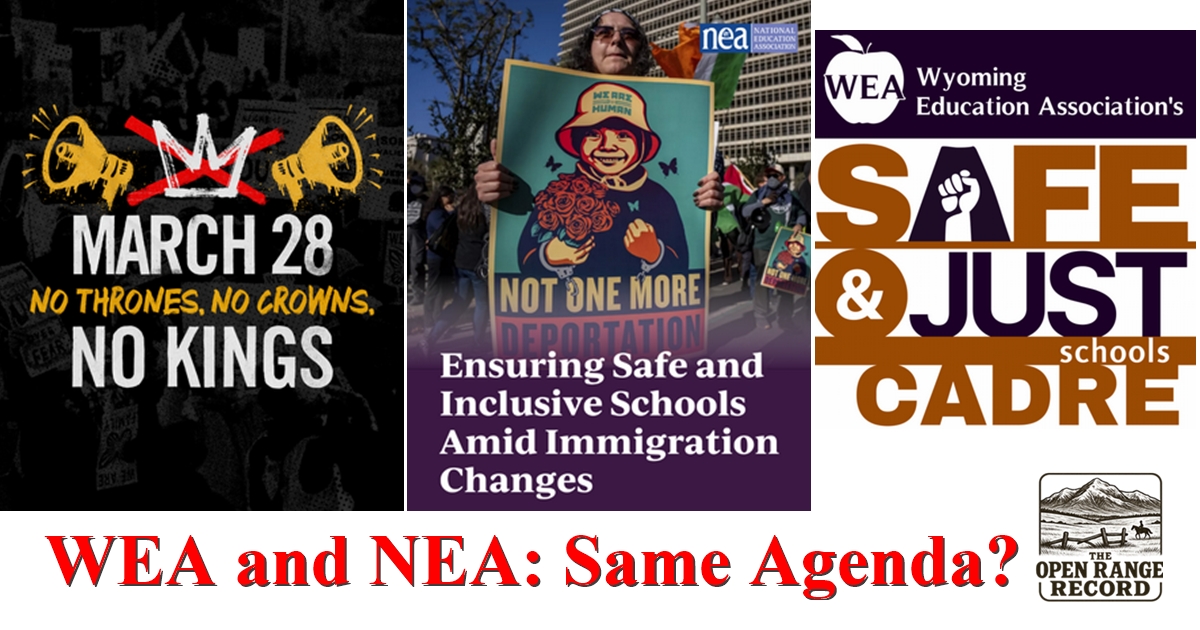
INVESTIGATIVE REPORT
When a new teacher is hired in Wyoming, the experience feels local. It starts with a handshake from a principal, a tour of the building, maybe a quiet moment in a classroom that will soon be filled with students. There’s a sense of community—of place. And somewhere in that early process, often tucked into a packet or mentioned in passing, is an introduction to the Wyoming Education Association.
It’s presented simply. A professional organization, support if you need it, protection if something goes wrong. And on the surface, that’s exactly what it is. But follow the structure behind it, and a different picture begins to take shape.
A Network That Starts Local
The Wyoming Education Association reports roughly 5,000 members across the state, according to its annual reports—a footprint that reaches into nearly every corner of Wyoming.
In the larger population centers, that presence is easy to see. It’s in Natrona County, through the Natrona County Education Association; in Laramie County, through the Cheyenne Teachers Education Association; in Sweetwater County, through the Sweetwater Education Association. These are the visible hubs.
But the network doesn’t stop there. From Evanston to Sundance, smaller districts maintain their own local associations, forming a web that stretches across the state’s wide and often disconnected geography. At first glance, these appear to be independent groups—local, self-contained, and responsive to their communities.
But they are not operating alone. Behind them are UniServ Directors—full-time, paid field staff funded through both the WEA and the National Education Association. These staff members move between districts, helping recruit members, assisting with negotiations, and supporting local leadership.
They are connective tissue. At the state level, leadership sits with WEA President Kim Amen and Vice President Dirk Andrews, guiding a system that is local in appearance—but coordinated in practice. And once that coordination becomes visible, the next question naturally follows.
The Wyoming Education Association is often described as being affiliated with the National Education Association. But within that structure, “affiliate” does not mean independent. State organizations like the WEA operate as part of a defined system governed by national bylaws. Those bylaws outline how dues are collected and transmitted, how representation is determined, and how participation in national decision-making is maintained.
This is not a loose partnership. It is a structured one. One that connects local educators in Wyoming to a national organization—not just in name, but through funding, governance, and shared direction.
How Money Moves
That
connection becomes even clearer when you follow the money. The NEA bylaws lay
out a system that requires dues collected at the local level to move
upward—through the state affiliate, and ultimately to the national
organization.
There are timelines, benchmarks, and consequences for falling behind. Local and state affiliates are expected to transmit a significant portion of dues by specific dates each year. If they don’t, penalties can apply. Continued failure can limit participation in the NEA’s national governing body. In other words, this isn’t an informal flow of support. It’s a system—structured, monitored, and enforced.
For many teachers, that system becomes tangible through a paycheck. Membership in the Wyoming Education Association often comes with annual dues ranging from $700 to $1,000, typically deducted automatically through payroll once a teacher opts in. Those dues don’t stay in one place. They are divided across local, state, and national levels, with a portion—often around $200—flowing directly to the National Education Association.
Political contributions are handled separately through voluntary PAC donations. But regular dues still fund the structure itself—supporting staff, training programs, communications, and the national framework that connects Wyoming educators to something much larger. That connection isn’t theoretical; it’s financial.
What That Structure Delivers
Through that structure comes more than representation. It delivers training. Programs like Safe & Just Schools are presented as professional development opportunities—tools to help educators build welcoming classroom environments. They introduce concepts like implicit bias, social-emotional awareness, and identity-based frameworks.

Other initiatives, like Read Across America, promote literacy while emphasizing the inclusion of diverse perspectives in classroom materials. Leadership programs go further, offering fellowships and training designed to develop educators as organizers and advocates.

Taken individually, each of these programs has a purpose. Taken together, they begin to reflect a broader approach—one that expands education beyond academics into social frameworks and guided perspectives. And while these programs are often described as free, they are not without cost. In some districts, they occur during contract hours.
From the Employee handbook for Uinta School District #1- Uinta County Handbook Page 18
“At the beginning of each school year, the Wyoming Education Association shall be credited with fifteen days of Professional Leave to be used by employees who are elected officers of Wyoming Education Association. The leave granted under this section shall be the total leave available for all elected officers of the Wyoming Education Association and not leave for each elected officer. Such days are not to be accrued from one school year to the next. Approval and scheduling of WEA leave must be accomplished well in advance and is dependent upon the agreement of the Wyoming Education Association to pay for substitute costs associated with such leave. The leave provided for in this section shall not be used as additional leave for Evanston Education Association Leave under this policy.”
Following the Money, Line by Line
If structure shows how things are connected, money shows how they move. In the 2024 election cycle, the WEA’s political action committee directed contributions to Wyoming candidates.
Karlee
Provenza (D–Laramie) — $5,700
Trey Sherwood (D–Laramie) — $5,700
Ken Chestek (D–Laramie) — $5,400
David Zwonitzer (R–Cheyenne) — $5,000
Jen Solis (D–Casper) — $5,000
Marguerite Herman (D–Laramie) — $2,200
Sarah Burlingame (D–Casper) — $1,900
Bob Nicholas (R–Cheyenne) — $1,000
David Northrup (R–Powell) — $1,000
When grouped by party affiliation, approximately 79 percent of those contributions went to Democratic candidates. The Republicans who received campaign contributions were not Conservative Republicans.

But those dollar figures only tell part of the story. In 2022, WEA-PACE endorsed Wendy Davis Schuler before she held a leadership role. Today, she serves as Chair of the Senate Education Committee and sits on key education-related councils.

That progression doesn’t prove cause, but it does show how early support can align with long-term influence. In 2024, the PAC also funded campaign mailers opposing Representative Jeanette Ward—an action that, while not a direct endorsement, shaped the outcome of that race.

In Wyoming, influence doesn’t require massive spending. It requires precision.
At the national level, the National Education Association operates on a broader stage. It engages in advocacy, promotes policy positions, and participates in coordinated efforts that extend beyond individual classrooms.
These activities are separate from daily instruction. But they are not separate from the structure. They are part of the same system—connected through membership, funding, and organizational alignment.
National Messaging in Practice
That connection is visible in how messaging is developed and shared.
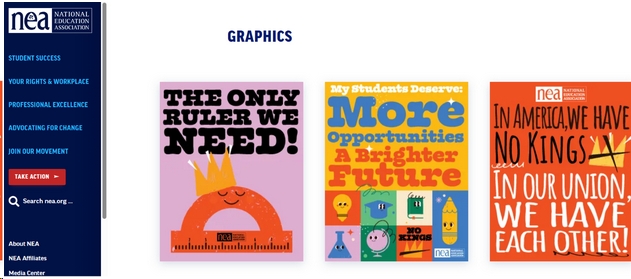

At the national level, the NEA produces campaign-style materials designed for broad distribution. These include coordinated graphics, slogans, and messaging built around shared themes. Campaigns such as “No Kings” reflect language centered on unity, collective action, and public engagement—appearing across multiple formats and platforms.
These materials are not classroom curriculum. But they are part of the same ecosystem—created, distributed, and reinforced through the same national structure that connects to state affiliates like the Wyoming Education Association. And that connection is difficult to ignore.
Individually, each piece can be explained. But when you look at the system as a whole, the training programs especially since Covid; the Union dues that go to political lobbying and national messaging about overthrowing a sitting President, the messaging begins to move in the same direction.
Author’s Thoughts
Wyoming has amazing teachers. Every student remembers their favorite teacher. Some teachers are members of the WEA for legal protection only. Some teachers are being forced to adhere to this agenda. They are being forced to teach subject matter that conflicts with their religious and moral values.
Good teachers are leaving not just because of pay. Pay can be used as an excuse, but many of those in the fight know that money is not the only reason. The kids are becoming unmanageable due to restorative justice. Education is being disrupted, and often the administration does not support and address concerns.
We the People need to come together and recognize the emergency this truly is in our communities.