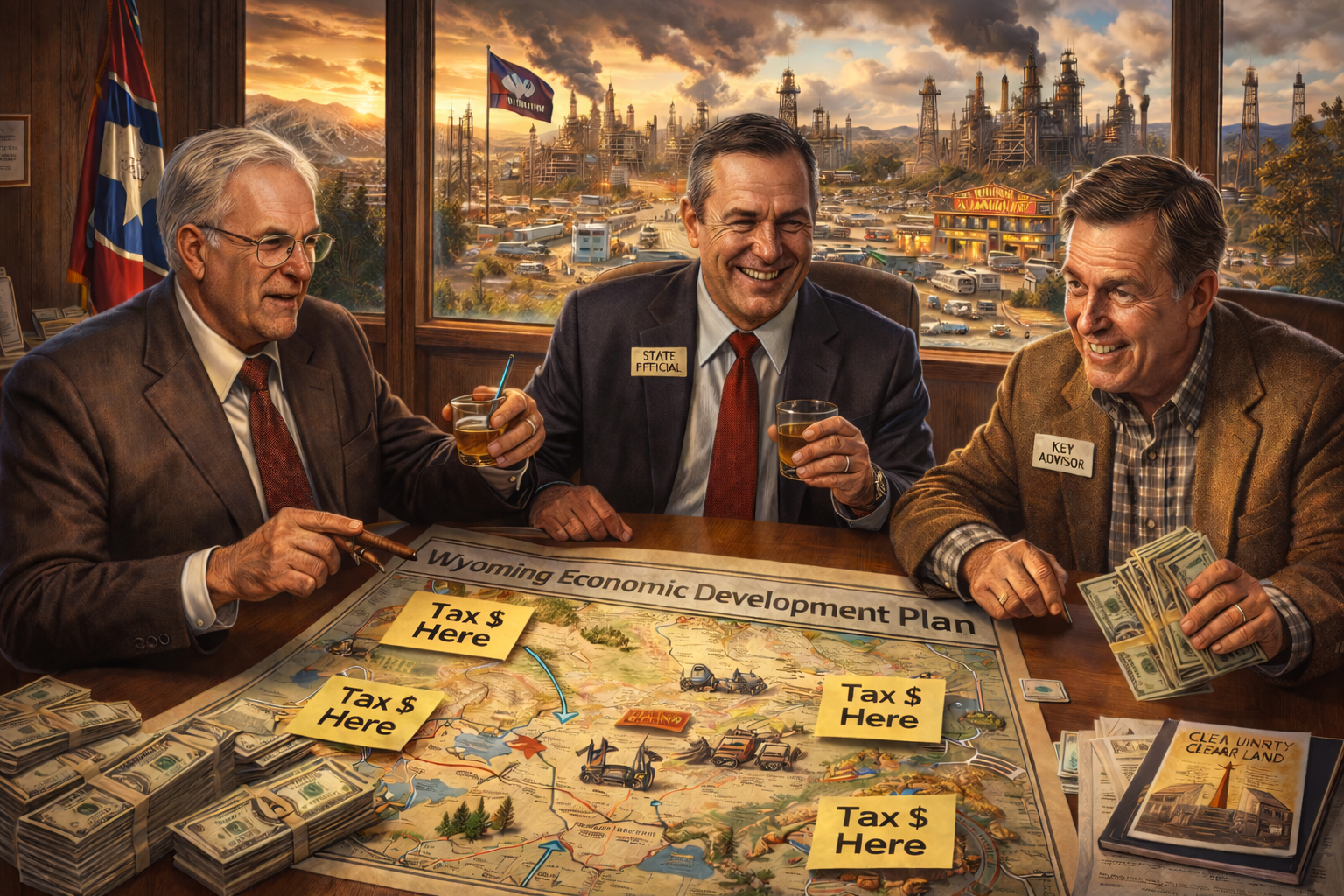
Economic growth in Wyoming did not become complicated by accident. What used to be debated openly—taxes, jobs, infrastructure, energy—has been quietly rerouted over the last forty years through a growing web of associations, nonprofits, and government-adjacent organizations. They shape the narrative, control access, and influence outcomes long before voters ever hear about a project or a piece of legislation.
This was not a hostile takeover. It was a slow one. It happened incrementally, under language most people trusted: economic development, efficiency, expertise, public-private partnership. Each step sounded reasonable. Each layer added distance between citizens and decisions. And because it happened gradually, most people never noticed how much authority was being transferred out of public view and into institutional hands.
That is how systems entrench themselves—quietly, professionally, and without ever asking permission. Now Wyoming voters are living with the results. Projects appear fully formed. Legislation arrives pre-packaged. Testimony is dominated by agencies, associations, and industry representatives who speak confidently about what is “necessary” or “inevitable,” while the people paying the bills are lucky to get a few minutes at the microphone.
For decades, Wyoming citizens trusted that the people operating these systems were acting in the public’s best interest. That trust is exactly what allowed this structure to grow unchecked. And here is the uncomfortable truth: trust alone is no longer enough.
If voters want different outcomes, they are going to have to do something harder than voting on slogans. They are going to have to take time to understand who these organizations are, who funds them, who belongs to them, who they actually represent, and how deeply they influence the people asking for their vote.
Here’s How the Game Is Played
Many of the organizations shaping economic development and tax policy in Wyoming operate in the space between government and private industry. They are not elected; they are not accountable to voters. Yet they exert enormous influence over which projects move forward, how legislation is framed, and which voices are taken seriously.
One example is Advance Casper, an economic development organization that operates as a public-private hybrid.
Advance Casper receives public funding through local governments while also relying on private investment, memberships, and business participation. When public dollars are blended with private buy-ins, access is no longer equal. Influence concentrates among those who can afford to participate at higher levels—those with the time, money, and institutional relationships to stay engaged year-round.
As a result, decisions about which companies are recruited, where projects are located, and which communities absorb the risk are often shaped upstream, before the public ever sees a proposal or has a meaningful opportunity to weigh in. This model is not unique to Casper. Variations of it exist across Wyoming, and while often described as efficient or strategic, they raise legitimate questions about transparency, accountability, and whose interests are being prioritized when “economic development” is discussed behind closed doors.
Another important example is the Wyoming Taxpayers Association.
Despite its name, the Wyoming Taxpayers Association does not primarily represent individual, everyday Wyoming taxpayers. Most working families are not members. They do not pay dues, sit on boards, or vote on its policy positions. Instead, it is a paid-membership advocacy organization funded by a mix of large businesses, industry groups, lobbyists, and government entities.
Those same membership dollars fund the organization’s operations, its advocacy positions, and the research and policy analysis it produces and promotes during legislative sessions. That creates a structural concern—not about intent, but about incentives. When research shaping tax and fiscal policy is financed by the same institutions that benefit from the outcomes being advocated, voters are right to question who that analysis ultimately serves.
Who the “Insiders” Actually Are
In Wyoming, the insiders are not outsiders who suddenly arrived. They are often people who claim deep, generational Wyoming roots—families who have circulated for decades inside boards, commissions, agencies, associations, and political offices. Many have spent their entire adult lives operating within the same small ecosystem of government, advocacy groups, and industry-adjacent organizations. This is the political-government bubble.
Some have worked in the private sector as government liaisons for industries like oil and gas. Others served on advisory boards, economic development groups, or statewide associations that regularly interact with agencies and legislators. They may not have carried the title “lobbyist,” but their role has often involved managing government relationships, influencing outcomes, and protecting institutional interests on behalf of an employer or organization. That experience does not disappear when campaign messaging changes.
How This Affects Regular People
Wyoming citizens are not paying dues to these organizations, but they are living with the results of decisions shaped by them. Working families fund government through taxes and fees—local governments use public dollars to pay membership dues to associations that represent institutional interests. Large businesses and industry groups also pay dues to secure access, influence, and a seat at the table.
Those associations, in turn, advocate policies that protect the interests of their paying members—whether that means preserving government revenue streams and spending authority or securing favorable tax treatment, incentives, and regulatory outcomes for private industry. Meanwhile, the average Wyoming citizen is not sitting in those rooms—not because they do not care, but because participation requires time, money, and insider access most people simply do not have.
As a result, decisions are shaped before the public ever sees legislation, a budget, or a ballot question. This does not require anything improper. It only requires unequal access, aligned incentives, and a system that consistently listens to the same voices.
Why Reformers Are Being Targeted
This structure explains something else voters are seeing right now. Those who are attempting to challenge the system—questioning agencies, associations, spending, and long-standing relationships—are being labeled “extreme,” “dangerous,” or “divisive.” That response is not accidental.
The loudest critics of reform are often career elected officials and long-time institutional players—the same people who helped build, protect, and benefit from the system as it exists today. When power is threatened, it rarely defends itself honestly. It attacks credibility instead.
The Grassroots Illusion
Many candidates now running as reformers or grassroots conservatives did not come up challenging the system; they came up inside it. Rebranding does not undo years spent navigating institutional power. It does not erase records, relationships, endorsements, or the networks that helped elevate a candidate in the first place. Some candidates are very good at presentation. But when voters look past the packaging, they should ask whether there is anything of substance underneath.
The primary is the moment Wyoming voters have to decide whether they want polished messengers for existing power structures or leaders willing to challenge the system and represent people who do not have lobbyists, paid memberships, or institutional backing. If the system is ever going to change, it will not be because the people inside it suddenly decided to fix themselves. It will be because citizens finally recognized the game and chose not to play along anymore.