This should make you uncomfortable Wyoming
In the capital city of Cheyenne, Wyoming, statistics reveal a sobering reality. National research examining the concentration of registered sex offenders across American cities found that Cheyenne ranks 10th in the nation, with roughly one registered sex offender for every 186 residents.
At the state level, the picture is similarly concerning. When offender populations are compared per capita, Wyoming ranks 12th in the nation, with approximately 421 registered offenders for every 100,000 residents.
Other national analyses have placed Wyoming as high as 7th in the country for sex offenders per capita, illustrating how the issue stands out in a sparsely populated state.
For a state with fewer than 600,000 residents, those numbers carry weight. This could help explain why the 2026 legislative session saw an unusually large number of bills focused on sexual crimes and the protection of children. Lawmakers introduced multiple bills aimed at strengthening protections for minors and addressing gaps in Wyoming law.
Several proposals directly addressed crimes against children:
HB0008 — Stalking of minors – Passed and signed
HB0009 — Grooming of children: offenses and amendments – Passed and Signed
HB0028 — Sexual exploitation of children amendments – Passed and Signed
HB0102 — Protecting kids from deepfakes and exploitative images - Passed
Other legislation addressed broader concerns surrounding obscenity, accountability, and offender proximity to children:
HB0010 — Sexually explicit materials in libraries requirements – Died in Senate
HB0072 — Obscenity amendments – House Did Not Consider
HB0092 — Sexual predators prohibited from holding public office - Passed
SF0088 — Sex offenders prohibited from residing near childcare facilities - Passed
Taken together, these bills addressed different aspects of the same problem: preventing exploitation and strengthening protections for minors.
A Case That Shook a Community
In 2025, a teacher in Cheyenne was arrested and charged with 16 felony counts related to the alleged sexual abuse of female students.
Investigators determined the abuse began in August 2024 and continued until the teacher was placed on administrative leave in May, according to reporting by the Wyoming Tribune Eagle.
Cases like this send shockwaves through communities. They also raise difficult questions about how predators gain access to children and how systems can better prevent abuse before it continues.
One of the most important aspects of protecting children is understanding how grooming works. Predators rarely begin with overt abuse. Instead, grooming is often a gradual process designed to normalize inappropriate conversations, behaviors, or sexual topics with children.
Experts studying exploitation consistently warn that one of the most common tactics used by predators is the normalization of sexual language and sexual behavior around minors. By lowering a child’s sense of what is inappropriate, groomers attempt to reduce resistance and silence alarm.
Why HB0010 Is So Important
Within that broader context, HB0010 -Sexually Explicit Materials in Libraries Requirements became one of the most debated bills of the session.
Supporters argued the issue was widely misunderstood. For them, the bill was not about banning books. Instead, it focused on ensuring that materials containing explicit sexual content were not made accessible to minors in school libraries.
This is a preventative measure. If predators rely on gradually breaking down boundaries and normalizing sexual discussions with children, then limiting minors’ exposure to explicit sexual material in educational settings becomes part of a broader strategy to preserve those boundaries.
Another factor driving the surge in legislation is the rapid evolution of technology. Sexual exploitation increasingly occurs through social media grooming, digital coercion, online sharing of explicit images, artificial intelligence–generated sexual imagery, and deepfake technology targeting minors.
Bills like HB0102, addressing exploitative deepfake images involving children, demonstrate how lawmakers are attempting to update statutes to confront crimes that did not exist even a decade ago.
Transparency and Public Awareness
Wyoming’s sex offender registry has also transformed how communities understand the issue. Originally created in 1994, the registry was first used internally by law enforcement. Over time, legislation expanded public access so citizens could search offender information online by name or geographic location.
To see what your area looks like go here https://www.nsopw.gov
Residents can now see where offenders live and receive alerts when offenders move into nearby neighborhoods. That transparency has made the issue far more visible. Visibility often leads to action.
The large number of sex crime and child protection bills introduced in the 2026 session reflects something deeper than a legislative trend. It reflects a recognition that protecting children requires constant vigilance. Statistics reveal the scale of the problem. Technology continues to change how exploitation occurs. And real-world cases remind communities that the threat is not theoretical.
HB0010 was killed by the senate, Senator Troy Mckeown tried to bring the bill back only for it to fail the votes. This is not the first time this type of bill has been ran. Every year there is another excuse. Hopefully, Wyoming takes a proactive measure next year to protect the innocence and eyes of our youth.
A Chilling Reflection
Predators rarely appear as monsters at first. More often, they arrive quietly, through small conversations, subtle boundary crossings, and the gradual erosion of what once felt clearly wrong.
Grooming works not through force at the beginning, but through normalization. What was once shocking becomes all too familiar, and things that raise alarm once begin to feel ordinary. And too often then it is too late.
The line between innocence and exploitation is not erased in a single moment. It is blurred slowly…. conversation by conversation… exposure by exposure… boundary by boundary.
When the line disappears, predators no longer have to cross it.
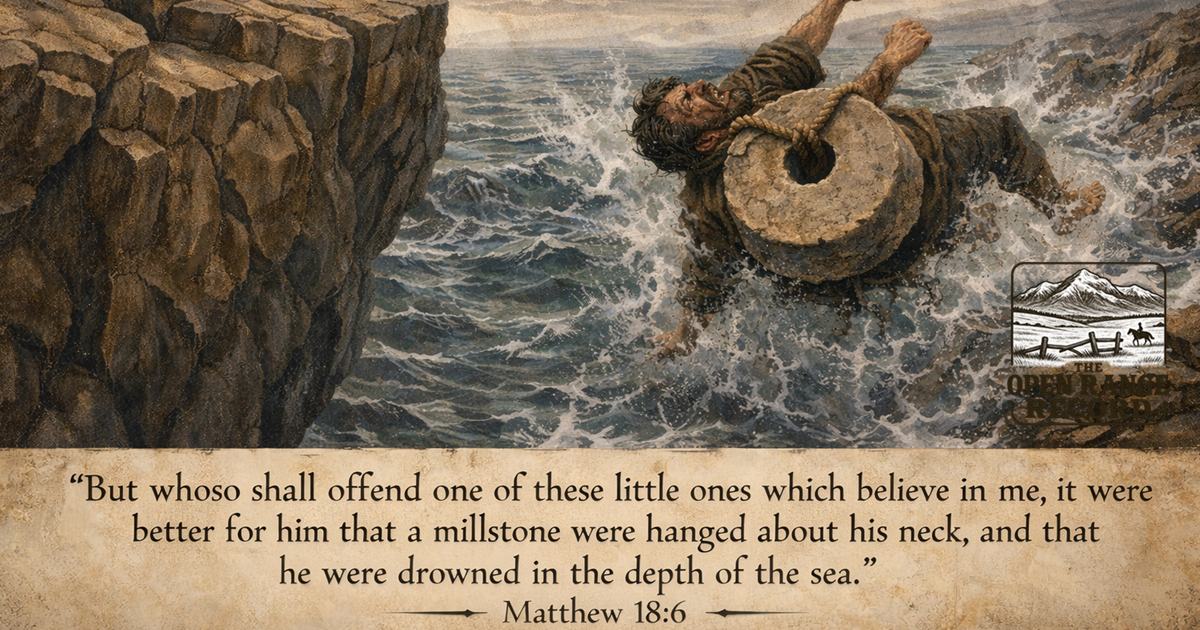
“It would be better for them to be thrown into the sea with a millstone tied around their neck than to cause one of these little ones to stumble.”— Gospel of Luke 17:2
Legislation in 2026, showcased a growing problem in our state. Bills usually arise when there is a need to correct or protect a certain situation. These pieces of legislation unveiled an unpalatable truth, there is a massive growing problem in our state. These laws are needed to stand in defense of our most vulnerable. Time will tell if these bills make a change.
When a civilization loses the courage to protect its children, it has already begun to lose far more than it realizes.
One thing is clear, this session took a step to hold the line once the deed has been done, but fell short of taking preemptive measures to keep kids safe from initial predator contact.