NEWS
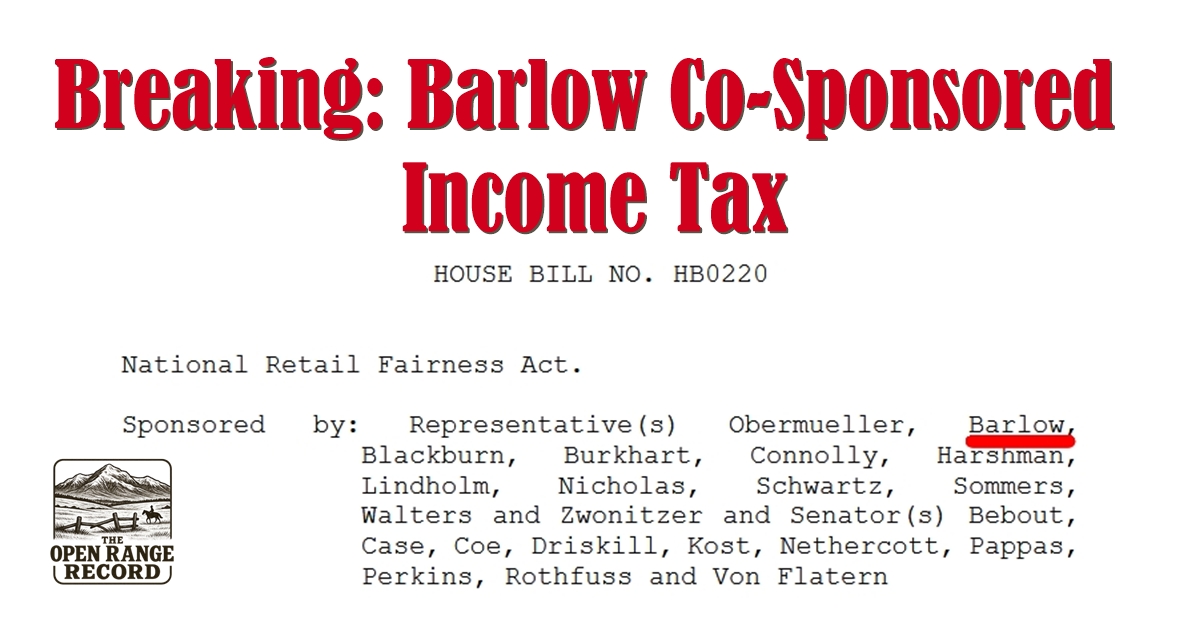
Eric Barlow, the Republican nominee for Wyoming governor, co-sponsored legislation in 2019 that would have established a state corporate income tax.
House Bill 220, the National Retail Fairness Act, proposed a 7% tax on qualifying corporate income earned in Wyoming. Barlow backed the measure while serving as House majority floor leader and a Republican representative from Gillette.
His sponsorship came seven years before the current debate over Proposition 1’s property-tax reduction, as co-sponsor of HB220 Cale Case recently told the Cowboy State daily about a state income tax, “It’s real. It’s not phony. It’s not a threat. It just makes income tax more logical.”
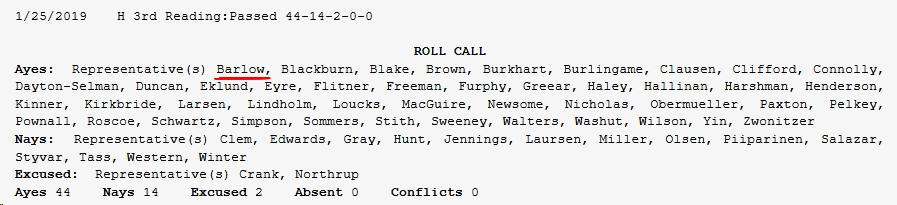
On January 25, 2019 Barlow, along with 43 other Wyoming House Members voted for the income tax.
HB220 was aimed at large corporations in retail, accommodations, and food services. It would not have taxed residents’ personal earnings.
Rep. Jerry Obermueller, a Casper Republican, was the bill’s chief sponsor. Barlow joined a group of legislative leaders sponsoring the corporate income tax, including House Speaker Steve Harshman, Senate President Drew Perkins, and Senate Revenue Committee Chairman Cale Case.
Under the introduced bill, the tax generally would have applied to corporations or affiliated groups with more than 100 shareholders in the designated business sectors. The proceeds would have gone to Wyoming’s school foundation program account. Supporters argued that Wyoming was missing an opportunity to collect revenue from corporations already paying income taxes elsewhere.
According to WyoFile’s reporting at the time, proponents maintained that corporations could offset a Wyoming tax against taxes paid in their home states. They argued the measure could bring money into Wyoming schools without increasing prices for Wyoming customers.
Business representatives disputed those assurances. Opponents warned that companies could pass costs to consumers and questioned the speed with which lawmakers were advancing the proposal. HB 220 passed the House on January 25, 2019, by a vote of 44–14, with two members absent. It died in a Senate committee the following month and never became law.
The income-tax discussion continued after that defeat. Case, one of Barlow’s fellow co-sponsors, participated in a July 2020 forum reviewing Tax Reform 2000. The original study, launched by the Legislature in 1997, had recommended personal and corporate income taxes as part of an effort to reduce Wyoming’s dependence on mineral revenue. “We need to consider income taxes at the very high level, both at the corporate and the personal level,” Case said during the forum.
The issue surfaced again this month in Cowboy State Daily’s reporting on Proposition 1, which would provide a 50% property tax exemption on qualifying residential structures. Case argued that lower property taxes would reduce the credits taxpayers could claim against a future state income tax, potentially increasing the revenue it would generate.
That discussion concerns what lawmakers might consider after Proposition 1. Barlow’s legislative record documents an earlier position: in 2019, the man now running for governor as the Republican nominee helped sponsor a bill to bring a corporate income tax to Wyoming. This raises serious questions of Barlow’s commitment to being a Republican.