NEWS
In 1978, legendary broadcaster Paul Harvey stood before the Future Farmers of America convention and delivered a tribute that generations of American farmers would never forget.
“So God made a farmer.”
Harvey spoke of hard work, sacrifice, faith, and families who understood that farming was more than a job. It was a way of life. Nearly fifty years later, those values remain alive across Wyoming. From the barn to the county fairs, FFA has helped preserve Wyoming tradition for generations.
But recent decisions by National FFA leadership have raised questions about religious freedom, corporate influence, and who should help shape the education of America's future farmers. At the center of those questions is Syngenta, an agricultural corporation ultimately owned by the Chinese government.
Wyoming's FFA students represent the future of an industry that feeds America. According to the Wyoming FFA Association, the state had 4,606 members and 64 chapters in 2026, reaching 22 of Wyoming's 23 counties. These students learn agricultural mechanics, livestock management, public speaking, leadership, and business skills.
Many also participate in 4-H and spend months preparing animals for county fairs. Local businesses support them through livestock auctions, scholarships, and donations. FFA is not simply an extracurricular activity. It helps prepare the next generation of farmers, ranchers, and agricultural business owners. That makes the decisions coming from National FFA headquarters especially important.
When Faith Became a Problem
On January 31, 2018, the National FFA Board of Directors adopted religious-expression guidelines. The policy instructed national officers and personnel that official verbal reflections, including remarks before meals, should be free of religious references or prayer. Similar guidance applied to written and visual communications representing the National FFA.
The board cited the First Amendment's Establishment Clause and the desire to include students of different beliefs. But critics questioned why inclusion required restrictions on religious expression.
The policy was adopted during the leadership of National FFA CEO Mark Poeschl. However, publicly available records reviewed do not identify who originally proposed or drafted the restrictions. Whoever the author, the policy came before the organization's later partnership with Syngenta.
In February 2019, Congress amended FFA's federal charter through Public Law 116-7, explicitly adding inclusion and diversity among the organization's purposes. The law did not require FFA to hire corporate diversity advisers or restrict students' personal religious expression. Nevertheless, the National FFA's organizational priorities continued to evolve.
Enter Syngenta
In February 2022, the National FFA announced a partnership with Syngenta to develop an equity, diversity, and inclusion strategy. Syngenta executive Brandon Bell, the company's North American diversity and inclusion leader, became FFA's inaugural executive in residence. According to FFA's own announcement, the strategy was intended to influence members, employees, leadership, programs, services, and events.
Bell's responsibilities included developing organizational strategies, training resources, and methods for measuring progress. This was more than a company donating money for scholarships or purchasing advertising at a convention. A corporate employee was invited to help develop the organization's internal practices. And Syngenta was not simply another American agricultural business.
Who Owns Syngenta?
Syngenta was originally based in Switzerland. In 2017, it was acquired by ChemChina, a Chinese state-owned corporation. It subsequently became part of Sinochem Holdings, another Chinese state-owned enterprise.
That means Syngenta's ultimate ownership rests with the Chinese government. The company sells seeds, crop-protection products, and agricultural technologies used by American farmers. Those commercial interests create an important question when the same company participates in educating future agricultural leaders.
A business that sells agricultural products has a financial interest in the decisions farmers make. When that business also helps shape educational programming, potential conflicts of interest deserve examination. Chinese state ownership introduces an additional concern about foreign influence.
That does not establish that the Chinese government directed FFA policy. But it makes transparency about corporate access, sponsorship agreements, and educational independence particularly important.
Congress Starts Asking Questions
On February 3, 2026, Republican Representatives Jason Smith, David Schweikert, and Tracey Mann sent National FFA a letter demanding answers about its relationship with Syngenta. The lawmakers requested information about financial contributions, partnership agreements, Syngenta employees serving in organizational positions, and recommendations involving diversity policies. They raised concerns about foreign influence and whether the National FFA was maintaining its educational mission.
The National FFA responded that its relationship with Syngenta was advisory, that Bell's engagement ended in 2023, and that corporate sponsors do not control FFA's curriculum or governance. Those assurances merit consideration.
But the larger question remains: What safeguards prevent corporate sponsors from influencing educational priorities in ways that serve their own interests? The complete sponsorship agreements, conflict disclosures, and internal recommendations would help answer that question.
Although Bell's advisory engagement ended in 2023, the National FFA's inclusion initiatives continued. Today, FFA uses the term “Belonging and Engagement” to describe its efforts to create a welcoming environment. The organization also describes a state collaborative initiative that received support from Syngenta and other corporate donors.
A change in terminology does not automatically mean the underlying policies disappeared. Nor does it prove that the programs remained unchanged. Understanding what continued requires examining the actual training materials, funding agreements, and guidance distributed to state associations. That includes determining whether any of those materials reached Wyoming classrooms.
The Christian Farmers Who Were Turned Away
The religious-expression controversy has not disappeared either. In 2026, Fellowship of Christian Farmers International was denied exhibit space at the National FFA Convention. The ministry, which serves farming communities through outreach and charitable work, had previously participated in national conventions.
According to the organization, its exclusion began in 2018. The National FFA maintained that its exhibitor policy was intended to preserve neutrality toward religious and political organizations. Critics questioned that explanation, particularly because Christian-affiliated universities appeared among approved exhibitors.
The dispute raises a basic question: Can an organization claim to welcome people of different beliefs while excluding certain organizations because of their religious affiliations? There is no established evidence connecting Syngenta to the exhibitor decision. The religious restrictions began before its diversity partnership. But both controversies raise questions about how National FFA leadership defines inclusion and applies its policies.
Who Should Shape the Next Generation?
Paul Harvey's tribute was not about corporate strategies, political movements, or organizational branding. It was about the people who feed America. Wyoming families understand that agriculture requires independence, responsibility, and the freedom to make difficult decisions.
FFA students deserve an education that prepares them to think critically, evaluate agricultural products, and make informed decisions without inappropriate corporate pressure. They also deserve clarity about how their national organization handles religious expression.
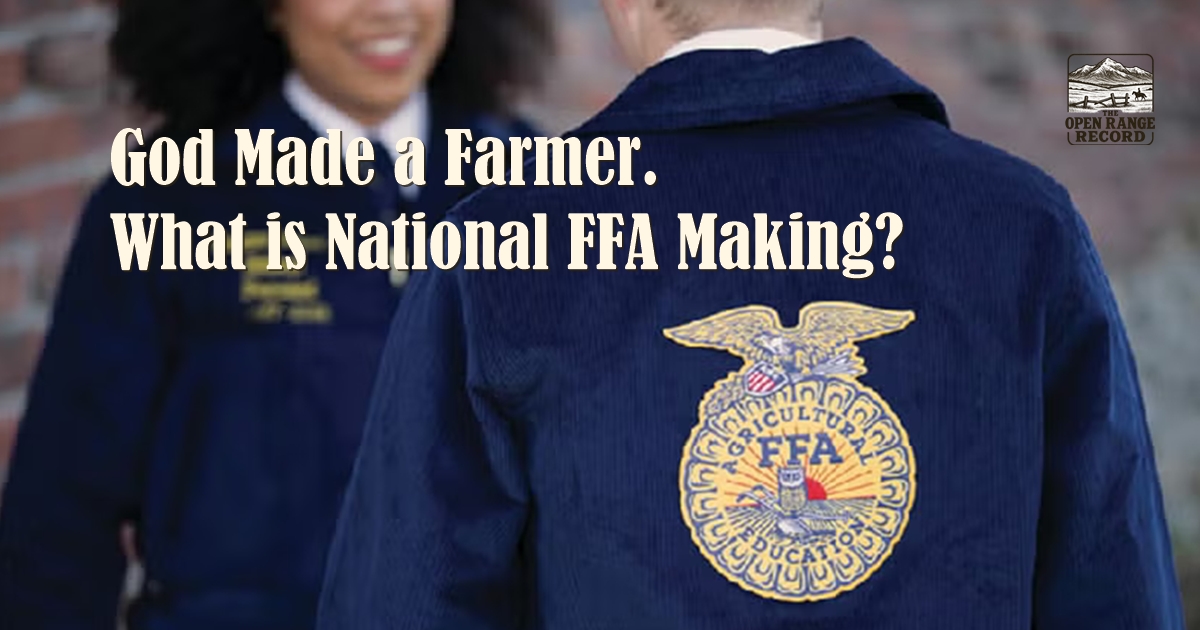
The National FFA has a long history of serving young Americans, and its teachers, volunteers, and students continue doing valuable work. The questions concern national leadership and accountability, not the young people wearing blue jackets.
Who approved the religious-expression restrictions? And why have some Christian organizations been excluded from an institution that promises inclusion?
Those are questions National FFA should answer openly, because the student showing a steer at a Wyoming county fair today may be running a family ranch tomorrow. And the future of American agriculture deserves more than assurances. It deserves transparency.