NEWS
**
Update to Original Article
Sweetwater County School District No. 1 policy KJ specifically says revenue-enhancement activities cannot promote “any religious or political organization” and cannot promote, favor, or oppose a candidate or an issue being put before voters. While this policy specifically deals with advertising and revenue enhancement, the standard is pretty clear, the district recognized there should be a line between school business and political activity. If that standard matters when it comes to advertising, it is fair to ask why the same level of caution wasn’t used before directing parents, through official school communications, to the Wyoming Education Association for information.
**
Encouraging citizens to vote is appropriate. Public institutions can provide election dates, registration information, polling locations, and links to official election resources. Sweetwater County School District No. 1 did all of that in a recent post on its official Facebook page, and then some.
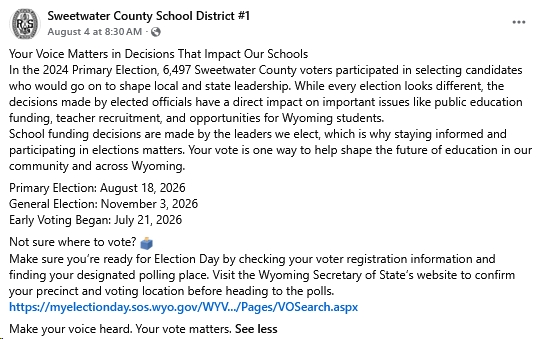
The district told residents that decisions made by elected officials directly affect public education funding, teacher recruitment, and opportunities for Wyoming students. It reminded voters that school-funding decisions are made by “the leaders we elect” and said voting is one way to shape the future of education.
Attached to that election message was a district-branded graphic declaring that “strong schools require local control and sustainable funding.” It promoted greater spending flexibility, defended the “importance” of property taxes, and warned that budget reductions could lead to delayed maintenance, fewer programs, larger classes, fewer course offerings, and reduced opportunities for students, without acknowledging that those are ultimately district budgeting and priority decisions, not unavoidable outcomes dictated by the state.
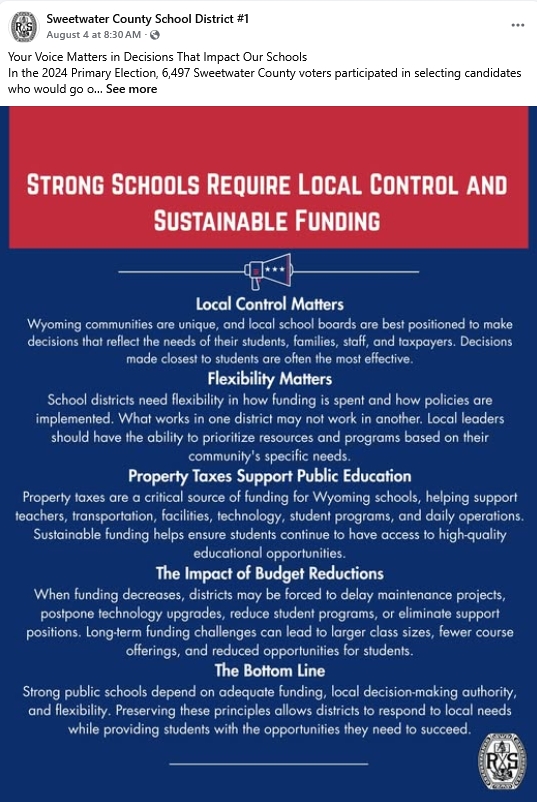
That is much more than information about when and where to vote; it is a political argument. The message told voters which policy issues should shape their decisions and then supplied the district administration’s preferred conclusions: local control is being threatened, funding restrictions are harmful, property-tax support is essential, and reduced spending will hurt students.
These are contested policy judgments, not neutral facts. Many candidates, lawmakers, parents, and taxpayers believe stronger accountability, tighter spending controls and different district priorities are necessary to protect both students and taxpayers. The problem is that the district used its official, taxpayer-funded platform during an election to present those views as the responsible position for voters to adopt.
A neutral election post would have been straightforward: the primary election is August 18; early voting has begun; here is where citizens can confirm their registration and polling location. Instead, the district wrapped a policy campaign inside an election reminder, presenting only the institutional position of the district.
School administrators and employees have every right to advocate as private citizens. They may support candidates, criticize legislation, defend property taxes, and argue for additional education spending on their own time and through their own platforms. Sweetwater County School District No. 1, however, is not a private citizen.
It is a taxpayer-funded government entity serving residents with widely different political beliefs. Its official Facebook page is not the superintendent’s personal account. Its communications staff are not political organizers. Its public credibility and institutional reach do not belong to whichever policy position district administrators prefer.
This is how political activism becomes embedded in public education. It rarely begins with an explicit candidate endorsement. It begins when administrators use official school platforms to tell families which issues matter, which consequences they should fear, and which policy decision voters are expected to reach. The district may call that community engagement. Taxpayers may reasonably see it as institutional politics conducted on public time.
The timing makes that concern harder to dismiss. The post was not merely a general statement about the district’s legislative priorities. It was presented specifically in connection with the August partisan primary and told voters that the leaders they elect will determine school funding and educational opportunities. That shifts responsibility away from the district itself.
The advocacy graphic then provided the political framework through which voters were invited to evaluate those candidates. The district did not say, “Vote for Candidate A.” It did not name a preferred candidate. Instead, it used the election message to frame the primary around policies that protect the district system, its funding and its spending discretion, while presenting those institutional interests as though they were automatically the same as the interests of students and families.
Though that may not satisfy the narrow legal definition of candidate electioneering, it is still political persuasion. Taxpayers are entitled to know who created and approved the graphic, whether it was produced during paid staff time, whether the Board of Trustees authorized this type of election-season advocacy, and what district policy permits official resources to be used to advance one side of a contested public-policy debate. Those are basic accountability questions.
Sweetwater County School District No. 2 recently used an official district letter to direct parents to the Wyoming Education Association’s legislative scorecard and encourage them to contact regional legislators about district funding concerns. Both incidents reflect the same troubling instinct: treating official school communication systems as tools for political mobilization.
That instinct should concern residents regardless of whether they agree with the message being promoted.
A person who supports the district’s funding position today may feel differently when a future superintendent or board uses the same institutional power to advance a political cause that person opposes. Neutral standards are important because public authority eventually changes hands, something humans routinely forget until the machinery is pointed in their direction.
The district does not have the right to designate one side of a funding debate as the official “pro-education” position. Supporting students does not require agreeing with every spending request, administrative priority, or every claim about the consequences of legislative decisions.
Sweetwater County School District No. 1 may explain its budget, describe the effects of legislation, and provide verifiable information about district operations. It should do so openly, accurately, and without attaching a political sales pitch to voting instructions.
Parents and taxpayers are not a captive political audience simply because the district has access to their attention. A school district should not use its taxpayer-funded platform to tell them what political conclusions to carry into the voting booth.