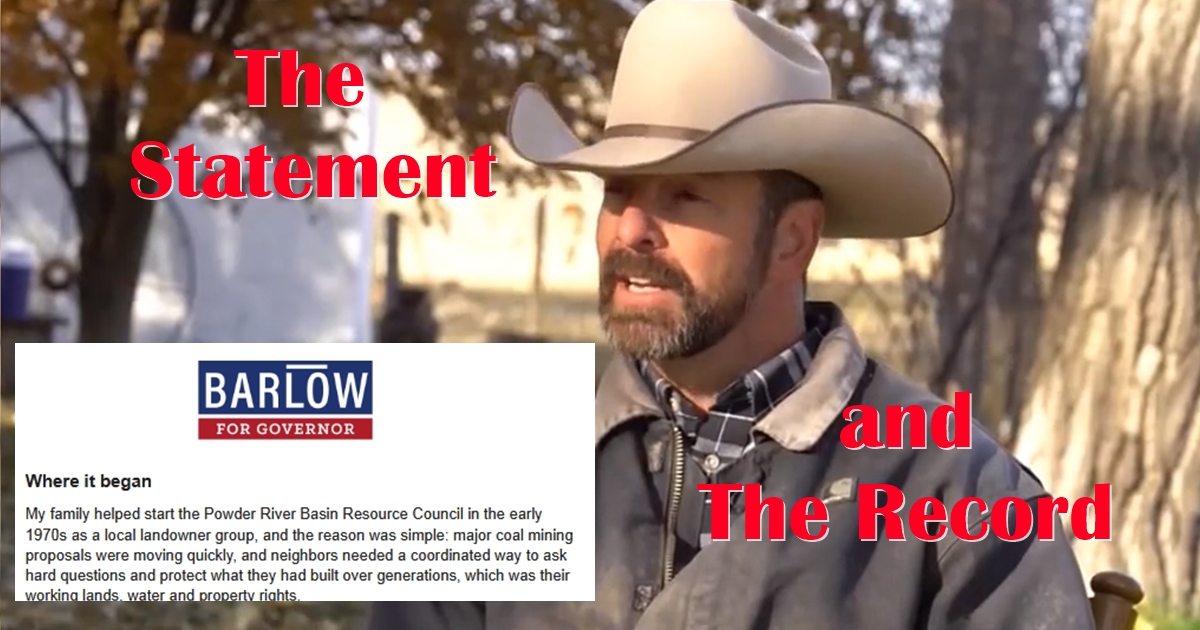
March 27, The Open Range Record published a piece entitled,“Born in a Barn: Eric Barlow and a History of Radical Environmental Politics in Wyoming.” Shortly after publication, Barlow’s campaign issued a statement in which he said,
“Over the decades, that organization grew, and its mission broadened into a statewide advocacy operation with priorities and litigation that no longer matched its original local-landowner purpose. I no longer felt comfortable with the proposed solutions, especially in my role as an elected representative for my community and Wyoming. So, I left.”
What Barlow doesn't mention in his statement is that he is the person who filed one of the larger lawsuits the Powder River Basin Resource Council and the WORA were involved in.
But how he described his transition from activism in the WORA and the Powder River Basin Resource Council to the Wyoming House of Representatives to Wyoming PBS is very different. in a 2019 interview, Barlow explains, though he doesn’t mention the groups by name for obvious reasons, that his activism was the catalyst for entering politics not an impediment to it.
Eric Barlow’s written response to “Born in a Barn” confirmed the central historical point of the original article. His family did start the Powder River Basin Resource Council as a local landowner group focused on responsible development, property rights, and protecting working lands. In his statement, Barlow said the point was never to stop mining, but to make sure Wyoming developed coal responsibly.
His statement acknowledges the founding story, then jumps straight to the conclusion he wants voters to accept. The group changed, he did not, and his record proves he has always stood for Wyoming energy, private property, and practical problem-solving.
But he never says when the break happened. He never says what, specifically, pushed him away. He never identifies which priorities, lawsuits, alliances, or policy positions crossed the line for him. He simply asks voters to take his word for it.
The Missing Timeline
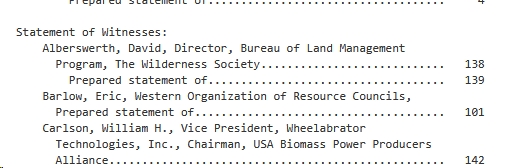
Barlow’s campaign biography says he was elected to the Wyoming House in 2012 and began serving in January 2013. His public identification with the PRBRC and WORC world was visible well before that. He was quoted in the lawsuit with Earthjustice in 2002, and testimony was submitted on his behalf to Congress through WORC and PRBRC in 2003.
If that wider advocacy world had already become something he no longer believed in, voters are entitled to ask when he decided that and whether the separation came before his political ambitions took shape or only after those ties became inconvenient in coal country. Barlow’s response is disciplined and narrow. It answers the origin story but does not fully answer the political question.
Who Is Lining Up Behind Him Now?
Now there is a second layer to that same problem. If Barlow’s public image in Cheyenne has long been the good-old-boy rancher, the veterinarian, and the plainspoken Wyoming Republican he has worked hard to project, then voters should know whether that image is the whole story or simply the most useful part of it. Once a candidate runs statewide, the question is no longer only about where he came from; it is also who is lining up behind him now.
Trevor Neilson is not just another visible supporter with a Barlow campaign sign in his yard. He is a figure with a public résumé that runs through the Clinton White House, Bill Gates’s philanthropy orbit, global impact investing, climate-activist finance, and now Wyoming’s emerging AI infrastructure buildout through Prometheus Hyperscale. That does not tell voters everything about his role in Barlow’s campaign, but it does tell them this is not an ordinary yard-sign moment.
Trevor Neilson’s Record
Neilson’s background is not hard to find. Tatler Asia profiled him as a former Clinton White House staffer, a founding member of the team that launched the Bill & Melinda Gates Foundation, a former head of public affairs for Bill Gates, a co-founder of Global Philanthropy Group, and a World Economic Forum Young Global Leader. That is not a Campbell County résumé, it is one of global influence.
His record on climate politics is even more striking. A 2023 Sunday Times report said Neilson founded the Climate Emergency Fund, which became a prime financial backer of Extinction Rebellion, Just Stop Oil, and dozens of other activist groups. Neilson later distanced himself from those tactics, calling them “counterproductive” and arguing that disruption for the sake of disruption was alienating the very people activists needed to persuade.
That is not the same thing as walking away from the broader project. It is a shift in method, not necessarily in worldview.
That distinction tracks with something else happening in Wyoming politics right now: the move from blunt activism to polished coalition-building. Not street theater, but language about balance, stewardship, innovation, freedom, and the center. Not slogans about shutting things down, but softer rhetoric about building the future responsibly.
Neilson is also open about his interest in shaping political identity. Listings for his book The Forgotten Center describe it as a call for a new centrist movement rooted in common sense, moral clarity, and the overlooked wisdom of middle America.
Wyoming’s Next Buildout
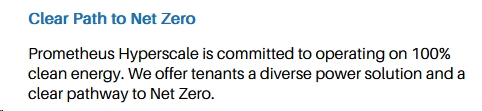
Neilson is now part of Wyoming’s future-facing pitch in a very concrete way. Prometheus Hyperscale announced in September 2024 that he joined as president when the company launched its expanded Wyoming project near Evanston. The company said its flagship campus had grown from 120 megawatts to a planned 1-gigawatt facility. Prometheus describes itself as building infrastructure for the age of AI and says it has tied its Wyoming ambitions to energy-transition and “net zero” messaging.
At the same time, TerraPower’s Natrium reactor project in Kemmerer — backed by Bill Gates — received its construction permit in March 2026, a major milestone for advanced nuclear development in Wyoming. Public announcements described it as the first construction permit ever issued for a commercial non-light-water power reactor, with a 345-megawatt design and storage that can boost output to 500 megawatts.
It cannot be overstated that there is no public proof that Prometheus and TerraPower are formally linked. But it is fair to say they sit inside the same emerging Wyoming future: hyperscale data centers, advanced nuclear, carbon-managed gas, AI infrastructure, and the political class trying to make all of it sound inevitable, moderate, and good for everyone.
The Question Voters Still Deserve Answered
If Eric Barlow wants voters to see him as the practical Campbell County rancher who believes in responsible development, why does part of his visible support orbit look so comfortable in the world of donor capital, climate activism, AI infrastructure, and a self-conscious new political center?
That question becomes even more important when paired with the one Barlow still has not answered. If the Powder River Basin Resource Council and the advocacy world around it truly stopped reflecting his values, when did he decide that? Before he thought about running for office, or only after he realized those ties might not fit the political image he needed in coal country? Or, was it, as he described to WYPBS, a catalyst for his entry into state-level Wyoming politics.
If he wants voters to believe the break was rooted in principle, then principle ought to come with specifics. Which priorities changed? Which alliances crossed the line? Which lawsuits or ideologies made him walk away? His statement does not say.
Barlow confirmed the barn. He did not explain the break. And before Wyoming hands him the governor’s office, it would be wise to ask not only where he came from, but who is gathering around him now.