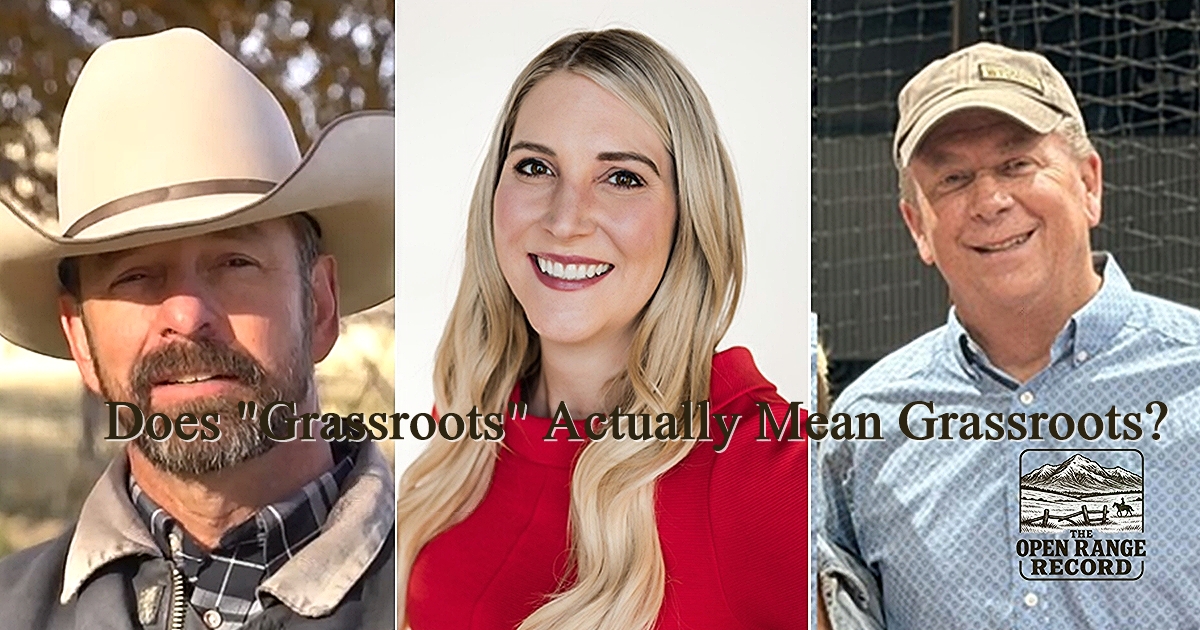
Follow the smaller dollars, follow where they come from, and a very different picture of Wyoming's race for governor begins to emerge.
Political campaigns love the word grassroots. Everybody wants to be grassroots. But rather than simply accepting the label, perhaps Wyoming voters should measure it.
I think there are three ways to do that: Where does the money come from? How much comes from smaller individual contributors rather than large checks? And how much support comes from people contributing something besides money—their time, mileage, food, lodging, venues and services?
Apply those measurements to Wyoming's Republican candidates for governor and Brent Bien's campaign begins to look remarkably different from the two campaigns with considerably more money.
Follow the Smaller Dollars
Let's start with individual contributions of $500 or less. On sheer volume, Eric Barlow wins. Across the reports I reviewed, Barlow raised approximately $349,856 from contributions of $500 or less. Bien raised approximately $58,200 through contributions of that size, while Megan Degenfelder's filing showed approximately $40,119.
Barlow deserves credit for that. He clearly has substantial grassroots participation. However, Bien's number deserves a second look: despite Degenfelder's seven-figure campaign, Bien actually raised approximately $18,000 more than Degenfelder from individual contributions of $500 or less.
The percentages make the contrast even clearer. For every $1 raised from individual contributors, approximately 45 cents of Bien's came from contributions of $500 or less. For Barlow, it was about 28 cents. For Degenfelder, about 11 cents.
Barlow raised the most grassroots dollars. Bien, however, appears to have built the campaign most dependent upon grassroots dollars.
Then Ask Where Those Dollars Come From
Contribution size is only half of the equation. This is a race for governor of Wyoming, so I also wanted to know how much of the individual money was coming from Wyoming.
Approximately 97% of Bien's individual contribution dollars came from Wyoming addresses. For Barlow, the figure was approximately 86%. Degenfelder's listed individual contributions were approximately 68% from Wyoming, leaving roughly one-third coming from outside the state.
Colorado stood out as Degenfelder's largest source of out-of-state individual money, with additional contributions from Texas, California, Virginia, Maryland, Florida, Illinois, Washington, and other states.
Those figures demonstrate something other than raw fundraising totals. Barlow may have raised the most actual Wyoming individual dollars, but Bien's individual fundraising is the most heavily concentrated inside Wyoming.
Barlow's Grassroots Campaign Has Another Layer
Barlow's smaller contributors are real, but when I followed his bigger contributions, I found another financial network layered around them.
His contributor list includes former House Speaker Albert Sommers, former House Speaker Tom Lubnau, former Senate President Ogden Driskill, former State Auditor and gubernatorial candidate Rita Meyer, and former Secretary of State and State Auditor Max Maxfield. Other donors have current or former connections to the Legislature, lobbying, government affairs, boards, major Wyoming businesses, and organizations that operate within or alongside state government.
Then there are Jackson and Teton County contributors, where I found substantial wealth along with finance, philanthropy, conservation, and land-trust connections. None of that is improper, but it tells voters something a simple donor count does not: Barlow's grassroots participation exists within a much larger and highly interconnected Wyoming political, governmental, business, and institutional network.
Follow the PAC One Step Further
Barlow also received substantial PAC support, including $168,250 from Civil Leadership PAC. When I followed that PAC's disclosure backward, I found a $100,000 contribution from cryptocurrency entrepreneur Charles Hoskinson, $40,000 from Hladky-related sources, and $15,000 from B. Wayne Hughes Jr., owner of Cowboy State Daily.
Other people associated with Cowboy State Daily also appear among Barlow's contributors. Tom Lubnau, Gail Symons, and Rod Miller have written political commentary or stories for the publication and also appear among Barlow contributors. Lubnau's connection goes further: the former Wyoming House Speaker is also part of Barlow's campaign leadership team.
None of that establishes anything improper or tells us how Cowboy State Daily determines its coverage. However, media ownership, political commentary, campaign contributions, and campaign leadership intersecting around the same candidate are relationships readers are entitled to know about when evaluating political coverage during an election.
The Teton County Network Goes Deeper
Another Barlow contributor who caught my attention was Trevor Neilson. Neilson, now associated with Prometheus Hyperscale, has a résumé extending far beyond Wyoming, including work connected to the Clinton White House and the Bill & Melinda Gates Foundation. He was recognized as a World Economic Forum Young Global Leader and later co-founded the Climate Emergency Fund.
Those affiliations do not tell us what Barlow believes, nor does Neilson's contribution make Barlow responsible for Neilson's views. They do show that Barlow's financial coalition includes people connected to national political, philanthropic, environmental, and institutional networks.
Then there is Dr. Brent Blue, a Jackson physician who has publicly provided abortion services and has been an outspoken participant in Wyoming's abortion debate. His contribution does not establish Barlow's position on abortion. However, because Barlow's pro-life position has repeatedly been an issue in this campaign, voters are entitled to know that Blue is among his financial supporters and decide for themselves whether it matters.
Degenfelder's Million-Dollar Number Needs Context
Degenfelder's campaign presents a different financial structure. Her primary report showed more than $1.2 million in total contributions, but $522,000 came through loans, including approximately $497,000 from her father and $25,000 from herself, and another $392,500 came from PACs. Together, loans and PAC money represented roughly 71.5% of that reported total.
Her individual money also looks different from Bien's. Nearly one-third of the individual dollars listed came from outside Wyoming, almost 79% of the listed individual contribution dollars came from contributions exceeding $1,000, and contributions of $500 or less produced only about 11 cents of every individual-contribution dollar.
That makes the Bien comparison particularly interesting. Despite Degenfelder's vastly larger overall campaign, Bien raised approximately $18,000 more from individual contributions of $500 or less.
Degenfelder's individual donor list adds another layer. It includes former Wyoming Senate President and Republican Party chairman Diemer True, former House Speaker and Senate President Eli Bebout, and multiple members of the True and Bebout families. It also includes major energy figures such as Denver billionaire Philip Anschutz and oil-and-gas executive L. Roger Hutson. Those contributions are not improper, but they show that her individual fundraising includes an established Wyoming political and energy-industry network alongside the large-dollar and out-of-state money.
Degenfelder has also made President Donald Trump's endorsement a central feature of her campaign messaging. But an endorsement, like a campaign war chest, still has to translate into votes.
The Number That Keeps Catching My Eye
There is one line in Bien's report I keep coming back to: in-kind contributions.
In the 2026 primary filings, in-kind support represented approximately 21% of Bien's reported contributions, compared with about 2% for Barlow and 0.13% for Degenfelder. In raw dollars, Bien reported $40,210 in in-kind contributions, Barlow $22,794.32 and Degenfelder about $1,637.
An in-kind contribution can be mileage, food, lodging, administrative work, outreach, venue, supplies, or services. It can represent people doing the work required to move a campaign across Wyoming. The numbers do not prove Bien has the strongest ground game, but they compel us to ask: are we seeing campaign enthusiasm hiding in plain sight on a finance report?
Campaigns can buy television commercials, mailers, consultants, and digital advertising. What they cannot simply purchase is someone who believes enough to cook the food, set up the chairs, open a building, drive across the state, knock on a door, put up a sign or bring a neighbor along. That is a ground game.
What If This Election Isn't About Money?
Put the numbers together and the three campaigns look very different. Barlow has the largest individual fundraising operation and genuine Wyoming grassroots support, but it sits alongside substantial large-dollar, PAC, family/personal and institutional-network support. Degenfelder's much larger war chest relies heavily on loans and PACs, with a greater share of out-of-state and large-dollar individual money.
Bien has far less money. But his individual fundraising is approximately 97% Wyoming-based, about 45 cents of every individual dollar came through contributions of $500 or less, and roughly 21% of his primary-report contributions were in-kind.
So maybe the most interesting question in this governor's race isn't who raised the most money. Maybe it's who built the strongest ground game.
If Brent Bien wins after being dramatically outspent by two seven-figure campaigns, the biggest story on election night may not simply be who won. It may be how he won.
A PAC isn't a vote. A television commercial isn't a vote. A consultant isn't a vote. A $100,000 donor gets one vote, and so does the Wyoming citizen who gave $25. The $25 contributor may also put up a sign, talk to ten neighbors, bring friends to an event, and tell everyone at the coffee shop why they believe in their candidate.
Perhaps the most powerful campaign contribution of all is still the one nobody can purchase, a voter who believes in you enough to tell somebody else why.