NEWS
Eric Barlow wants Wyoming voters to believe that questioning his support for coal, oil and natural gas is absurd.
“For anybody to think I’m not supportive of coal and oil and gas and uranium is disingenuous,” the Republican candidate for governor recently told Cowboy State Daily. He accused his critics of trying to “dredge something up that does not exist.”
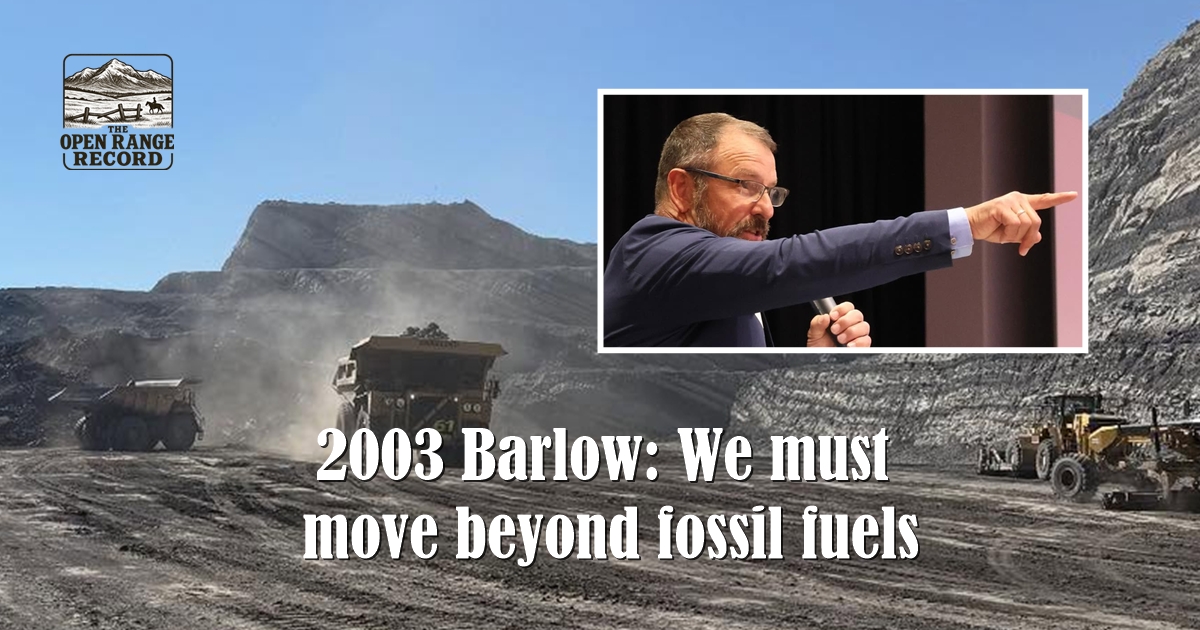
But it does exist—and it is well preserved in the official records of Congress. On March 19, 2003, Barlow, in a letter, testified before the U.S. House Resources Committee on behalf of the Western Organization of Resource Councils and the Powder River Basin Resource Council. His testimony did not merely call for responsible development or better protection of surface owners. It concluded with an unmistakable demand that America move away from fossil fuels.
“There has not been a meaningful acknowledgement that we must move beyond nonrenewable sources of energy,” Barlow told Congress. He then called for the country to “transform our energy paradigm” toward “clean and sustainable sources of energy.” Although he conceded that fossil fuels would retain some role, he said it must be “one of transition and not reliance.”
Barlow went so far as to suggest that this transition was necessary for our national security.

The Open Range Record contacted Barlow for this story. In response he said,
"Calling my 2003 testimony anti-energy is simply false. I explicitly supported responsible energy development while standing up for Wyoming landowners and protecting our water. Supporting Wyoming energy and protecting property rights are not mutually exclusive. These discussions continue today for other energy and indsustrial sectors."
His testimony is not simply a request for oil and gas companies to clean up drilling sites. It was an argument that fossil fuels should become a thing of the past rather than the foundation of America’s energy system. For a Wyoming politician now presenting himself as an unwavering defender of coal, oil, natural gas, and uranium, that is an insurmountable contradiction.
More Than Surface-Owner Protections
Barlow and his campaign now portray his environmental activism primarily as a defense of ranchers, water, and private property rights. Those concerns were certainly included in his congressional testimony. But Barlow went considerably further.
He told Congress that oil and gas development was producing “degradation and ruination” and placing Wyoming’s resources in “grave jeopardy.” He called for greater federal intervention and argued that Bureau of Land Management offices should be prohibited from approving new leases and drilling permits whenever the Secretary of the Interior could not certify that the office had sufficient staffing and enforcement funding.
Most importantly, he ended his testimony by declaring that America must “move beyond” nonrenewable energy and treat fossil fuels as a bridge to something else—not as resources upon which the nation should continue to rely.
What cannot reasonably be argued is that the statement was merely about reclaiming abandoned wells, because it wasn’t. He forcefully advocated for an end to our use of coal, oil, and gas. The congressional testimony speaks for itself.
A Long Environmental Record
The 2003 testimony was not an isolated statement. Barlow appeared before Congress representing the Powder River Basin Resource Council, an organization his own family helped establish. Barlow acknowledged that history in an April 2026 campaign statement, saying his family helped start the council during the early 1970s.
The Barlow family’s concerns initially centered on protecting ranchers and landowners as large-scale coal development arrived in the Powder River Basin. But Eric Barlow later became personally involved in legal disputes over energy production.
In 2002, Barlow joined other ranchers and environmental organizations such as EarthJustice in a federal court fight involving coal-bed methane leases in northeastern Wyoming. The litigation sought to defend a ruling that stopped activity on three federal leases until additional environmental analysis could be performed--the same tactic that Earthjustice has recently used against the Trump Administration to halt energy development in the Mountain West. In Barlow’s suit, the groups involved included the Wyoming Outdoor Council, Natural Resources Defense Council, and Defenders of Wildlife, represented by Earthjustice.
Barlow’s campaign now says the Powder River Basin Resource Council subsequently expanded beyond its original landowner mission and embraced priorities and litigation with which he disagreed. He says he eventually left the organization because its proposed solutions no longer reflected his beliefs.
That may explain why he separated himself from the organization. It does not erase what he personally told Congress.
It also doesn’t erase his vote to impose a low-carbon standard on Wyoming coal-fired power plants, compelling utilities to investigate and implement immensely expensive carbon-capture technology through HB0200 from 2020-”Reliable and dispatchable low-carbon energy standards.” A peer reviewed study from 2022 found that these standards could increase the price of electricity by 237%.

Today, he tells Republican voters that questioning his commitment to coal is “disingenuous.”
The contradiction is not merely rhetorical. It has consequences for Wyoming families, businesses, and energy producers. Electricity rates are not an abstract policy matter. Higher generation costs affect household budgets, agricultural operations, mines, manufacturers, and every other sector of Wyoming’s economy.
A policy that makes coal-fired electricity dramatically more expensive can undermine coal just as effectively as an outright prohibition. If coal plants become uneconomical because of government mandates, they will eventually close—regardless of whether politicians continue calling themselves “pro-coal.”
In a Wyoming gubernatorial race, being pro-coal is just as essential as being against a state income tax. When asked about the importance of coal in Wyoming, Brent Bien, who is running against Barlow, said,
“I reject the idea that Wyoming should transition away from the very resources that provide reliable power, good-paying jobs, fund our schools and communities, and strengthen America's energy security. … Wyoming has hundreds of years of energy beneath our feet. Let's use it responsibly, strengthen our grid, create Wyoming jobs and make our state an energy powerhouse. Wyoming energy isn't something to transition away from. I'm interested in unleashing it.”
Campaign Rhetoric Meets the Historical Record
Barlow points to more recent actions as proof of his support for Wyoming energy. He notes that he pursued a coal severance-tax reduction in 2014, supported subsequent reductions, and offered a budget amendment that he says enabled the mining of another 97 million tons of coal. That is part of his record. But so is HB200.
People can change their views, and a political career spanning 14 years will rarely be perfectly consistent. Barlow’s energy record, however, is not simply an inconsistent vote or two. If Barlow changed his position, he should explain when and why. Instead, he now says the record his critics are discussing “does not exist.” It plainly does.
In his recent comments to Cowboy State Daily, Barlow pointed to his Campbell County roots and the support he has received from coal miners and rig workers. Geography, however, is not a substitute for an explanation. Being elected in an energy-producing county does not alter the words he delivered under his own name before a Congressional committee.
The issue is not whether Barlow once demanded reasonable protection for ranchers. Wyoming conservatives generally support private property and water rights. The real question is why Barlow went beyond those protections and advocated transforming America’s energy system so that fossil fuels would become sources of “transition and not reliance.” That’s the same energy-transition agenda rhetoric Wyoming’s elected officials now routinely condemn.
Wyoming Voters Deserve an Answer
A candidate’s record matters most when it contradicts the image being constructed during a campaign. Today, Barlow wants to be regarded as a dependable champion of Wyoming’s energy industries. In 2003, he told Congress that the country needed to move beyond nonrenewable energy and end its reliance on fossil fuels. In 2020, he voted to impose the agenda he advocated for in front of Congress on Wyoming energy producers.
Perhaps Barlow genuinely changed his mind. Perhaps he no longer believes what he told Congress or in his vote almost 20 years later. If so, Wyoming voters deserve a direct acknowledgment of that change—not an insistence that the documented record was invented by political opponents, because it wasn’t.
The question for Barlow is simple: Does he still believe fossil fuels should serve only as transitional resources, or does he now believe Wyoming and the nation should continue relying upon them? Before Wyoming Republicans entrust him with the governor’s office, he should answer it.
*Editor's Note: Megan Degenfelder's campaign was also contacted for this story but did not reply in time for this article. When received, this article will be updated to reflect her statement.