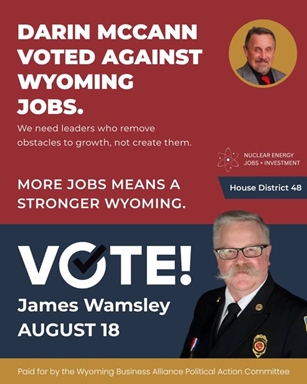
Sometimes a story doesn't start at a government meeting or in a stack of public records. Sometimes it starts in a mailbox. When a Wyoming Business Alliance PAC Mailer criticizing representative Darren McCann's voting record arrived in Sweetwater County, it raised questions about two pieces of legislation: HB0046 and HJ0003. Days later, many of those same issues resurfaced during the House District 48 candidate forum. Together, the Mailer and the forum offered a chance to compare campaign messaging with the public record.
HB 46: More Than a Nuclear Tax
The PAC mailer states that McCann voted to raise taxes on nuclear power production. HB0046, introduced by the joint revenue interim committee, would have placed wind, solar, and nuclear electricity under the same tax framework, replacing Wyoming’s separate nuclear tax chapter. Under the proposal, wind, solar and nuclear generation generally would have been taxed under the same statutory framework at $1 per megawatt-hour after applicable exemptions for new facilities.
Whether that represented a good tax policy is open to debate. Those in favor of the bill argued the proposal would create a uniform tax structure regardless of energy source, while opponents believed emerging technologies should continue receiving favorable tax treatment. What the legislative record shows, however, is that HB0046 proposed a broader restructuring of Wyoming’s electricity tax framework than simply “raising taxes on nuclear power.” The bill ultimately failed introduction and never became law.
HJ3: A Different Question Entirely
The Wyoming Business Alliance PAC also criticizes McCann for supporting HJ0003, suggesting the measure would have created barriers to Wyoming’s nuclear future.
First, let’s look at HB0131 passed in 2022. HB0131 allows advanced reactors to store the spent fuel they generate under federal Nuclear Regulatory Commission requirements to be temporarily stored on-site. HB0131 functions, in part, as a legislative follow-up to Wyoming’s 2020 small modular reactor law, filling a statutory gap by expressly addressing temporary on-site storage of spent fuel generated by an advanced reactor.
Rather than regulating nuclear power generation, HJ0003 proposed asking Wyoming voters whether the state constitution should require statewide voter approval before high-level radioactive waste or spent nuclear fuel could be stored within Wyoming. Unlike questions involving taxation or economic incentives, the storage of high-level radioactive waste carries implications measured, not in years, but in generations. HJ0003 addressed whether Wyoming voters should approve any future expansion beyond reactor site storage including proposals involving spent nuclear fuel from outside of the state.
Some believe elected officials should make those decisions. Others that Wyoming citizens should have the final say before the state ever becomes a long-term storage location for spent nuclear fuel or high-level radioactive waste. Those are policy questions about governance and public approval, not about whether Wyoming should embrace nuclear energy. HJ0003 also failed introduction.
Where Does Wamsley Stand?
During the House District 48 candidate forum, McCann’s opponent, James Wamsley, made clear that he supports Wyoming’s growing nuclear industry. “The nuclear power industry is on our horizon whether we like it or not,” he said. “We should embrace that and develop it responsibly.”
If McCann’s votes are important, Wamsley’s own position naturally becomes part of the discussion. His support for Wyoming’s growing nuclear industry raises additional questions about taxation, spent fuel storage, and whether Wyoming voters should have the final say before high-level radioactive waste or spent nuclear fuel is stored in the state.
The Debate Turns to Property Taxes
The House District 48 candidate forum shifted the discussion from nuclear energy to one of the biggest issues facing Wyoming voters this election cycle, property taxes. Although the moderator never specifically mentioned Wyoming’s existing 25% residential property tax exemption or the proposed constitutional amendment that would reduce residential property taxes by 50%, both candidates clearly understood what was being discussed.
The moderator asked:
“Many policy decisions made in Cheyenne have significant financial impacts on counties, municipalities, and special districts. In your opinion, should the Legislature avoid shifting costs to local governments without also providing revenue to offset those costs? Why or why not?”
Wamsley argued that reducing taxes must be balanced against the public services those taxes support. He cited roads, law enforcement, fire protection, and emergency communications before warning that local governments cannot continue watching revenue “go away and go away and go away.” His answer reflected arguments made by local governments throughout the property-tax debate that reductions in essential services could happen if not accompanied by replacement revenue.
McCann argued Wyoming has a spending and priorities problem, rather than a revenue problem. He called for a forensic review of government spending and argued that elected officials should identify waste, improve efficiency, and prioritize essential services before asking taxpayers for additional revenue.
The exchange also left several important questions unanswered. Neither candidate was directly asked whether they support Wyoming's existing 25% homeowner property tax exemption or the proposed constitutional amendment that would reduce residential property taxes by 50% if approved by the voters. Given how much discussion property taxes have generated across Wyoming, those questions would have provided voters with valuable insight into where each candidate stands.
Wyoming’s Economy: The Missing Piece
Another interesting moment came during the discussion about Wyoming’s economy. Wamsley correctly observed that southwest Wyoming has experienced repeated boom-and-bust cycles and emphasized the importance of diversifying the state’s economy. That observation is difficult to dispute. What received far less attention, however, was one of the primary reasons those cycles occur.
Much of southwest Wyoming’s economy depends on federally managed mineral development and the federal leasing, permitting, regulation, and litigation decisions that shape it. Those decisions, along with commodity prices, often influence Wyoming’s recurring boom and bust cycles.
Public Service and Perspective
James Wamsley is not simply another first-time legislative candidate. He has spent decades in public service, including approximately twenty years in the trona industry before becoming Fire Chief for the City of Rock Springs. That experience provides context for his emphasis on protecting local government services during the forum.
Throughout Wyoming’s property-tax debate, local governments have consistently argued that reducing tax revenue threatens essential public services. During the candidate forum, Wamsley’s answers reflected that same philosophy. McCann’s answers reflected another.
Understanding each candidate’s background helps explain why they approach government spending, taxation, and local government finance from different perspectives. Neither background disqualifies either candidate; both simply provide voters with additional context as they evaluate two different approaches to governing.
A Citizen Legislature—and Two Different Realities
The final question of the evening may have provided the clearest contrast between the candidates. The moderator asked how each candidate would balance the demands of Wyoming’s citizen legislature with the responsibilities of maintaining a full-time career.
Wamsley emphasized the importance of attending committee meetings and actively participating throughout both the legislative session and the interim.
McCann acknowledged criticism that he had missed several interim committee meetings. He explained that one committee met on Mondays and Tuesdays, the same days he performs surgeries as an orthopedic physician assistant. Serving in Wyoming’s citizen legislature, he said, sometimes requires balancing public service with the profession that supports his family.
During the campaign, the Rock Springs City Council adopted ordinance 2026-06, creating paid legislative leave for eligible city employees elected to the Wyoming legislature, while maintaining compensation and employment protections. The timing of that policy provides context for the forum discussion about balancing legislative service with full-time employment. This policy change was brought before the council one week after Wamsley announced his candidacy. The ordinance received its first reading April 21st, its second reading May 5th, and final approval was on May 19th, adding Section 817, “Legislative Leave,” to the City’s Personnel Policies.
That policy may well serve an important public purpose, but it also provides important context for the final exchange during the debate. Wamsley discussed attending every committee meeting, while employed by a public entity that had recently adopted a legislative leave policy covering eligible employees serving in the Legislature. McCann described the challenge of balancing legislative service with private employment.
Timing alone does not establish motive or coordination; it does, however, provide additional context for the debate discussion about balancing legislative service with full-time employment and leaves reasonable questions unanswered.
Questions That Remain
The House District 48 race has generated vigorous debate over nuclear energy, property taxes, government spending, and Wyoming’s economic future.
The Wyoming Business Alliance Political Action Committee chose to make Rep. Darin McCann’s legislative record the centerpiece of its campaign against him. Therefore, before publication, The Open Range Record sought additional clarification from challenger James Wamsley with an email submitted through his campaign website. Questions were submitted regarding property tax relief, HB0046, HJ0003, spent nuclear fuel storage, federal land policy, and his views on balancing local government funding with tax relief. No response has been received from Mr. Wamsley by the time of publication.
Campaign mailers and candidate forums are valuable sources of information, but they represent only part of the public record. Legislative history, public documents, and the candidates’ responses often provide additional context that helps voters evaluate the issues for themselves. For House District 48 voters, the campaign mailer, the candidate forum, and public record together provide a fuller picture of the issue shaping this race.