OPINION
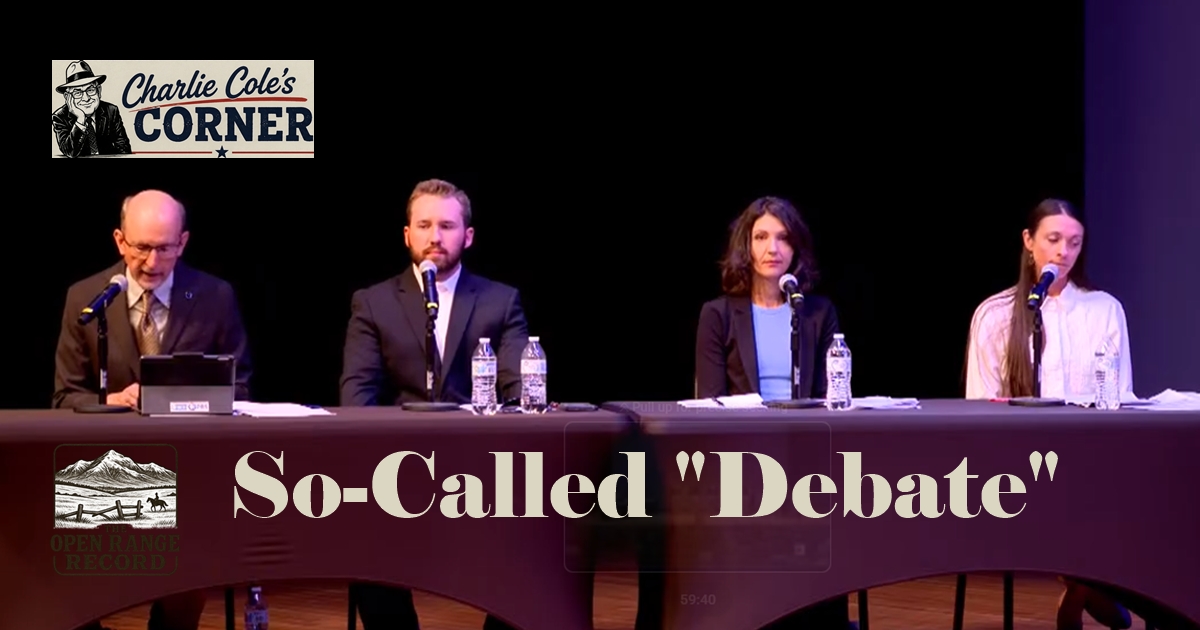
I forced myself (regrettably) to watch through the almost 90-minute congressional “debate” hosted in Sheridan by Wyoming PBS. I watched my first political debate while still a young lad in 1960 (Kennedy-Nixon) and have probably watched at least 100 of them since. I must concede that this farce was among the worst I’ve ever seen!
This embarrassing spectacle involved questions which were asked by a panel put together by Wyoming PBS. I must admit that I don’t know any of these people, but I got a pretty good impression of where they stand on the political spectrum after about 3 minutes of this “debate.”
The first question out of the shoot was from the head PBS guy, and it asked whether each candidate would vote to approve additional funding for the war with Iran which, the questioner stated, was initiated by the U.S. Each candidate was given 90 seconds to respond. Of course, with 8 candidates on the stage, a substantial debate would likely have taken about 6 hours. But, as veteran debate watchers well know, these clown shows ceased to be genuine debates decades ago. It proceeded through the evening with even less time allotted for each answer. Sort of like, “How would you solve the problems in the Middle East? You have 10 seconds for your answer.” This is laughable.
Next came a litany of questions posed by the panel members, including addressing (of course) issues such as how to provide more affordable and accessible healthcare in Wyoming (as if this should ever had been a matter for the federal government at all), followed by several “lightening rounds” where a panel member would toss out a word or phrase and the candidates had up to 15 whole seconds to respond with their “reactions,” sort of like a verbal Rorschach test. These included really hot topics such as nationwide abortion ban exceptions, racial gerrymandering, Citizens United (the USSC case), one’s “political heroes,” in-person townhalls, recommended vaccinations, Israel, increasing the number of representatives in the (U.S.) house, and ICE. Many of these sounded more like bait than a debate.
Finally, they (mercifully) got to their final round of “debate” questions. Again, 60-second initial responses followed by some weird “rebuttal” only from the candidate standing next to the addressed candidate in an apparent attempt to mimic an actual back and forth debate. Anyway, these earth-shaking issues addressed things such as how, if elected, a representative would facilitate decreasing the long response time by federal agencies (as if a single, freshman congressman would have even minimal impact on the federal bureaucracy); what measures the candidate would take to address the “crisis” of the disproportionally high rates of murder of indigenous people in Wyoming and across the nation; the ever-present issue of “affordable housing” (as if that were a matter for the federal government); and what changes need to be made to the federal immigration system.
One candidate’s response to the immigration question consisted of his praising the infamous 1986 Simpson-Mazzoli bill which facilitated the granting of amnesty to millions of illegal aliens supposedly in exchange for tightening border enforcement and instituting employer sanctions to prevent further illegal “immigration” into the country. This bill was typical of attempts at seeking “bipartisanship” with the Democrat Party. The Democrats got their long-desired legalization of millions of illegals but then reneged on the border control and enforcement provisions of the bill. The Republicans got, as my dear Dad used to say, what the bird left in the tree. So, touting this as a model for immigration reform belies a misunderstanding of public policy in general and of history in particular in this case. One would expect more from a candidate aspiring to serve in Congress.
Overall, this was typical of the types of “debates” we’ve had to endure for a long time. Little wonder that attendance is sparse and interest even lower. This, in turn, is a reflection of how steep has been the decline in civic knowledge and involvement in our country. Many schools no longer even teach civics as a subject in high school. Far too much time is spent by candidates pandering to the whims of people, in contradistinction to President Kennedy’s famous call for citizens to ask what they can do for their country. Given the decline in the quality across many domains of public education, none of this, sadly, is unexpected. It is, however, lamentable.
At the end of the evening, I was left wondering why the people of Wyoming need to spend almost $2 million annually on WY PBS. This doesn’t seem to be worth the state’s funding.
Charles Cole, Sheridan