NEWS
Wyoming voters received an extraordinary text message in the final hours of Tuesday’s primary election: President Donald Trump had supposedly endorsed Reid Rasner for Congress. There was just one problem. Trump had done no such thing.
The message arrived around 1 p.m., only six hours before Wyoming’s polls closed. It prominently declared, “I am proud to have President Trump’s ENDORSEMENT,” encouraged voters to support Rasner and concluded with the disclaimer, “Paid for by Reid Rasner for WY.” The White House quickly and unequivocally denied the claim.
White House Political Director Matt Brasseaux confirmed that Trump had endorsed Harriet Hageman for the U.S. Senate and Megan Degenfelder for governor—but no candidate in Wyoming’s congressional race. Anyone suggesting otherwise, Brasseaux said, was “incorrect and false.” Cowboy State Daily independently confirmed his identity through his WhiteHouse.gov email address.
After the story became public, the same telephone number reportedly sent another message acknowledging that “President Trump’s endorsement has not been made in this congressional race.” That correction came more than two hours after the original message—and while voters were still casting ballots.
It remains unclear who physically sent the text. A campaign disclaimer is not, by itself, proof of its origin, and the possibility of spoofing cannot be completely dismissed. Rasner’s campaign did not respond to repeated requests for comment. This wasn’t the first time. It followed a documented pattern of Rasner publishing social-media posts carefully constructed to create the impression that prominent Republican officials supported his campaigns.
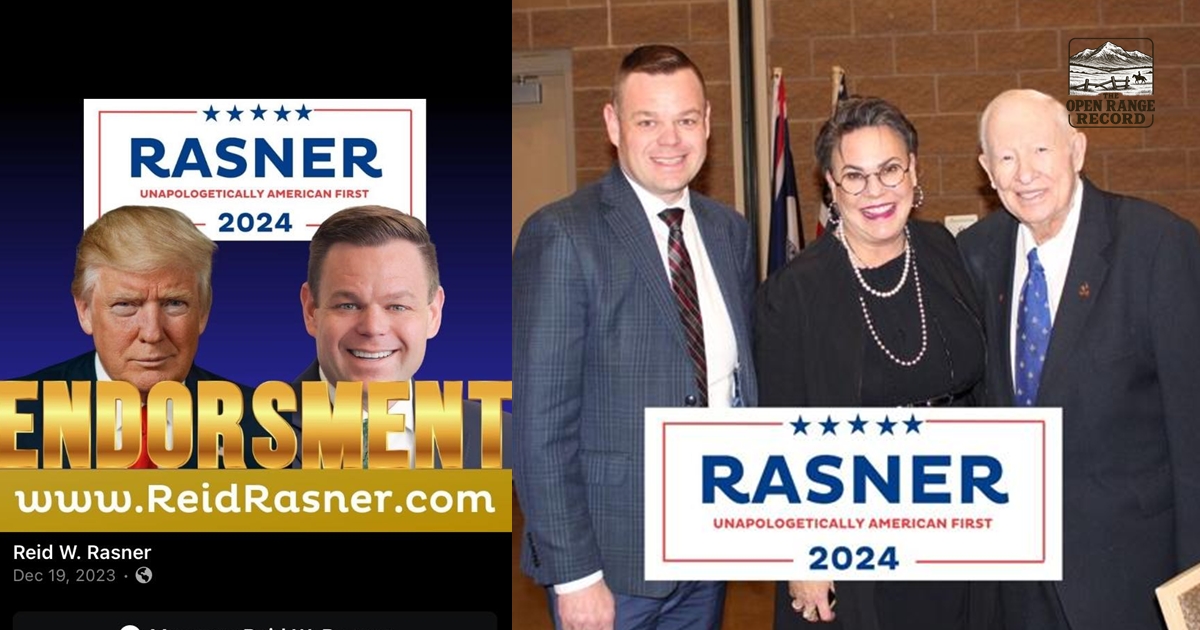
In December 2023, Rasner published a social-media graphic featuring photographs of himself and Trump with the word “ENDORSEMENT” prominently displayed. A casual viewer scrolling past the post could easily have concluded that Trump had endorsed Rasner. Only after opening the post and reading the additional text did it become clear that Rasner was endorsing Trump—not the other way around.
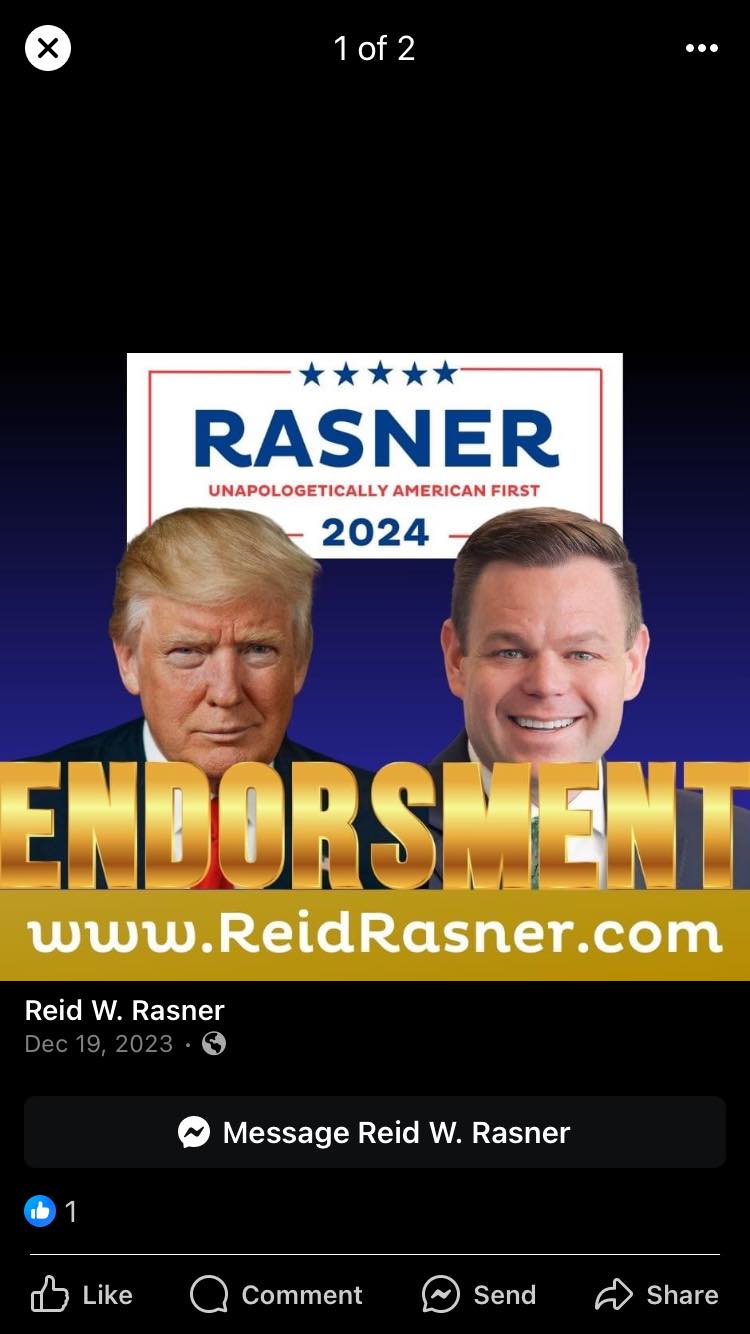
Technically, the full post disclosed the direction of the endorsement. Visually, however, it invited precisely the opposite conclusion. Political advertising is often consumed in a matter of seconds. Voters see a photograph, a name and a headline before deciding whether to open the post. Campaigns understand this. A misleading first impression is not cured merely because the fine print eventually reveals the truth.
Rasner used similar tactics involving Rep. Harriet Hageman during his unsuccessful 2024 campaign against Sen. John Barrasso. Rasner repeatedly posted photographs of himself with Hageman alongside campaign language such as, “Hang on Harriet, I am on my way! The Wyoming Congressional Delegation 2024 is getting STRONGER” and “The Rasner/Hageman duo will crush the deep state.” Another post placed their photograph behind a “RASNER 2024” campaign logo.
Rasner never expressly wrote that Hageman had endorsed him. He apparently preferred insinuation to an explicit claim. Hageman’s campaign nevertheless believed the posts were misleading enough to demand that they be removed. Her attorney sent Rasner a cease-and-desist letter stating in unmistakable capital letters: “REID RASNER DOES NOT HAVE REPRESENTATIVE HAGEMAN’S ENDORSEMENT.”
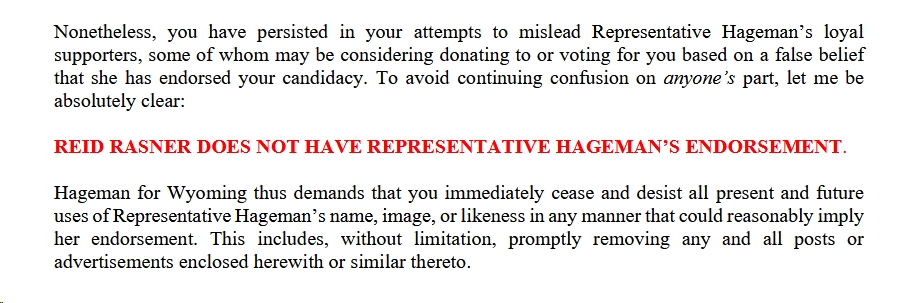
The letter accused Rasner of attempting to mislead Hageman’s supporters, including voters who might support or donate to him under the false impression that she had endorsed his candidacy. According to reporting at the time, Rasner had published at least seven Facebook posts featuring himself with Hageman, some of which he paid to promote.
Hageman was not alone. State Rep. John Bear complained about Rasner’s use of a photograph taken with him. Wyoming Republican National Committeeman Corey Steinmetz reportedly asked Rasner to remove a similar photograph. Other legislators raised comparable concerns.
The Election Day text was not an isolated misunderstanding. Whether the message originated directly with Rasner’s campaign or someone else, it relied on the same cultivated association Rasner had repeatedly used: place his name beside a prominent conservative, emphasize the appearance of political partnership and allow voters to draw a conclusion that the facts do not support.
This time, there was no need to parse photographs or ambiguous captions. The message used the words “President Trump’s ENDORSEMENT,” told voters to support Rasner and carried Rasner’s campaign disclaimer. The White House called it false.
Wyoming voters deserved the truth before they voted, not a correction after a deceptive message had already circulated during the final hours of the election. An endorsement is not a decorative campaign prop. It is a statement by one person that voters may rely upon when evaluating another.
Candidates cannot continually manufacture the appearance of support from prominent officials and then hide behind technical wording when challenged. There is a point at which carefully engineered ambiguity stops looking like an innocent misunderstanding and begins looking like a deceptive campaign strategy.