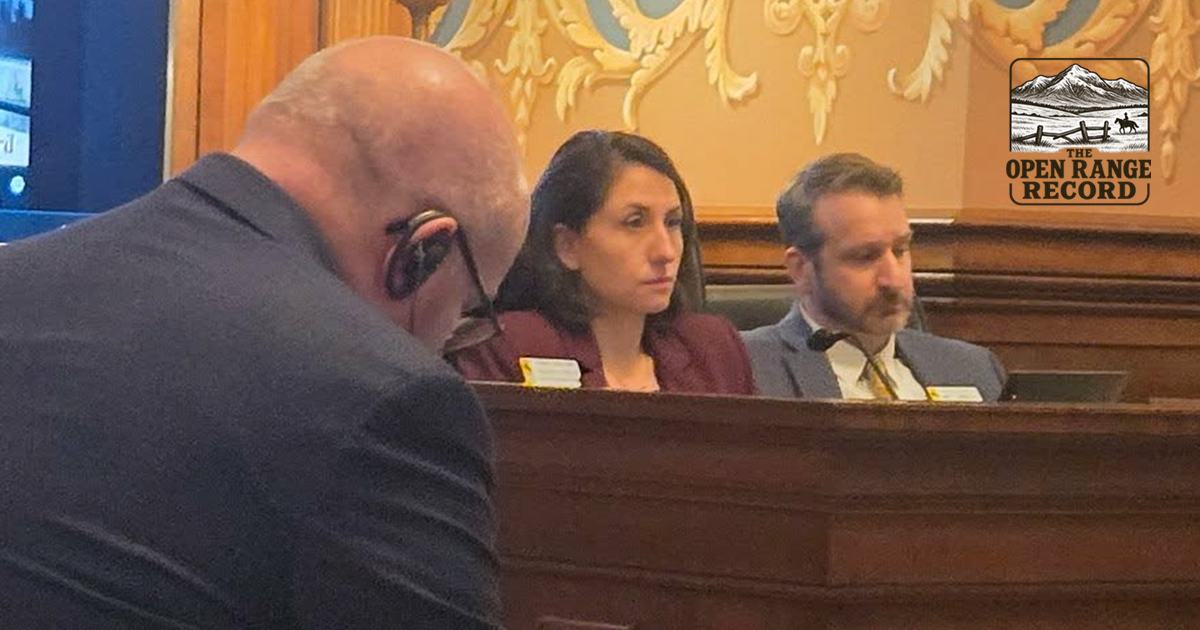
As the House Special Investigative Committee continues its inquiry into the check controversy (the distribution of campaign checks on the House floor at the start of the 2026 session), the focus has shifted from the checks themselves to the mechanics of the investigation. New testimony suggests that the Legislative Service Office (LSO), the officially non-partisan administrative arm of the Wyoming Legislature, may have played a partisan role in orchestrating the fallout.
While the LSO is traditionally viewed as a neutral body of attorneys and researchers, recent explosive statements from lawmakers and witnesses have led to accusations that the office is acting as a "Deep State" within the Capitol, coordinating with minority Democrats to target conservative members.
The Blocked Amendment: Representative Chris Knapp
A primary point of contention involves Representative Chris Knapp (R-Gillette), who was one of the ten lawmakers originally slated to receive a contribution. During the proceedings, it was revealed that Knapp sought to offer an amendment to the motion that originally formed the Special Investigative Committee.
Knapp reportedly requested that LSO staff draft an amendment to the motion, which was brought by Representative Karlee Provenza (D-Laramie), to ensure the committee’s scope was balanced and fair. According to Knapp, his request was effectively denied, preventing him from modifying the language of the investigation before it was unanimously passed by a House body that he argues was not fully informed of the motion's origins.
This alleged refusal to provide drafting services to a sitting Republican member, while simultaneously assisting the opposition, has fueled concerns that the LSO is selectively exercising its power to shape legislative outcomes.
The Open Range Record previously reported in an interview with Speaker of the House Chip Neiman that Matt Obrecht did not inform him, as is legislative procedure, of Provenza’s motion to create the investigative committee. The first time Neiman heard of the motion was when Provenza presented it on the floor.
Bextel's Testimony: The "Secret" Motion
The most direct accusations came from Rebecca Bextel, the Teton County activist at the center of the controversy. In her testimony before the committee on February 26, 2026, Bextel leveled a series of charges against LSO Director Matt Obrecht.
Bextel testified that Obrecht was intimately involved in helping Democrat leadership draft the motion that launched the investigation. Most significantly, she alleged that the LSO director was aware of the check-passing incident well before it was publicly raised on the floor by Representative Mike Yin (D-Jackson) yet chose not to bring the matter to Republican leadership, including Speaker Chip Neiman (R-Hulett).
"The real scandal that affects Wyoming is this," Bextel stated during her concluding remarks. "We have Democrats masquerading as Republicans, and we have an LSO director 'being in on' a plan to derail the budget session."
Bextel argued that by withholding information from the Speaker and instead assisting the minority party in weaponizing the incident, the LSO violated its mandate of non-partisanship to create a "political wildfire.”
A Crisis of Neutrality
The LSO’s role is governed by strict statutes regarding confidentiality and neutrality. Historically, discussions between lawmakers and the LSO staff attorneys who write their bills are confidential. However, the current accusations suggest a breakdown in this system, where the office's "special projects" and legal drafting capabilities may have been leveraged to favor one faction of the legislature over another.
LSO Director Matt Obrecht has defended the office's actions, stating that the info provided by witnesses is not confidential and is part of the public record for the investigative committee. Nevertheless, the optics of the director allegedly drafting a motion for Democrats while a Republican member was denied the ability to amend that same motion has created a rift in the 2026 session.
Broader Implications for the 2026 Session
The "Checkgate" investigation has already cost the state significant time during a critical budget session. If the LSO is found to have bypassed the Speaker of the House to coordinate an investigation into members of the majority party, it could trigger a fundamental restructuring of how legislative staff is managed in Wyoming.
As the committee moves toward issuing its final report, the focus on the "Deep State" at the LSO continues to grow. For many in Cheyenne, the question is no longer just about who received a check, but who organized the investigation and why.