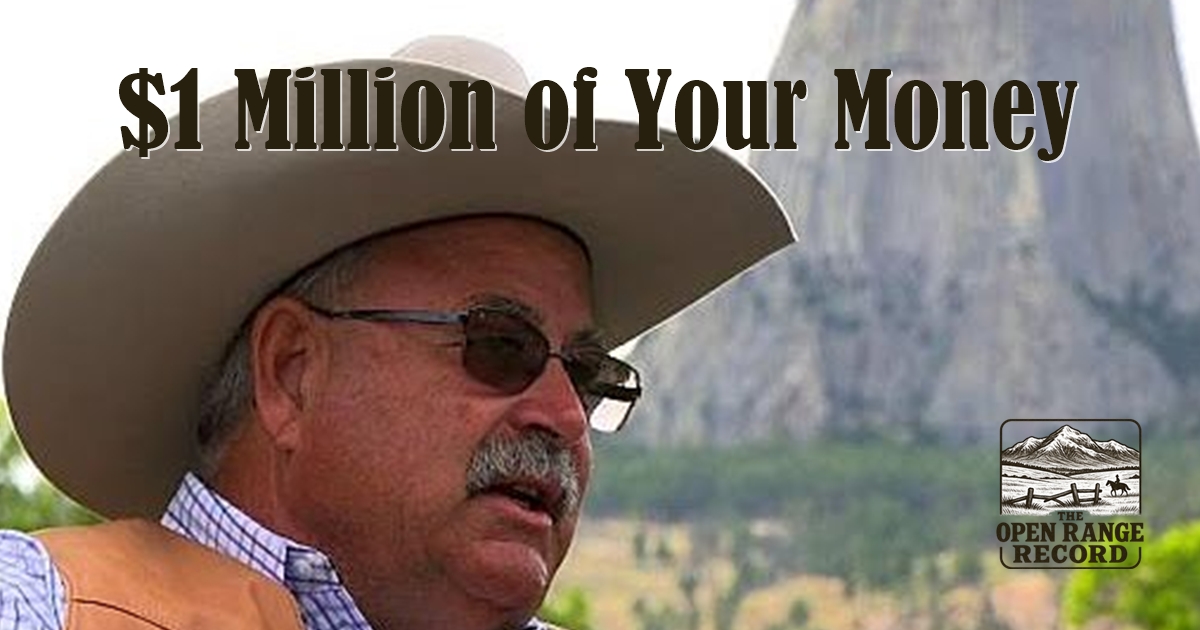
The Devils Tower land swap was not simply about 80 acres. That was simply the piece of the story the public could see. The larger story was unfolding quietly in parallel through conservation easements, legislative appropriations, land trusts, and a political world Ogden Driskill already knew intimately long before most Wyoming citizens had ever heard the term “conservation easement.”
By the time the Driskill family land entered one of the largest conservation structures in northeastern Wyoming, Ogden Driskill was not some rancher stumbling through unfamiliar paperwork. He was one of the men who helped build Wyoming’s conservation-easement machine itself.
The Wyoming Stock Growers Land Trust traces its origins to a December 2000 vote of the Wyoming Stock Growers Association before formally registering in 2001. Later reporting identified Driskill as one of the organization’s founding board members. The same reporting noted that future U.S. Senator Cynthia Lummis served alongside him during the organization’s early years.
These facts change the story entirely from one about a landowner seeking conservation protections to a sitting Wyoming state senator operating inside a system he had helped create. While the exact date Driskill stepped off the Wyoming Stock Growers Land Trust board remains unclear in publicly available reporting, records indicate he resigned before formally applying for the Devils Tower conservation easement project. By then, the machine was already built. In January 2011, Ogden Driskill was no longer merely a rancher or conservation advocate; he was a sitting Wyoming senator.
Then Came the Money
In 2012, the Wyoming Legislature passed SF0042 — Enrolled Act No. 33 — authorizing major conservation funding projects under the Wyoming Wildlife and Natural Resource Funding Act. Buried inside the bill was the “Devils Tower conservation easement.” The legislation authorized approximately $1 million in Wyoming Wildlife and Natural Resource Trust funding tied to a project budget exceeding $8.9 million for roughly 7,493 acres in Crook County.
While the legislation moved through Cheyenne, Ogden Driskill sat in the Wyoming Senate. Legislative records show Driskill voted to introduce the bill. The measure later moved through committee, including a committee on which he served. Recorded votes show Driskill voting “conflict” during committee consideration and again on third reading before final passage. Driskill himself appeared to recognize the conflict optics because the overlap is impossible to ignore.
Ogden Driskill helped build the machine. He sat in the Senate while public money moved through the machine, then land tied to his family benefited from the machine. And eventually, so did the same 80-acre Devils Tower parcel examined in Part One of this series.
The public was told the Devils Tower exchange came with conservation restrictions meant to prevent unrestricted development of the land after the transfer from the State. But the conservation framework itself was not some outside burden imposed on Driskill. It was a world he already knew from the inside.
SF0042 also placed a deadline on the mone]=y. The legislation stated that any unexpended and unobligated funds for the Devils Tower conservation easement would revert to the State on June 30, 2015. In plain English, that $1 million was not an open-ended promise sitting there forever. It had to be obligated for the project before the statutory deadline or return to the account.
That makes the timing important, because Crook County records show the Devils Tower conservation easement was ultimately executed in 2015 and covered thousands of acres tied to Bear Lodge and Driskill family holdings near Devils Tower. The easement did not remove the land from family control. Ranching continued; roads remained. Utilities, water infrastructure, tourism-related uses, and recreation remained.
The land stayed economically alive while development rights were permanently restricted. And that is the part many people misunderstand about modern conservation easements. They are not always about walking away from the land. Sometimes they are about preserving control of the land while restructuring its long-term financial and development future.
That does not make conservation easements inherently improper, but it does change how the public should view the overlap between political influence, public funding, land policy, and private family interests. Especially in Wyoming, where the same small circle of political, ranching, and conservation power often overlaps for decades.
SF0042 itself hints at how sensitive lawmakers understood these deals to be. The legislation required recipients to certify that no gratuities, kickbacks, gifts, commissions, contingency fees or other considerations were connected to the appropriations or grants. That language implies that the Legislature clearly understood large conservation transactions involving public money carry conflict concerns and political sensitivity. And yet the public record still shows a sitting Wyoming senator operating inside that same world while legislation tied to a conservation project connected to his own family holdings moved through the Capitol.
Again, none of this proves criminal wrongdoing, but it does raise legitimate public-interest questions. Because conservation policy is not just about preserving land; it is also about power. Who controls the land, who structures the deals, who receives the benefits, and who writes the rules everyone else must live under.
Supporters would likely argue the Devils Tower easement preserved important ranchland from subdivision and protected viewsheds near one of Wyoming’s most iconic landscapes.
Critics may see something else entirely. A politically connected insider helping build a conservation system that later intersected with his own family’s land, his own political career, public funding, and eventually even the same 80-acre parcel transferred through the Devils Tower land exchange. Whether Wyoming citizens view that as prudent conservation policy or insider power structure depends entirely on how much trust they still place in the people running the machine.
The story does not end there, because while the public was watching land swaps, conservation easements and legislative appropriations unfold around Devils Tower, another set of records was quietly developing in parallel: Mortgages, encumbrances, and ranch property disputes. And eventually, allegations involving the Schmid ranch that raise an entirely separate set of questions about financing and land control.